Reptile Nutrition
Chameleon Diet Guide
Evidence-based feeding for true chameleons, with emphasis on feeder diversity, insect nutrition, calcium and vitamin balance, UVB physiology, hydration, reproductive demands, and the major nutritional differences among commonly maintained species and ecological groups.

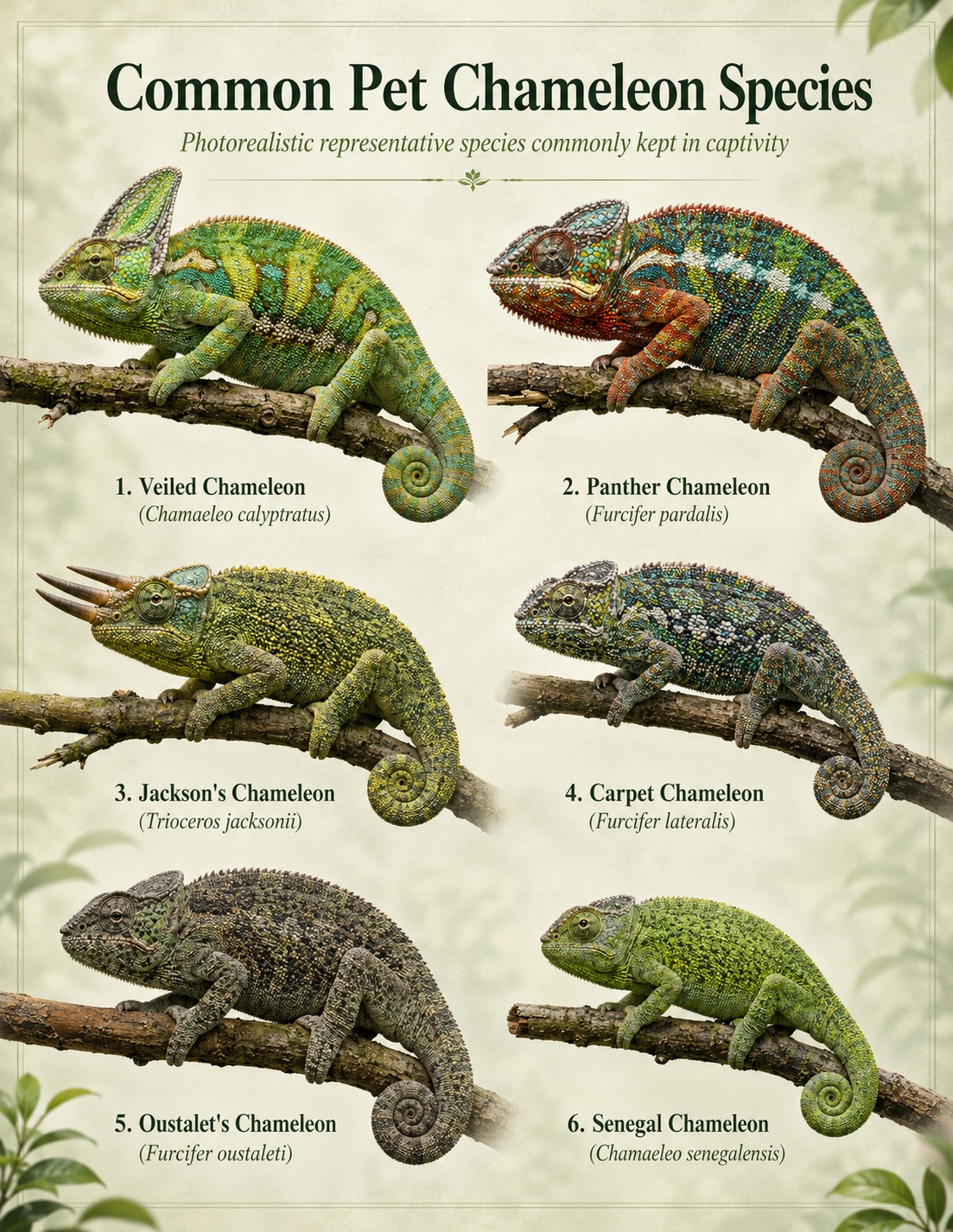
Diet Overview
Most chameleons are predominantly invertebrate predators. Their natural diets are much broader than the familiar captive menu of crickets and mealworms: field studies document beetles, flies, moths and caterpillars, grasshoppers, roaches, spiders, snails, and many other arthropods. Some large species occasionally take small vertebrates, and a few species deliberately consume plant material or fruit. These exceptions are biologically interesting, but they do not justify feeding every captive chameleon fruit, vegetables, mice, or other vertebrate prey.
The central nutritional challenge in captivity is not simply persuading a chameleon to eat. It is producing a diet in which live prey are diverse, well nourished, appropriately sized, adequately hydrated, and correctly balanced for calcium, vitamins, and energy. Most commercially raised feeder insects are naturally poor sources of calcium, and many are poor sources of preformed vitamin A and vitamin D. The nutritional value of the insect therefore depends heavily on how it was maintained before it became food.
Diet cannot be separated from husbandry. A chameleon with an excellent feeder program can still develop metabolic bone disease if UVB exposure is inadequate, can become anorectic if kept too cool or chronically stressed, and can develop serious illness if hydration is poor. Feeding recommendations therefore have to be interpreted together with the exact species' temperature cycle, nighttime cooling, humidity, ventilation, UVB exposure, reproductive status, and body condition.
Chameleon Diversity and Feeding Ecology
The family Chamaeleonidae contains roughly 240 currently recognized species in the Reptile Database. They range from tiny leaf-litter chameleons to very large arboreal species and occupy rainforest, woodland, savanna, montane, Mediterranean, and arid habitats. This ecological diversity means there is no responsible single feeding formula for all chameleons.
| Group | Natural feeding pattern | Captive dietary emphasis |
|---|---|---|
| Veiled chameleon Chamaeleo calyptratus |
Primarily invertebrates; plant material is also consumed, especially under seasonally dry conditions. | Diverse live invertebrates; optional small amounts of safe leafy material and edible flowers. Fruit is not needed. |
| Panther chameleon Furcifer pardalis |
Predominantly insectivorous arboreal predator. | Diverse gut-loaded insects with carefully managed calcium, vitamin A/D, and UVB. |
| Jackson's chameleon Trioceros jacksonii |
Broad invertebrate diet including insects, spiders, and snails; occasional vertebrate prey is documented. | Varied smaller invertebrates; captive-bred snails can add diversity. Avoid routine vertebrate prey and chronic overfeeding. |
| Large Malagasy chameleons Calumma and large Furcifer |
Large arthropods dominate; occasional vertebrate or plant foods occur in some species. | Large but appropriately sized invertebrates, controlled energy intake, and species-specific seasonal feeding. |
| Meller's chameleon Trioceros melleri |
Insects and other invertebrates; small vertebrates can be taken in nature. | Large invertebrates and substantial variety; vertebrate prey is unnecessary in routine captive feeding. |
| Flap-necked chameleon Chamaeleo dilepis |
Arthropod predator; field samples are dominated by orthopterans and beetles. | Grasshoppers/locusts, roaches, beetles/larvae, flies, moths, and other well-prepared insects. |
| Montane African chameleons Trioceros, Kinyongia, Bradypodion |
Broad opportunistic arthropod diets, often shifting with season and prey availability. | Smaller varied prey, conservative energy intake, and attention to cooler species-specific husbandry. |
| Pygmy and leaf chameleons Rhampholeon, Rieppeleon, Brookesia |
Very small terrestrial or low-vegetation arthropod predators. | Micro-prey matched to gape size; tiny flies, small crickets/roach nymphs, and other cultured micro-invertebrates. |
Large wild chameleons sometimes consume lizards, birds, or other small vertebrates. That observation should not be converted into a captive requirement. Vertebrate prey is energy dense, can distort the mineral and vitamin profile of an otherwise well-managed diet, and is unnecessary for routine maintenance of the common pet chameleon species discussed here.
Choosing Feeder Insects and Other Invertebrates
No single feeder insect reproduces the diversity of wild prey. A practical captive diet should rotate several feeder types over time, using the more nutritionally useful insects frequently and energy-dense larvae more selectively.
| Feeder | Useful features | Important limitations |
|---|---|---|
| Crickets and locusts/grasshoppers | Readily accepted, active, available in many sizes, and well suited to high-calcium gut loading. | Naturally calcium-poor; nutritional quality depends strongly on feeder husbandry. |
| Roaches | Good-quality, active prey available in many sizes; useful for variety and larger chameleons. | Must be appropriately sized and well fed; do not rely on one roach species as the entire diet. |
| Silkworms | Soft-bodied, highly palatable, and useful for growing, debilitated, or selective animals when appropriately cultured. | Require correct culture food and can be expensive or seasonally difficult to source. |
| Black soldier fly larvae and adults | Larvae contain more calcium than many traditional feeders; adults provide flying-prey enrichment. | Small size limits their usefulness for large adults; do not assume one naturally calcium-rich feeder makes the whole ration balanced. |
| House flies and blue bottle flies | Excellent behavioral enrichment for arboreal visual predators and valuable dietary variety. | Use cultured flies from a clean source rather than insects exposed to waste, pesticides, or unknown pathogens. |
| Hornworms | Large, soft-bodied, and moisture-rich; useful when hydration or appetite is a concern. | High water content means fewer nutrients per unit wet weight; use within a varied ration rather than as the only feeder. |
| Mealworms and superworms | Convenient and useful as one component of a rotation. | Relatively poor calcium profile and greater energy density than many leaner feeders; should not dominate the diet. |
| Waxworms | Very palatable and sometimes useful for stimulating appetite. | High fat content makes them best treated as occasional foods rather than staples. |
| Captive-bred snails | Natural prey for some species, especially Jackson's chameleons; whole shells contribute mineral diversity. | Use only reliably captive-bred snails. Wild snails can transmit parasites and environmental contaminants. |
| Stick insects, mantids, moths, and other cultured insects | Increase prey diversity and natural hunting behavior. | Species identification and culture history matter; avoid potentially toxic or chemically defended species. |
Prey size
Prey should be small enough to be swallowed easily and captured without injury. For hatchlings and small chameleons, a conservative rule is to keep most feeders no wider than the space between the eyes. Large species can safely handle proportionally larger, soft-bodied prey, but oversized prey should not be used merely because the chameleon will attempt to shoot at it.
Wild-caught insects
Wild prey can provide excellent diversity in professionally managed collections when the species can be identified and the collection site is demonstrably free of pesticides and other contaminants. For most pet owners, cultured feeders are safer and more reproducible. Never feed fireflies, and do not offer unknown brightly colored or chemically defended insects. Avoid insects collected around pesticide-treated lawns, agricultural fields, roadsides, bait stations, compost contaminated with chemicals, or areas where herbicides and snail poisons are used.
Gut Loading and Feeder Preparation
Gut loading means feeding prey a specially designed, nutrient-dense ration shortly before the insect is offered to the chameleon. This differs from routine colony maintenance. A feeder colony may live and reproduce on a good general diet while still failing to deliver enough calcium to an insectivorous reptile.
Controlled nutrition research shows that cricket, mealworm, and silkworm nutrient concentrations can be altered substantially by the foods given before feeding. Current Merck Veterinary Manual guidance notes that most common feeder insects contain very little calcium relative to phosphorus and recommends high-calcium gut loading before they are fed to insectivorous lizards. Research on crickets suggests that approximately 24–72 hours of appropriate gut loading can meaningfully improve the calcium profile; around 48 hours is a practical target for many feeder systems.
A practical feeder-preparation sequence
- Maintain the colony well. Feed each insect species an appropriate maintenance diet and provide clean hydration so the insects themselves are healthy.
- Gut load before use. Move the insects intended for the next one to three days of feeding onto a nutritionally designed high-calcium gut-load ration.
- Provide moisture safely. Use moisture sources appropriate for the feeder species and avoid stagnant, mold-prone food.
- Dust immediately before feeding when indicated. Light dusting is most useful when powder adheres to dry, active insects and the prey is consumed soon after preparation.
- Feed promptly. Do not gut load insects and then return them to a low-calcium maintenance ration for several days before feeding them to the chameleon.
A few vegetables placed with crickets are better than starving the insects, but vegetables alone do not reliably create a nutritionally complete gut load. Commercial high-calcium gut-load products or veterinary/zoological formulations provide more predictable mineral delivery than improvised mixtures. The goal is not to make the feeder visibly coated in nutrients; the goal is to improve the composition of the whole prey animal.
Calcium, Vitamin A, Vitamin D, and UVB
Chameleons are unusually unforgiving of long-term errors in mineral and vitamin management. Nutritional secondary hyperparathyroidism, poor growth, skeletal deformity, reproductive disease, and eye or epithelial problems can arise when live prey, supplementation, UVB, and temperature are mismatched.
Calcium
Most feeder insects have an unfavorable calcium-to-phosphorus relationship. In current Merck data, commonly used insects may contain only about 0.03–0.3% calcium while containing roughly 0.8–0.9% phosphorus before nutritional manipulation. High-calcium gut loading can substantially improve this ratio. Dusting is also useful, but dusting alone is less reliable when prey are poorly nourished, powder falls off, or the chameleon does not consume the insects immediately.
A current veterinary chameleon handout from LafeberVet provides a practical baseline using plain calcium without vitamin D3: adult males approximately once weekly, adult females two to three times weekly, and juveniles at each feeding, with greater calcium support for actively egg-producing females. This should be treated as a starting framework rather than a universal prescription. The correct frequency changes with the gut-load formulation, feeder species, UVB exposure, supplement concentration, growth rate, reproductive status, and whether another fortified product is already being used.
Vitamin A
Preformed vitamin A deserves particular attention in chameleons. Current Merck guidance notes that hypovitaminosis A occurs in insectivorous lizards and that beta-carotene cannot be relied on as a vitamin-A source for many reptiles. Controlled panther-chameleon work found that low vitamin A reduced growth, health, lifespan, and reproductive performance, while excessive vitamin A also produced adverse changes. A controlled veiled-chameleon study likewise demonstrated important interactions among calcium, vitamin A, vitamin D, and UVB.
The practical conclusion is not to dose retinol aggressively. Instead, use a reputable reptile multivitamin that provides a controlled source of preformed vitamin A and follow a conservative schedule appropriate to the product and total diet. Standalone vitamin-A dosing and injectable vitamin A should be veterinary decisions because toxicity can be severe.
Vitamin D3 and UVB
Vitamin D physiology cannot be managed safely by supplement powder alone. Panther chameleons have been shown experimentally to alter their UV exposure according to dietary vitamin-D status, demonstrating that UVB is part of their normal physiological regulation. Controlled studies also show that the UVB environment affects reproductive success and vitamin-D status.
- Provide a high-quality, measured and species-appropriate UVB environment with access to shade and lower-exposure areas.
- Do not place glass or ordinary clear plastic between the chameleon and its UVB source.
- Use oral vitamin D3 conservatively. High vitamin-D intake can cause toxicity and should not be used to compensate for inadequate lighting.
- Do not combine multiple fortified supplements without calculating the overlap in vitamin A, vitamin D3, calcium, and other fat-soluble nutrients.
- Natural unfiltered sunlight can be valuable when temperature, security, shade, and escape prevention are safely controlled.
The exact ideal UV Index and exposure schedule differ among species, locality, enclosure design, and life stage. A nutrition article should therefore not substitute a single lamp distance or one UVI number for a complete lighting assessment.
Water and Hydration
Hydration is inseparable from nutrition in chameleons. Wild chameleons obtain water from prey, rain, dew, and high nighttime humidity. In captivity, many drink most readily by licking droplets from leaves, branches, and enclosure surfaces. A standing water bowl may be used by an occasional individual, but it should not be the sole or assumed source of drinking water.
Modern systems typically combine misting or rain-like water delivery, a dripper when useful, good drainage, and a species-appropriate day/night humidity cycle. The enclosure should not remain continuously wet. Adequate ventilation and a daytime drying period are important, while montane and humid-forest species may require substantial nighttime humidity and cooling.
Watering needs vary markedly among species. A veiled chameleon from a seasonally dry Arabian environment should not be managed exactly like a Jackson's chameleon from cool East African montane habitat or a large rainforest-associated Parson's chameleon. Water delivery should be adjusted to the species, enclosure airflow, ambient climate, and the animal's actual drinking behavior.
Feeding Schedule and Prey Presentation
Current veterinary guidance provides a useful general framework: juveniles and gravid females are usually fed daily, while healthy adults are commonly fed three to five times weekly. Species, prey size, body condition, reproductive status, temperature, season, and activity level then determine how much food is offered at each feeding.
When to feed
Offer most food during the first half of the daylight period, after the chameleon has warmed and become normally active. This gives the animal time to hunt, thermoregulate, digest, and use UVB during the remaining day. Avoid placing a large meal into the enclosure shortly before nighttime cooling.
Where and how to feed
- Feeder cups: useful for small insects, accurate intake monitoring, quarantine animals, and preventing prey from disappearing into drainage or substrate.
- Supervised free hunting: useful for exercise and normal visual-hunting behavior when prey cannot escape permanently or hide where they can bother the chameleon later.
- Branch-mounted cups: particularly useful for arboreal species because the animal can feed from a secure perch without descending to the floor.
- Hand or forceps feeding: useful for monitoring selected animals, but should not become the only method if the animal is otherwise capable of normal hunting.
Remove uneaten insects before they can hide in the enclosure, contaminate food or water, or disturb a sleeping or debilitated chameleon. Feeding directly on loose particulate substrate increases the chance that substrate will be swallowed with prey.
Species-Specific Diet and Feeding Directions
Veiled Chameleon — Chamaeleo calyptratus
Veiled chameleons are primarily insectivorous, but plant eating is genuine natural behavior. Current veterinary guidance notes that wild veiled chameleons consume plant material during the dry period. In captivity, some individuals will voluntarily eat small amounts of leafy greens, edible flowers, or other plant material, while others show little interest.
The dietary foundation should still be diverse, well-fed live invertebrates: crickets, locusts, roaches, silkworms, black soldier flies/larvae, cultured flies, hornworms, and other safe feeders. Plant foods are supplemental rather than a replacement for the insect ration. Small amounts of pesticide-free dandelion or hibiscus leaves and flowers and other verified safe leafy material may be offered. Current LafeberVet guidance specifically advises against offering fruit to veiled chameleons.
Female veiled chameleons deserve special nutritional management. They can produce infertile eggs without mating, and chronic high-calorie feeding can contribute to obesity and excessive reproductive demand. A peer-reviewed captive-care protocol specifically cautions against overfeeding adult females because obesity is associated with dystocia and other adverse outcomes. This does not mean restricting a truly gravid, underconditioned female; it means maintaining a lean, healthy body condition before and between reproductive cycles.
- Frequency: Hatchlings and juveniles: feed daily. Healthy adults: usually three to five feedings weekly, often approximating every other day. Actively gravid females may require daily feeding, but chronic overfeeding before breeding should be avoided.
- When: Feed after morning warming has begun and during the first half of the light cycle.
- Where: Use a branch-mounted feeder cup and/or supervised hunting among foliage. Keep prey off loose substrate and remove uneaten insects.
- How: Rotate several feeder species. Gut load calcium-poor prey and use supplementation based on the total feeder and UVB plan. Offer safe leafy material or edible flowers only as a minor optional component.
Panther Chameleon — Furcifer pardalis
Panther chameleons should be managed as insectivorous arboreal predators. Variety is important: crickets or locusts, roaches, silkworms, black soldier flies and larvae, house or blue bottle flies, hornworms, and other cultured prey can all contribute to a broad ration. Mealworms, superworms, and waxworms are better used as smaller parts of the rotation rather than as the principal diet.
This species has some of the best experimental chameleon nutrition data. Controlled studies demonstrate that vitamin A, vitamin D, and UVB exposure interact with growth, pathology, reproduction, and egg viability. Panther chameleons also behaviorally regulate UV exposure in response to dietary vitamin-D status. These findings support a balanced approach: provide effective UVB, correct the poor calcium profile of common insects, include controlled preformed vitamin A, and avoid attempting to solve every nutritional problem by increasing oral vitamin D.
- Frequency: Juveniles: daily. Healthy adults: generally three to five feedings weekly; alternate-day feeding is a common practical pattern.
- When: Morning to early daytime after normal basking and activity begin.
- Where: Elevated feeding cup or supervised foliage hunting.
- How: Rotate flying and crawling prey, gut load appropriately, dust according to the supplement plan, and adjust portions from serial weight and body condition rather than a fixed cricket count.
Jackson's Chameleon — Trioceros jacksonii
Jackson's chameleons are montane East African chameleons with a broad natural prey spectrum. Research on invasive Hawaiian populations confirms consumption of many insect groups and other arthropods, and native and introduced populations are also known to take snails. Small vertebrates can be eaten opportunistically in nature, but they are not required in a well-designed captive ration.
Captive feeding should emphasize smaller, varied prey such as crickets, flies, roach nymphs, silkworms, black soldier flies, small locusts, and other appropriately sized invertebrates. Captive-bred snails can be useful occasional prey for this species; wild snails should not be used because of parasite and contaminant risk.
Jackson's chameleons should not simply be fed like hotter, faster-growing veiled chameleons. Their cooler montane physiology and slower growth make chronic excessive calorie intake undesirable. Reproductive females are live-bearing and should be maintained in stable body condition rather than pushed for maximal weight gain.
- Frequency: Babies and juveniles: daily. Healthy adults: usually three to five feedings weekly, with portion size kept conservative enough to maintain lean body condition.
- When: Feed after the animal has warmed into its normal daytime activity range, not before the enclosure is warm or just before the nighttime temperature drop.
- Where: Elevated cups and supervised hunting among branches; flying prey can provide valuable enrichment.
- How: Favor diverse small-to-medium prey. Use captive-bred snails occasionally if desired. Avoid routine vertebrate prey and avoid aggressive vitamin/mineral supplementation.
Parson's Chameleon — Calumma parsonii
Parson's chameleons are among the largest chameleons and have a comparatively slow life history. Natural-history accounts describe a diet dominated by large insects and other invertebrates; occasional small vertebrates and possible plant consumption have been reported, but these observations should not be interpreted as a requirement for mice, birds, fruit, or salad in captivity.
For captive animals, emphasize appropriately sized roaches, locusts, silkworms, hornworms, large flies and moths, and other clean cultured invertebrates. Because this species can be seasonal and may reduce feeding substantially during cooler periods, appetite must be interpreted together with temperature, season, reproductive condition, hydration, and body weight. Do not try to defeat a normal seasonal reduction in intake by continually escalating to high-fat feeders.
- Frequency: Juveniles: usually daily. Adults: often daily to every other day during active periods, but actual intake may be lower and strongly seasonal; use body condition rather than a rigid schedule.
- When: Feed during the species' active daylight period after warming; seasonal cooling programs require corresponding feeding adjustments.
- Where: Large elevated feeding stations and supervised hunting in spacious arboreal enclosures.
- How: Use large but not oversized invertebrates, rotate prey extensively, and avoid routine vertebrate prey or fruit unless a species-specific zoological protocol calls for it.
Meller's Chameleon — Trioceros melleri
Meller's chameleons are large East African chameleons. Smithsonian sources describe natural prey that includes insects, spiders, worms, caterpillars, and small lizards, while the National Zoo feeds crickets, mealworms, and cockroaches. This supports a broad invertebrate-based captive diet without a need to reproduce occasional wild vertebrate predation.
Large roaches, locusts, silkworms, hornworms, moths, crickets, and other substantial invertebrates can be rotated. Prey variety is more important than simply increasing prey size. Meller's chameleons also have demanding hydration and temperature requirements, so poor appetite should trigger a husbandry review rather than an automatic switch to richer foods.
- Frequency: Growing animals: daily. Adults: usually daily to every other day depending on prey size, body condition, activity, and season.
- When: Feed after normal morning warming and while the animal still has many hours of appropriate daytime conditions ahead.
- Where: Large elevated cups and free-hunting opportunities in a spacious enclosure.
- How: Use large invertebrates rather than vertebrate prey, and track body weight so the animal is not unintentionally overfed.
Oustalet's / Malagasy Giant Chameleon — Furcifer oustaleti
Oustalet's chameleons are unusually useful for illustrating why wild-diet evidence must be interpreted carefully. University of Florida research on an introduced population found a broad generalist diet dominated by insects, especially weevils, caterpillars, and stinkbugs, with vertebrate remains in some samples. Field research in Madagascar also documented deliberate fruit feeding.
In captivity, the ration should nevertheless remain predominantly diverse invertebrates. Large insects are nutritionally and behaviorally appropriate, while vertebrate prey is unnecessary. Fruit is a real part of this species' natural history, but cultivated fruit is much more sugar-dense than many wild fruits. If fruit is used at all, keep it an occasional, small enrichment item rather than a routine calorie source.
- Frequency: Juveniles: daily. Adults: commonly three to five feedings weekly, adjusted for large body size, prey size, and condition.
- When: Morning to early daytime after normal warming.
- Where: Elevated feeding stations plus supervised hunting.
- How: Rotate large insects; do not feed vertebrate prey routinely. Small amounts of safe fruit can be reserved for occasional species-specific enrichment rather than used as a dietary staple.
Flap-Necked Chameleon — Chamaeleo dilepis
A peer-reviewed Southern African study found that flap-necked chameleons consume a range of arthropods but that orthopterans and beetles dominate both numerically and volumetrically. Spiders, mollusks, and lizards occurred only rarely. Captive feeding can therefore be built around locusts or grasshoppers, crickets, roaches, beetles and suitable larvae, flies, moths, and other cultured insects.
- Frequency: Juveniles: daily. Adults: generally three to five feedings weekly.
- When: Feed during normal daytime activity after warming.
- Where: Elevated feeding site with opportunities to shoot at moving prey.
- How: Emphasize varied arthropods, especially orthopteran-style prey when available; do not add vertebrate prey merely because rare wild predation has been recorded.
Other African Montane Chameleons — Trioceros and Kinyongia
Many African montane chameleons are maintained much less commonly than Jackson's chameleons and have limited controlled nutrition data. Species such as Fischer's-complex Kinyongia and other cool-adapted Trioceros should be treated as species-specific montane insectivores, not as small veiled chameleons.
Use a broad array of small and medium invertebrates and conservative supplementation. Their cooler thermal ecology means that excessive food offered under chronically warm conditions can compound husbandry problems. For uncommon or conservation-sensitive species, breeding-program protocols and records from experienced zoological collections should take priority over generic internet feeding formulas.
- Frequency: Growing animals: generally daily. Adults: usually three to five times weekly, often with smaller portions than comparably sized lowland species.
- When: During the daylight active period after the animal has reached its normal species-specific operating temperature.
- Where: Elevated cups and naturalistic branch hunting.
- How: Use smaller diverse feeders and avoid overfeeding; match supplementation and feeding intensity to cooler husbandry and actual body condition.
South African Dwarf Chameleons — Bradypodion
Recent 2026 research from the University of Johannesburg used fecal DNA metabarcoding to examine diets of Bradypodion damaranum and B. ventrale. The results support a broad opportunistic diet based mainly on insects and spiders, with beetles, flies, lepidopterans, and true bugs among the important prey groups. Earlier stomach-content studies likewise found substantial dietary overlap among dwarf-chameleon forms and seasonal shifts in prey use.
Captive management should reproduce this diversity with small flies, small crickets, roach nymphs, small moths, silkworms of suitable size, black soldier flies, and other cultured arthropods. Because these are small animals, a modest change in feeder size or number can substantially change caloric intake.
- Frequency: Juveniles: daily. Adults: small meals daily or near-daily may be appropriate for some species, but portions must be conservative; alternatives are three to five slightly larger feedings weekly.
- When: Feed during normal daylight activity and species-appropriate thermal conditions.
- Where: Small elevated cups or supervised release of tiny prey into planted enclosures.
- How: Rotate very small prey types and monitor body weight closely; do not rely on one micro-feeder culture indefinitely.
Pygmy and Leaf Chameleons — Rhampholeon, Rieppeleon, and Brookesia
These small chameleons differ from the classic tall-cage arboreal species because many forage close to the ground or in leaf litter. They still depend primarily on tiny invertebrates, but prey size and food placement become especially important. Very small fruit flies, newly hatched crickets, tiny roach nymphs, small flies or moths, and other cultured micro-prey can be used; the smallest juveniles may also investigate springtails and similar micro-arthropods, although such prey should not be assumed to provide a complete ration.
Because formal nutrient requirements are poorly studied, the safest approach is diversity, careful gut loading where feasible, measured supplementation, and close observation of growth. These species can dehydrate quickly and may stop feeding when temperature or humidity is inappropriate, so nutrition must be interpreted together with microclimate.
- Frequency: Juveniles and very small species: usually daily small feedings. Adults: daily to every other day depending on species, size, temperature, and body condition.
- When: During the species' normal daylight feeding period after the enclosure has stabilized at appropriate conditions.
- Where: Low vegetation, branch-adjacent cups, or controlled release near normal foraging areas rather than only at the top of the enclosure.
- How: Provide multiple kinds of micro-prey, remove excessive uneaten insects, and avoid heavy supplement coatings that can overwhelm tiny prey.
Life Stage, Growth, and Reproduction
Hatchlings and juveniles
Young chameleons grow quickly and generally require daily access to appropriately small prey. Fast growth increases the consequences of calcium, vitamin A, vitamin D, and UVB errors. Feeder variety should begin early rather than waiting until adulthood, because animals raised on one prey type can become nutritionally narrow and behaviorally selective.
Do not attempt to accelerate growth by simply feeding unlimited high-energy larvae. Rapid growth without adequate skeletal mineralization is not desirable. Growth should be evaluated with serial weight, body proportions, grip strength, activity, and skeletal development.
Adults
Adult maintenance energy requirements are lower than juvenile growth requirements. For many common species, feeding three to five times weekly is adequate when prey are nutritionally prepared and appropriately sized. Adults that become heavy, develop prominent fat pads, or steadily gain weight outside reproduction should have caloric intake reviewed.
Egg-producing females
Reproductive females can have markedly increased calcium and energy demands, but chronic overfeeding before reproduction can also be harmful, especially in veiled chameleons. The goal is to enter reproduction in lean, healthy condition, then provide adequate calcium, hydration, and energy during actual follicular development and egg production without driving obesity or excessively large clutches.
A female that stops eating near expected oviposition may be normal for a brief period, but prolonged anorexia, repeated digging without laying, weakness, abdominal enlargement, straining, or inability to perch normally warrants prompt veterinary evaluation.
Live-bearing species
Jackson's and several other montane chameleons retain developing young rather than laying a shelled clutch. Pregnancy is still nutritionally demanding. These females should receive adequate food and calcium while avoiding excessive weight gain and heat stress.
Foods and Practices to Avoid or Limit
- A cricket-only diet: even well-gut-loaded crickets should not be the only prey offered for months or years.
- Starved feeder insects: insects kept on cardboard, bran alone, or shipping material are not nutritionally complete simply because they are alive.
- Routine vertebrate prey: mice, birds, lizards, and other vertebrates are unnecessary for routine captive feeding of the common pet chameleons discussed here.
- Wild snails: use captive-bred snails only because wild gastropods can carry significant parasites and contaminants.
- Fireflies and unknown toxic insects: fireflies can be lethal to insectivorous reptiles. Avoid unknown brightly colored or chemically defended prey.
- Insects from pesticide-treated areas: pesticide exposure can be fatal and may be impossible to detect before feeding.
- Excess waxworms and other fatty larvae: use high-fat prey as part of a rotation, not as a staple.
- Fruit for most species: routine fruit feeding is unnecessary for veiled, panther, Jackson's, Meller's, and most other commonly kept chameleons. Oustalet's chameleons are a documented natural exception, but fruit should still remain a small captive component if used.
- Dog food, cat food, meat, or egg fed directly to the chameleon: these are not appropriate substitutes for whole invertebrate prey.
- Heavy or overlapping supplementation: chronic excess vitamin A, vitamin D3, calcium, or multivitamins can cause serious disease.
- Using oral vitamin D to replace UVB: these are not physiologically equivalent strategies.
- Relying on bee pollen as the multivitamin: pollen may be a useful feeder ingredient, but it does not replace a complete evidence-based supplementation plan.
- Leaving prey in the cage indefinitely: remove uneaten insects so intake is known and the insects do not hide, contaminate the enclosure, or disturb the chameleon.
- Standing water as the only hydration source: most chameleons drink most reliably from droplets and rain-like water delivery.
Weight, Body Condition, and Medical Warning Signs
Nutrition should be adjusted from the animal's response rather than from a recipe alone. Weigh growing juveniles regularly and record the results. Stable adults can be weighed less often, but the same scale and similar timing relative to feeding and defecation make trends easier to interpret. Photographs from the same angle can also help track body condition and casque, spine, limb, and tail-base changes.
Useful observations include appetite, number and type of prey eaten, tongue accuracy, grip strength, climbing ability, fecal output, urate appearance, reproductive status, and any recent change in supplement brand, UVB lamp, enclosure, or feeder supplier.
Selected References
- Merck Veterinary Manual. Nutrition in Lizards. Full review September 2025. Current professional guidance on insectivore feeding, calcium content of feeder insects, high-calcium gut loading, and general lizard nutrition.
- Merck Veterinary Manual. Nutrition in Reptiles. Current professional reference for reptile nutrients, vitamin A, vitamin D, and diet formulation.
- Divers SJ, Comolli JR. Merck Veterinary Manual. Management and Husbandry of Reptiles. Reviewed July 2025. Includes chameleon hydration, species-specific husbandry principles, and nutritional history.
- Merck Veterinary Manual. Nutritional, Metabolic, and Endocrine Diseases of Reptiles. Current guidance on hypovitaminosis A, vitamin toxicity, and nutritional metabolic disease.
- Driggers T. Old World Chameleon Care. LafeberVet; 2024. Current veterinary client handout covering diet, feeding interval, calcium supplementation, hydration, and common species differences.
- Finke MD. Gut loading to enhance the nutrient content of insects as food for reptiles: a mathematical approach. Zoo Biology. 2003;22:147-162. doi:10.1002/zoo.10082.
- Ferguson GW, Jones JR, Gehrmann WH, et al. Indoor husbandry of the panther chameleon Furcifer pardalis: effects of dietary vitamins A and D and ultraviolet irradiation on pathology and life-history traits. Zoo Biology. 1996;15:279-299.
- Hoby S, Wenker C, Robert N, et al. Nutritional metabolic bone disease in juvenile veiled chameleons (Chamaeleo calyptratus) and its prevention. Journal of Nutrition. 2010;140:1923-1931. doi:10.3945/jn.110.120998.
- Karsten KB, Ferguson GW, Chen TC, Holick MF. Panther chameleons, Furcifer pardalis, behaviorally regulate optimal exposure to UV depending on dietary vitamin D3 status. Physiological and Biochemical Zoology. 2009;82(3).
- Ferguson GW, Brinker AM, Gehrmann WH, et al. Is the natural UV zone important for successful captive propagation of the Panther Chameleon (Furcifer pardalis)? 2021. Experimental UVB irradiance and reproductive-success study.
- Diaz RE Jr, Anderson CV, Baumann DP, et al. Captive care, raising, and breeding of the veiled chameleon (Chamaeleo calyptratus). Cold Spring Harbor Protocols. 2015. Includes life-stage feeding and adult-female obesity/reproductive cautions.
- University of Florida IFAS Extension. Florida's Introduced Reptiles: Veiled Chameleon, Oustalet's Chameleon, and Panther Chameleon. University natural-history summary with feeding ecology and cited primary literature.
- Krysko KL, Gillette CR, Reichart RM, et al. Preliminary dietary analysis for the non-indigenous Oustalet's chameleon, Furcifer oustaleti, in southern Florida. Reptiles & Amphibians. 2012;19(4):280-287.
- Takahashi H. Fruit feeding behavior of a chameleon Furcifer oustaleti: comparison with insect foraging tactics. Journal of Herpetology. 2008;42:760-763.
- Kraus F, Medeiros A, Preston D, Jarnevich CS, Rodda GH. Diet and conservation implications of an invasive chameleon, Trioceros jacksonii, in Hawaii. U.S. Geological Survey / Biological Invasions. 2012;14:579-593.
- Reaney LT, Yee S, Losos JB, Whiting MJ. Ecology of the flap-necked chameleon Chamaeleo dilepis in Southern Africa. Peer-reviewed study summarized by Macquarie University; arthropod diet dominated by orthopterans and beetles.
- Adair MG, Teske PR, Tolley KA. Peri-urban sustenance: unexpectedly broad overlap in dwarf chameleon (Bradypodion) diets between natural and transformed habitats. Urban Ecosystems. 2026;29:92.
- da Silva JM, Carne L, Measey GJ, et al. The relationship between cranial morphology, bite performance, diet and habitat in a radiation of dwarf chameleon (Bradypodion). Biological Journal of the Linnean Society. 2016;119:52-67.
- Smithsonian's National Zoo and Conservation Biology Institute. Meller's Chameleon. Zoological natural history and managed diet.
- Animal Diversity Web. Parson's Chameleon (Calumma parsonii). University of Michigan natural-history account.
- The Reptile Database. Chamaeleonidae species search. Current taxonomic reference.
- ReptiFiles. Jackson's Chameleon Care Guide, Panther Chameleon Care Sheet, and Veiled Chameleon Care Sheet. Detailed modern husbandry references already included in this site's Reptile Resources directory; used as secondary practical sources where consistent with veterinary and primary literature.
- Divers SJ, Stahl SJ, eds. Mader's Reptile and Amphibian Medicine and Surgery. 3rd ed. Elsevier; 2019. Clinical principles of reptile nutrition, metabolic bone disease, husbandry, and chameleon medicine.