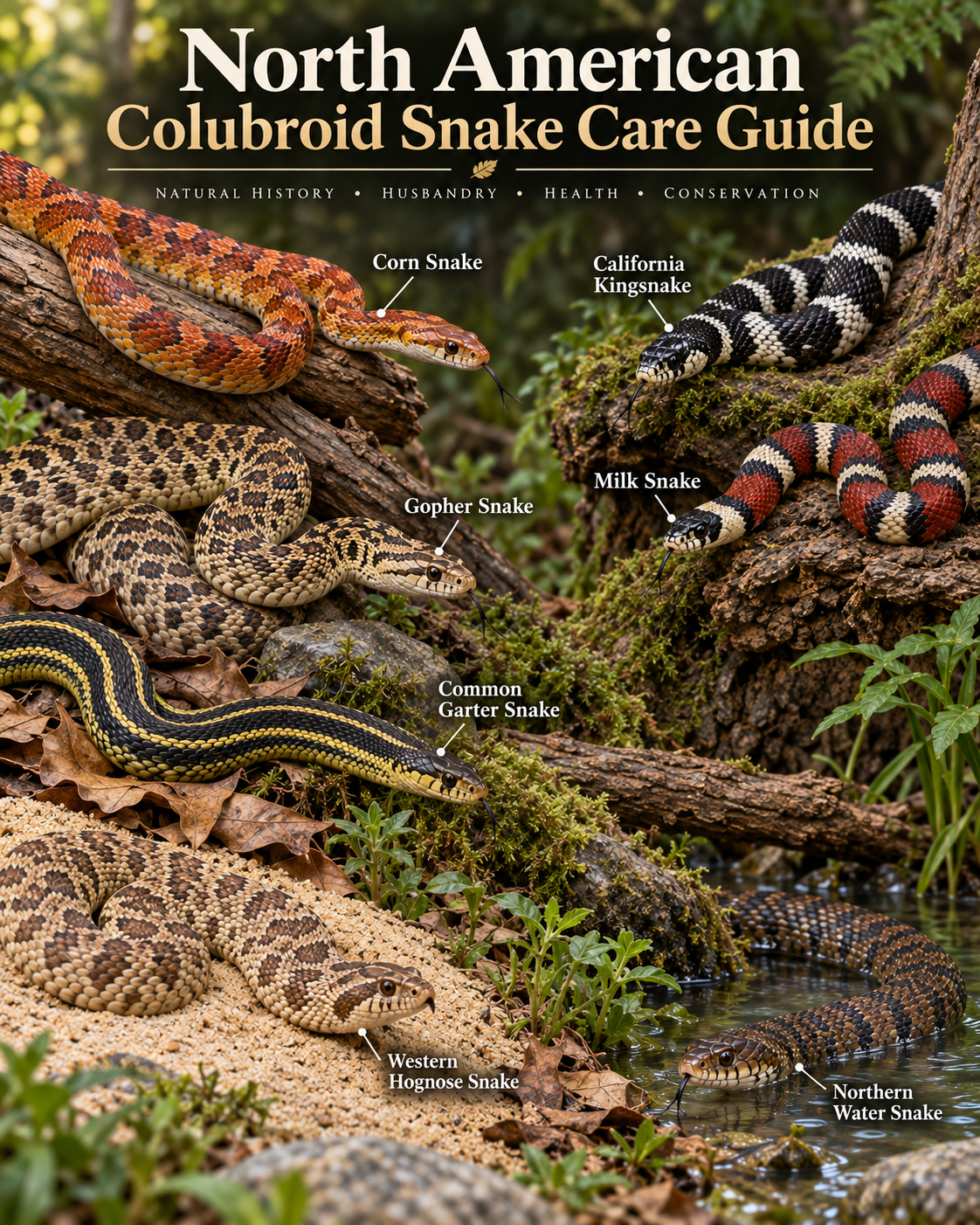
Snake Husbandry & Preventive Care
North American Colubroid Snake Care Guide
A comprehensive husbandry and preventive-care guide for the extraordinarily diverse North American colubroid assemblage—from corn snakes, ratsnakes, kingsnakes, milksnakes, pine and gopher snakes to garters, watersnakes, hognose snakes, indigos, racers, coachwhips, green snakes, and specialized small or semiaquatic native groups. General principles are followed by extensive ecology-based individual sections because these snakes cannot be managed safely or humanely as one generic “colubrid” type.
Quick Care Principles
| Area | Best-practice principle | Important variation |
|---|---|---|
| Space | Provide at least full-body extension plus ecology-appropriate width/height. | Active racers/indigos need far more travel space; rough greens need vertical structure; micro-colubroids need small but complex escape-proof habitats. |
| Heat | Thermostat-controlled warm/basking zone plus a cooler retreat. | Coachwhips and western hognose use hotter exposed surfaces; ring-necks and earth snakes require much cooler microclimates. |
| Humidity | Create gradients and humid retreats rather than uniformly wet cages. | Desert glossy/long-nosed snakes differ markedly from Nerodia, Farancia, and forest micro-colubroids. |
| Light | Strong day/night cue; seasonal photoperiod for temperate species. | Diurnal racers, garters, hognose, indigos, and green snakes are especially appropriate candidates for measured UVB. |
| Structure | Match natural locomotion: burrows, branches, leaf litter, rock crevices, brush, or water. | Security is created by cover and retreat choice—not by keeping the enclosure undersized. |
| Social | Solitary housing is the safest default. | Kingsnakes may prey on cage mates; garter aggregation in nature does not eliminate captive competition/disease concerns. |
Scope, Taxonomy, and Identification
“North American colubroids” is used here as a practical website grouping for non-viperid/non-elapid advanced snakes traditionally placed largely within Colubridae and related colubroid lineages. Modern snake taxonomy is dynamic. The husbandry decision should therefore begin with the actual species and locality, not merely the historical family label.
The detailed groups deliberately mirror the site's North American Colubroid Diet Guide: Pantherophis, Lampropeltis, Pituophis, Thamnophis, Nerodia, Heterodon, Drymarchon, racers, Masticophis, Opheodrys, Arizona/Rhinocheilus, Diadophis, Storeria/Virginia, Regina-type aquatic natricines, and Farancia.
Planning Before Acquisition
- Identify species, locality, expected adult size, activity pattern, and whether it is terrestrial, fossorial, arboreal, riparian, or semiaquatic.
- Build the adult habitat first when possible. Active colubroids can outgrow small starter tanks quickly.
- Run the complete enclosure for several day/night cycles before introduction.
- Locate a reptile veterinarian and determine what fecal/infectious-disease screening is appropriate.
- Prefer documented captive-bred animals. Many uncommon native snakes adapt poorly after collection and may be regulated.
- Confirm a legal source and retain acquisition records.
Legal, Conservation, and Captive-Origin Considerations
Native-snake possession and collection laws vary substantially among states, provinces, counties, and municipalities. Protected taxa, bag limits, collection seasons, breeder permits, interstate movement, and release rules may apply. The Eastern indigo snake is federally threatened in the United States and is the focus of active AZA conservation/reintroduction work. Never assume that a common-looking native snake is legal to collect or transport.
Captive-bred animals are preferred for welfare, biosecurity, conservation, and acclimation. Never release a long-term captive snake into the wild; disease, locality genetics, and legal restrictions make unsupervised release inappropriate.
Housing and Usable Space
For many terrestrial colubroids, a useful starting formula is enclosure length at least approximately snake length and width at least half snake length, with height increased for climbers. This is a minimum spatial framework, not an ideal maximum. Highly active racers, coachwhips, indigos, large ratsnakes, and Pituophis benefit from substantially more.
Glass can work but loses heat and may feel visually exposed. PVC, sealed wood, fiberglass, and well-designed front-opening terraria allow better environmental control. Provide multiple hides and visual barriers so a large enclosure remains secure.
Escape Prevention and Heat Safety
Colubroids can pass through surprisingly small gaps. Use positive door locks, secure cable ports, and ventilation openings smaller than the snake's head. Small Storeria, Virginia, Diadophis, and neonates require especially fine escape-proofing.
Thermostatically control heat sources. Guard all internal lamps/emitters. Avoid hot rocks and unregulated heat mats. Overhead heat is generally preferable because it creates a natural surface-to-retreat gradient; burrowing snakes must be able to escape heat by moving downward.
Thermoregulation
Merck's current veterinary husbandry table gives corn/rat snakes a broad air POTZ of 77–86°F (25–30°C), with basking areas generally warmer and nights cooler. That broad range is useful only as a starting framework: North American colubroids span cool northern forests, humid wetlands, prairies, deserts, and subtropical habitats.
Create a broad basking area large enough for the snake's coil rather than one tiny hot point. The warm hide should be near the basking zone, while the cool hide must remain genuinely cooler. Nighttime heat is often unnecessary for healthy temperate adults when the room remains within the species' safe seasonal range.
Measuring Devices and Environmental Monitoring Procedures
The controller setting is not the habitat measurement. Verify the environment independently.
| Device | Use | Procedure |
|---|---|---|
| Digital probe thermometer | Air temperature | One at warm-hide/snake height and one at the cool retreat; add probes to elevated perches or water zones where relevant. |
| Infrared thermometer | Surface temperature | Survey basking stone, branches, substrate, hides, and multiple points across the warm zone. Do not use it as an air thermometer. |
| Thermostat | Heat control/safety | Secure the control probe; then calibrate the setting against independent surface/air measurements. |
| Digital hygrometer | Relative humidity | Place at snake level away from direct mist/water. Compare ambient habitat with humid retreat when needed. |
| UV Index meter (Solarmeter 6.5 or equivalent) | UV exposure | Measure at dorsal height on the basking surface and verify UVI 0 shaded retreats. |
| Water thermometer | Aquatic-zone temperature | Required for Nerodia, Regina-type and Farancia habitats; never infer water temperature from air. |
| Scale | Body mass | Record serial weights with a tared container or platform scale. |
Procedure for mapping an enclosure
- Run the completed habitat for several normal cycles before adding the snake.
- Measure basking surface temperature with IR.
- Measure warm-hide air temperature with a probe.
- Measure cool-hide air temperature independently.
- Check intermediate and elevated zones; semiaquatic species also require water temperature.
- Record humidity at the snake's level and inside special humid retreats if clinically relevant.
- If UVB is used, measure the actual UVI at the snake's back, not merely lamp distance.
- Repeat at the hottest daytime period and at night.
- Re-map after seasonal room changes, bulb replacement, substrate change, ventilation modification, or rearrangement.
Routine: inspect displays daily, survey surfaces weekly, review records monthly, and perform a full re-map seasonally or after equipment changes.
Lighting, Photoperiod, and UVB
Provide bright white daytime light and complete darkness at night. Temperate North American snakes receive strong seasonal day-length information; a practical captive range is approximately 10–14 hours for many species, with more extreme seasonal programs reserved for locality-specific breeding management.
UVB is not traditionally considered essential for rodent-fed snakes, but modern veterinary guidance recognizes potential health/welfare benefit of broad-spectrum lighting. When UVB is offered, measure it. Most exposed diurnal species in this guide use conservative basking targets around UVI 2–3; highly sun-exposed whipsnakes may use somewhat higher values, while secretive woodland micro-colubroids require very low exposure and abundant shade.
Humidity, Ventilation, and Hydration
Humidity must be interpreted with habitat and microclimate. Even desert snakes retreat to more humid burrows, while semiaquatic snakes still need dry, ventilated resting areas. Use deep substrate, leaf litter, humid hides, water placement, and limited misting to create choice. Do not reduce ventilation simply to force humidity upward; veterinary guidance warns that poor ventilation combined with heat/humidity promotes skin and respiratory disease.
Fresh potable water should always be available. For aquatic-associated groups, provide a basin large enough for natural swimming/soaking but easy to drain and disinfect.
Substrate Choices, Depth, and Drainage
Substrate should reproduce the functional properties of the natural habitat: burrowability, moisture buffering, drainage, leaf-litter cover, or riparian structure.
| Habitat type | Useful substrate | Typical depth |
|---|---|---|
| Eastern forest/field ratsnakes, garters | Additive-free topsoil + coconut fiber + play sand; leaf litter | 3–5 in |
| Prairie/desert hognose, glossy, long-nosed, Pituophis | Topsoil + washed play sand + optional clay | 4–8 in |
| Woodland micro-colubroids | Forest soil/coconut + deep pesticide-free leaf litter, bark, moss pockets | 3–5 in |
| Riparian/semiaquatic | Well-drained soil/leaf litter on land; separate cleanable aquatic zone | 3–5 in land zone |
| Quarantine/medical | Paper or paper towel | Temporary only |
A common naturalistic blend is roughly 40% additive-free topsoil, 40% coconut fiber, 20% washed play sand; arid burrowers can shift toward 50–60% soil and 40–50% sand with clay for structure. Never use soil containing fertilizer, pesticides, manure pellets, perlite, or wetting agents. Avoid cedar/aromatic wood, walnut shell, sharp gravel, and chronically wet artificial turf.
Drainage
Semiaquatic and frequently misted habitats need waterproof floors, removable trays, drainage layers, or drains. Standing water beneath substrate is not a humidity strategy. Heavy rocks must rest on the enclosure floor before loose substrate is added so burrowing cannot undermine them.
Hides, Climbing, Burrowing, Water, and Enrichment
At least two snug hides are appropriate for most terrestrial species. Add ecology-specific structures: high branches for Opheodrys; robust low branches and shelves for ratsnakes/indigos; deep soil for hognose and Pituophis; brush-like visual barriers for racers/coachwhips; and land-water interfaces for natricines/Farancia.
Enrichment can include novel scent trails, rearranged leaf litter, additional cork tunnels, seasonal branches, multiple basking textures, live plants, and target training. Do not repeatedly dismantle the animal's core retreats merely to create novelty.
Handling and Bite Considerations
Allow new snakes to establish normal feeding/behavior before routine handling. Support the body and avoid restraint by the tail. Fast racers, coachwhips, watersnakes, and indigos often do better with hook-assisted or target-based transfers than prolonged hand restraint.
Hognose snakes are rear-fanged and have prey-subduing oral secretions. Most human effects are local, but prolonged chewing should be prevented. Wash bites thoroughly; significant pain, progressive swelling, systemic signs, or allergy-like reactions warrant medical advice.
Seasonality and Brumation
Many North American colubroids experience major seasonal changes in temperature, photoperiod, rainfall, prey, and activity. Routine pet health does not require deliberate brumation. Controlled cooling is primarily a breeding/seasonal-management tool for healthy, established animals of known species/locality.
Before planned brumation, confirm adequate body condition and absence of disease, stop feeding early enough for digestion at normal temperatures, reduce light/temperature gradually, and monitor mass/hydration. Never place a recently fed, sick, underweight, parasitized, or newly acquired snake into cold dormancy.
Reproduction and Neonatal Care
Most groups here are oviparous, while garter/ribbon snakes, watersnakes, and several small natricines are live-bearing. Reproductive protocols must be taxon-specific. Provide appropriate nesting substrate/depth for egg-layers and secure warm retreats for gravid live-bearers. Record pairing, ovulation/gestation observations, egg or birth dates, incubation conditions, neonate mass, first shed, feeding, and growth.
Neonates require escape-proof housing, correctly scaled hides and gradients, and species-appropriate prey. Do not assume a rodent diet for insect, amphibian, fish, worm, mollusk, or crayfish specialists.
Detailed Species and Group Care
Corn Snakes and North American Ratsnakes — Pantherophis
Species/forms included, adult size, and area of origin
| Species or form | Typical adult size | Native range | Natural habitat |
|---|---|---|---|
| Corn snake — P. guttatus | Usually 3–5 ft (0.9–1.5 m) | Southeastern and south-central United States | Deciduous/pine woodland, rocky slopes, fields, farms, barns and suburban edge; frequently climbs. |
| Eastern/central ratsnake forms — Pantherophis spp. | Commonly 4–6 ft (1.2–1.8 m); some larger | Eastern and central United States | Forest, woodland edge, floodplain, rocky areas, farms and structures; strongly scansorial. |
| Western ratsnake — P. obsoletus | Commonly 4–6 ft (1.2–1.8 m) | Central United States | Woodland, prairie edge, riparian corridors and agricultural landscapes. |
| Great Plains ratsnake — P. emoryi | Usually about 3–5 ft (0.9–1.5 m) | Central/southwestern United States into northern Mexico | Prairie, rocky areas, canyon country, open woodland and farm edges. |
Habitat design concept
A terrestrial enclosure with substantial climbing opportunity. These snakes use tree trunks, ledges, hollow logs, shrubs, rock faces and buildings as well as ground refuges. Security should come from multiple retreats and visual cover, not from restricting the animal to a small box.
Adult enclosure size
For most adult corn snakes use at least 48 × 24 × 24 in (122 × 61 × 61 cm). For a 5–6 ft ratsnake, provide 5–6 ft of usable length; 6 × 3 × 3 ft is an excellent target for a large active adult. Increase height where possible because adults climb readily.
Measured environmental targets
| Parameter | Starting target |
|---|---|
| Basking surface | 88–90°F (31–32°C) |
| Warm-side air | 80–85°F (27–29°C) |
| Cool retreat | 72–80°F (22–27°C) |
| Night | Usually 65–75°F (18–24°C) for temperate adults; locality dependent |
| Humidity | About 50–70% for most; dry western forms may run somewhat lower, humid southeastern forms often use the upper range |
| UVB | Optional UVI about 2–3 at an exposed basking branch with UVI 0 shade |
| Photoperiod | Roughly 10–14 hr seasonally; 11–13 hr is a simple nonbreeding schedule |
Substrate
Use 3–5 in of additive-free topsoil/coconut/play-sand mix or another moisture-buffering forest/field soil. Add pesticide-free leaf litter. Aspen can work for drier animals but is less useful when humidity must be retained.
Step-by-step habitat setup
- Install a guarded overhead halogen/flood source over one end and thermostat any supplemental heater.
- Place a broad basking slate, cork shelf, or branch under the heat source, large enough for most of the snake's coil.
- Add a snug warm hide beneath/adjacent to the basking zone, a cool hide at the opposite end, and a separate humid retreat with lightly damp moss or soil.
- Install at least two securely anchored branches at different heights, plus a cork round or hollow-log analogue and an elevated shelf/hide.
- Add leaf litter and live/artificial plants so the snake can cross the enclosure without remaining continuously exposed.
- Place a stable water bowl on the cool half and leave an unobstructed route long enough for full-body extension.
Routine care and maintenance
Spot-clean waste promptly, replace contaminated leaf litter, and check doors, cable ports and branch fastenings weekly. Weigh juveniles monthly and adults every 1–3 months. Good body condition is athletic rather than cylindrical and soft. Rotate scent trails, additional branches, bark and leaf piles for enrichment without repeatedly destroying core refuges.
Seasonality
Temperate ratsnakes experience seasonal photoperiod and winter inactivity. Routine pets do not require brumation. Breeding-associated cooling should be used only with a known species/locality, adequate body condition, no recent meal and a controlled protocol.
Behavior, handling, and special cautions
Corn snakes are often tolerant of handling, but larger ratsnakes may be more active or defensive. Support the entire body rather than restraining the head. Persistent nose rubbing or escape behavior usually indicates inadequate cover, incorrect environmental choices or insecure enclosure design.
Kingsnakes and Milksnakes — Lampropeltis
Species/forms included, adult size, and area of origin
| Species or form | Typical adult size | Native range | Natural habitat |
|---|---|---|---|
| California kingsnake — L. californiae | Usually 3–4.5 ft (0.9–1.4 m) | Western United States and Baja California | Desert edge, chaparral, woodland, riparian corridors, farms; uses rodent burrows and surface cover. |
| Eastern/common kingsnake forms — L. getula complex | Often 3–5 ft (0.9–1.5 m) | Eastern and southeastern United States | Forest, grassland, wetland edge, agricultural and suburban habitats. |
| Florida kingsnake — L. floridana | Often 3.5–5 ft (1.1–1.5 m) | Florida peninsula | Moist flatwoods, marsh edges, canals, fields and disturbed habitat. |
| Mexican black kingsnake — Lampropeltis desert form | Usually 3–4 ft (0.9–1.2 m) | Sonoran region of Mexico and adjacent Southwest | Arid scrub and desert-associated habitat. |
| Milksnakes — Lampropeltis spp./complexes | Roughly 2–5 ft (0.6–1.5 m), depending on taxon | Broadly distributed from Canada through much of the United States into Mexico/Central America | Forest, prairie, rocky slopes, agricultural margins, montane and desert-edge habitats. |
Habitat design concept
Primarily terrestrial to semi-fossorial snakes that need deep substrate, tight retreats, low climbing features and strong escape prevention. The group spans humid Florida habitats to arid western deserts, so species/locality must determine moisture management.
Adult enclosure size
Use 48 × 24 × 24 in for most 3–4 ft adults. Animals approaching 5–6 ft should receive 5–6 ft of length. Provide 18–24 in of height for low branches and shelves.
Measured environmental targets
| Parameter | Starting target |
|---|---|
| Basking surface | 85–90°F (29–32°C); some western forms may use 90–92°F |
| Cool retreat | 70–78°F (21–26°C) |
| Night | Usually 65–75°F (18–24°C) for temperate forms |
| Humidity | Generally 40–60%; Florida/eastern forms may use more, arid western forms less |
| UVB | Optional UVI 2–3 with deep shade |
| Photoperiod | 10–14 hr seasonal or 11–13 hr simple maintenance |
Substrate
Provide about 4 in of soil-like substrate. Humid/eastern forms: topsoil/coconut/leaf litter. Arid western forms: topsoil/play sand with a drier surface. Always provide a localized humid retreat.
Step-by-step habitat setup
- Place a thermostat-controlled overhead basking source at one end and a flat stone/cork surface over or beside the warm hide.
- Install snug warm and cool hides; offer more than two choices because many kingsnakes prefer very tight spaces.
- Add about 4 in of diggable substrate and partly bury cork flats/tunnels to create subterranean routes.
- Add low branches, rock-like ledges and leaf litter without reducing floor travel space.
- Place water on the cool side; use a larger bowl for humid eastern forms and a modest stable bowl for arid taxa.
- Use positive door locks and fine cable-port closures; juveniles are accomplished escape artists.
Routine care and maintenance
These snakes are usually strong feeders. Wash hands after prey handling and use long tongs. Target/tap training can reduce food-response confusion. Spot-clean immediately, maintain the humid hide and replace contaminated substrate in sections. Weigh regularly because obesity is common in sedentary captive kingsnakes.
Seasonality
Northern and high-elevation milksnakes/kingsnakes may brumate naturally; southern/coastal forms have milder winter cycles. Routine pets do not require forced brumation.
Behavior, handling, and special cautions
House singly. Ophiophagy is natural in many kingsnakes and cannibalism can occur even between similarly sized animals. Cohabitation should not be routine.
Pine, Bull, and Gopher Snakes — Pituophis
Species/forms included, adult size, and area of origin
| Species or form | Typical adult size | Native range | Natural habitat |
|---|---|---|---|
| Bullsnake — P. catenifer sayi | Commonly 5–7 ft (1.5–2.1 m) | Central United States into southern Canada/northern Mexico | Prairie, grassland, agriculture, sandy upland and burrow systems. |
| Gopher snake forms — P. catenifer | Usually 4–6 ft (1.2–1.8 m) | Western North America | Desert, chaparral, woodland, grassland, farmland and rocky terrain. |
| Northern pine snake — P. melanoleucus | Often 4–6 ft (1.2–1.8 m) | Eastern United States, especially sandy pine systems | Longleaf/pine forest, sandy upland, old fields; strong burrow dependence. |
| Florida pine snake — P. mugitus | Often 4–6+ ft (1.2–1.8+ m) | Southeastern United States | Sandhill, scrub, pine flatwoods and pocket-gopher burrow systems. |
Habitat design concept
A long, deep, burrowable habitat is more important than decorative height. Field studies show gopher snakes spend substantial time underground; the enclosure should permit real excavation and cool subterranean retreat.
Adult enclosure size
For most adults use 6 × 3 × 2–3 ft; large bullsnakes and pine snakes benefit from 6–8 ft length. Juveniles can start smaller only if they retain equivalent environmental complexity.
Measured environmental targets
| Parameter | Starting target |
|---|---|
| Basking surface | 90–95°F (32–35°C) |
| Warm air | 80–86°F (27–30°C) |
| Cool retreat | 70–78°F (21–26°C) |
| Night | Often 60–72°F (16–22°C) for temperate adults |
| Humidity | About 30–55% air humidity plus a humid underground retreat; southeastern pine snakes need more moisture than desert gopher snakes |
| UVB | Optional UVI 2–3 |
| Photoperiod | Strong seasonal cycle appropriate |
Substrate
Provide 5–8 in of compactable substrate: roughly 50–60% additive-free topsoil with 40–50% washed play sand; clay can be added for tunnel stability.
Step-by-step habitat setup
- Before adding substrate, set all heavy stone/slate furnishings directly on the enclosure floor so burrowing cannot undermine them.
- Install a guarded overhead basking source over a broad flat surface.
- Add 5–8 in of compactable soil and create at least two preformed burrow systems with buried cork tubes or safe large tunnels.
- Place one burrow entrance near the warm end and one in the cool/deeper end.
- Add a humid underground chamber with slightly damp soil or moss, but keep most exposed surface dry for western forms.
- Add low sturdy branches, logs and surface cover while preserving large areas for digging.
- Place a stable water bowl on the cool side.
Routine care and maintenance
Allow some tunnels to persist rather than collapsing the entire substrate at each cleaning. Spot-clean accessible waste and renovate the substrate in sections. Inspect the rostrum for abrasion. Measure both surface basking temperature and temperature within deeper burrows.
Seasonality
Many populations undergo prolonged winter dormancy. Routine pets need a seasonal light/temperature rhythm but not necessarily brumation. Breeding cooling must be planned around locality and body condition.
Behavior, handling, and special cautions
Loud hissing, tail vibration, body inflation and striking are characteristic defensive displays and do not automatically indicate an aggressive animal. Avoid repeated forced handling; use a hook-assisted initial lift and calm body support.
Garter and Ribbon Snakes — Thamnophis
Species/forms included, adult size, and area of origin
| Species or form | Typical adult size | Native range | Natural habitat |
|---|---|---|---|
| Common garter snake — T. sirtalis | Usually 2–4 ft (0.6–1.2 m); large females may be longer | Across much of Canada and the United States into Mexico | Moist meadows, woodland, marshes, ponds, streams and suburban areas. |
| Plains garter snake — T. radix | Usually 2–3.5 ft (0.6–1.1 m) | Central North America | Prairie, wet meadow, agricultural margins and water edges. |
| Checkered garter snake — T. marcianus | Usually 2–3 ft (0.6–0.9 m) | Southwestern United States through Mexico/Central America | Grassland, desert-edge and irrigated/wet areas. |
| Ribbon snakes — Thamnophis ribbon-snake taxa | Usually 1.5–3 ft (0.45–0.9 m) | Eastern and central North America | Strongly riparian; dense shoreline vegetation, marshes, ponds and streams. |
Habitat design concept
An active, visually complex terrestrial-riparian enclosure with a substantial clean water area, dense cover and climbing/basking structures. Garters are not aquarium snakes: they need dry land, dry hides and a real warm-to-cool gradient.
Adult enclosure size
Use 48 × 24 × 24 in or larger for an average adult. Large females do better with 5 ft of length. Ribbon snakes benefit from additional height and fine branches.
Measured environmental targets
| Parameter | Starting target |
|---|---|
| Basking | 85–90°F (29–32°C) |
| Cool zone | 70–78°F (21–26°C) |
| Night | 60–72°F (16–22°C), locality dependent |
| Humidity | Generally 35–60%; higher local humidity near water and at night is normal |
| UVB | UVI 2–3 is a useful optional target for these often-diurnal baskers |
| Photoperiod | Strong 10–14 hr seasonal cycle |
Substrate
Use 3–4 in of well-drained topsoil/coconut blend with leaf litter. Keep the terrestrial surface mostly dry while providing moist moss/soil under selected cover.
Step-by-step habitat setup
- Create a warm basking area at one end with a branch, flat stone or cork platform.
- Provide at least two land hides and a humid retreat.
- Add dense grass-like plants, cork, branches and leaf litter so the snake can move under cover.
- Place a large removable or drainable water basin on the cool side. It should permit swimming and full-body soaking but allow easy exit.
- For ribbon snakes, add more fine branches and overhanging foliage above the water.
- Keep electrical equipment outside the splash zone and monitor water temperature separately.
Routine care and maintenance
Inspect water at least daily because garters frequently defecate in it. Disinfect whenever contaminated. Maintain a dry terrestrial zone to prevent dermatitis. Weigh regularly and monitor individuals carefully if any social housing is attempted.
Seasonality
Northern garters can show pronounced seasonal dormancy and communal hibernation in nature. Routine captive maintenance does not require deliberate brumation.
Behavior, handling, and special cautions
Although garters may aggregate in the wild, solitary housing is simplest for pet health. If compatible groups are kept, duplicate hides/basking areas, separate animals for feeding, prevent unintended breeding and maintain individual weights and health records.
Watersnakes — Nerodia
Species/forms included, adult size, and area of origin
| Species or form | Typical adult size | Native range | Natural habitat |
|---|---|---|---|
| Northern watersnake — N. sipedon | About 2–4.5 ft (0.6–1.4 m), females larger | Northeastern/central North America | Lakes, ponds, rivers, streams, marshes, bogs and riparian edges. |
| Banded/southern watersnake — N. fasciata | Usually 2–4 ft (0.6–1.2 m) | Southeastern United States | Swamps, ponds, marshes, canals and slow waterways. |
| Diamondback watersnake — N. rhombifer | Commonly 3–5 ft (0.9–1.5 m) | Central/south-central United States into Mexico | Rivers, lakes, sloughs and marshes; often basks on branches over water. |
| Brown watersnake — N. taxispilota | Often 3–5 ft (0.9–1.5 m) | Southeastern United States | Rivers, lakes and swamps; strongly associated with branches over water. |
Habitat design concept
A land-and-water riparian enclosure, not a mostly aquatic fish tank. These snakes bask, climb, hide beneath terrestrial cover and use water extensively. Cleanability is a major design requirement.
Adult enclosure size
Use at least 48 × 24 × 24 in for moderate adults; large females and 4–5 ft species should receive 5–6 ft length. More height is useful for branch-basking species.
Measured environmental targets
| Parameter | Starting target |
|---|---|
| Basking | 86–90°F (30–32°C) |
| Cool land | 72–78°F (22–26°C) |
| Water | About 70–78°F (21–26°C) for temperate species |
| Night | Usually 65–75°F (18–24°C) |
| Humidity | About 50–70% with strong ventilation and dry retreats |
| UVB | Optional UVI 2–3 over an exposed basking site |
Substrate
Use 3–4 in of well-drained soil/leaf litter on the land section. Avoid continuously saturated land substrate.
Step-by-step habitat setup
- Design at least half of the usable enclosure as dry land with secure hides and substrate.
- Install a removable or plumbed water basin large enough for natural swimming and full-body submersion.
- Provide multiple textured haul-out sites; no steep slick walls.
- Anchor branches and cork above/near the water so the snake can bask while remaining close to an escape route.
- Place overhead heat over a dry basking platform, not over the entire water body.
- Use filtration sized for waste load if the water volume is large; build in siphon or drain access.
Routine care and maintenance
Inspect the water daily and remove feces immediately. Clean/filter based on actual water quality rather than a fixed schedule. Measure water temperature independently. Keep at least one completely dry hide at all times. Observe skin for blistering or scale damage.
Seasonality
Temperate watersnakes overwinter in terrestrial shelters/rock crevices rather than remaining active in warm water year-round. Routine pets can receive a milder seasonal cycle without forced brumation.
Behavior, handling, and special cautions
Many Nerodia are defensive and musk/bite repeatedly when restrained. Use calm hook-assisted transfers, keep handling brief and avoid interpreting defensive behavior as a need for harsher restraint.
Hognose Snakes — Heterodon
Species/forms included, adult size, and area of origin
| Species or form | Typical adult size | Native range | Natural habitat |
|---|---|---|---|
| Plains/western hognose — H. nasicus | Males often 14–24 in (35–60 cm); females commonly 24–36 in (60–90 cm) | Great Plains and central/western North America into northern Mexico | Prairie, grassland, sandy soils and semi-arid scrub. |
| Eastern hognose — H. platirhinos | About 18–41 in (45–105 cm); females larger | Eastern/central United States and southern Canada | Sandy woodland, field edges, shrubland, areas near wetlands and amphibian habitat. |
| Southern hognose — H. simus | Usually about 14–30 in (35–75 cm) | Southeastern United States | Sandy uplands, pine-oak forest, scrub and old fields; strongly fossorial. |
Habitat design concept
A deep, diggable terrestrial enclosure with a strong dry-to-moist soil gradient. These snakes should be able to disappear completely beneath substrate. Western forms are drier; eastern and southern forms need more moisture and different dietary management.
Adult enclosure size
A 36 × 18 × 18 in habitat is a good starting point for most adults; large female westerns/easterns benefit from 48 × 24 × 18–24 in. Floor area and substrate depth matter more than climbing height.
Measured environmental targets
| Parameter | Starting target |
|---|---|
| Western basking | 90–95°F (32–35°C) |
| Western humidity | 30–50% with humid hide |
| Eastern/southern basking | 86–90°F (30–32°C) |
| Eastern/southern humidity | 50–60%, with slightly moist cool-side soil |
| Cool zone | 72–80°F (22–27°C) |
| UVB | Optional UVI 2–3; these are frequently diurnal |
Substrate
Provide 4–6 in of topsoil/play-sand blend. For western forms keep most surface dry; for eastern/southern forms retain slightly more cool-side soil moisture. Add a humid hide to all.
Step-by-step habitat setup
- Place a broad warm surface over one end, with a snug hide partially buried beneath/near it.
- Fill the enclosure with 4–6 in of diggable soil before adding lightweight surface furnishings.
- Partly bury cork flats and short cork tubes to create starter burrows.
- Place a cool hide and humid hide at the opposite end.
- Add sparse grasses, leaf litter and low obstacles while preserving open soil for excavation.
- Use a shallow, stable water bowl that cannot flood the substrate.
Routine care and maintenance
Do not repeatedly excavate a hidden animal simply because it is not visible. Track weight, feeding and sheds instead. Spot-clean tunnel openings and renovate substrate gradually. Monitor rostral scales for abrasion. Keep humidity microclimates rather than misting the whole enclosure.
Seasonality
Temperate hognose snakes show strong seasonal inactivity. Brumation is not required for routine pet health and should never be used to address feeding problems without veterinary/husbandry review.
Behavior, handling, and special cautions
Hognose snakes are rear-fanged and have prey-subduing oral secretions. Prevent prolonged chewing bites; swelling can occur. Wash bites and seek medical advice for progressive swelling, significant pain or systemic signs. Avoid intentionally provoking hooding/feigned-death behavior.
Indigo Snakes and Cribos — Drymarchon
Species/forms included, adult size, and area of origin
| Species or form | Typical adult size | Native range | Natural habitat |
|---|---|---|---|
| Eastern indigo snake — D. couperi | Commonly 5–7 ft (1.5–2.1 m); may reach about 8.6 ft (2.6 m) | Florida and southern Georgia, with conservation/reintroduction areas elsewhere in the Southeast | Longleaf pine sandhill, scrub, flatwoods, hammocks and dunes; relies heavily on below-ground refuges such as gopher tortoise burrows. |
| Texas indigo — D. melanurus erebennus | Commonly 6–8 ft (1.8–2.4 m) | South Texas into northeastern Mexico | Thornscrub, brushland, riparian corridors and agricultural edge. |
| Other cribos — Drymarchon melanurus complex | Often 6–8+ ft (1.8–2.4+ m) | Primarily Mexico, Central America and northern South America; represented in some North American collections | Tropical/subtropical forest edge, savanna and brush, depending on form. |
Habitat design concept
A room-scale or very large active-snake habitat. Drymarchon are highly mobile, visual, curious colubrids. Their needs are poorly met by conventional narrow snake cages.
Adult enclosure size
For an adult Eastern/Texas indigo use 8 × 4 × 4 ft as a starting minimum, with 10–12 ft or room-scale length preferable for large animals. Provide wide doors or a service vestibule for safe transfer.
Measured environmental targets
| Parameter | Starting target |
|---|---|
| Basking | 88–92°F (31–33°C) |
| Cool | 72–78°F (22–26°C) |
| Night | 65–75°F (18–24°C), locality dependent |
| Humidity | About 50–70% with humid burrow retreats |
| UVB | UVI 2–3 is a reasonable optional target for active diurnal animals |
| Photoperiod | Strong seasonal day length |
Substrate
Provide 4–8 in of soil/leaf-litter substrate where drainage permits. Incorporate large burrow-like boxes/cork tunnels that can be inspected.
Step-by-step habitat setup
- Use an escape-proof PVC/fiberglass/sealed-wood room or very large enclosure with redundant locks.
- Create a broad overhead basking zone sized for the whole coil, plus a cool end that remains genuinely cooler.
- Install multiple large ground hides and at least one long burrow-like retreat; Eastern indigos should have deep, secure below-grade style shelter.
- Add large low platforms, logs, anchored branches, leaf piles and long open travel lanes.
- Provide a large, stable water basin on the cool half.
- Create multiple enrichment stations and use target/tap training so routine servicing does not require physical capture.
Routine care and maintenance
These snakes produce substantial waste and need frequent spot cleaning. Large water bowls should be drainable. Weigh monthly to every 2 months and monitor strong axial muscle tone. Rotate scent trails, novel objects, boxes, logs and substrate zones. Maintain enough space for voluntary movement every day.
Seasonality
Eastern indigos move seasonally between upland and lowland habitats and use underground shelters during cool periods. Captive seasonality should be gentle unless managed under a specialized breeding/conservation protocol.
Behavior, handling, and special cautions
The Eastern indigo snake is federally threatened in the United States; legal possession, transfer and breeding may require federal/state authorization. Retain detailed legal and acquisition records. Captive-bred legal stock is essential.
Racers — Coluber constrictor and Related Racer Forms
Species/forms included, adult size, and area of origin
| Species or form | Typical adult size | Native range | Natural habitat |
|---|---|---|---|
| Eastern/North American racer — C. constrictor | Often 3–5 ft (0.9–1.5 m); some adults longer | Broadly distributed through much of the United States and parts of Canada/Mexico | Sunny fields, open woodland, hedgerows, thickets, scrub, marsh edges and lake margins. |
| Regional racer forms | Similar 3–5+ ft range depending on population | Eastern, central and western North America | From humid woodland edge to dry scrub and chaparral. |
Habitat design concept
A long, bright, visually complex enclosure built for speed. Racers are wide-ranging diurnal snakes and generally poor candidates for small cages or frequent handling.
Adult enclosure size
Use 6 × 3 × 3 ft or larger for a typical adult; 8 ft length is preferable for large active individuals. Include a service strategy that reduces escape risk.
Measured environmental targets
| Parameter | Starting target |
|---|---|
| Basking | 90–95°F (32–35°C) |
| Cool | 72–80°F (22–27°C) |
| Night | 60–72°F (16–22°C) for temperate forms |
| Humidity | 35–60% depending on locality, plus humid retreat |
| UVB | UVI 2–3 with strong visible light |
| Photoperiod | Seasonal 10–14 hr cycle |
Substrate
Use 3–5 in of naturalistic topsoil/play-sand/leaf-litter blend matched to locality.
Step-by-step habitat setup
- Create a long warm-to-cool axis with the basking zone at one end and no obstacles blocking rapid travel.
- Line enclosure edges with dense plants/brush-like cover so the snake can move while visually screened.
- Provide at least three hides plus cork tubes or a removable transfer box.
- Add low-to-medium branches and an elevated basking shelf.
- Use front-opening doors with positive locks; consider an internal shift box or service vestibule.
- Place water securely on the cool side.
Routine care and maintenance
Avoid chasing the snake around the enclosure. Train it to enter a removable hide/shift box for cleaning. Use long tools and deliberate movements. Monitor for rostral injury and chronic pacing, which often indicate insufficient space or visual security.
Seasonality
Temperate racers hibernate in protected sites during winter. Routine pet management can follow a seasonal photoperiod and mild winter cooling without full brumation.
Behavior, handling, and special cautions
These are best treated as observation animals. Repeated hand capture can create chronic stress and injury risk to both snake and keeper.
Coachwhips and Whipsnakes — Masticophis
Species/forms included, adult size, and area of origin
| Species or form | Typical adult size | Native range | Natural habitat |
|---|---|---|---|
| Coachwhip — M. flagellum | About 3–8.5 ft (0.9–2.6 m), usually 4–6 ft | Southern and western United States into Mexico | Dry open terrain: desert, prairie, scrub, chaparral, woodland, farm edge and creek valleys. |
| Striped whipsnake — M. taeniatus | Often 3–5 ft (0.9–1.5 m) | Western United States | Desert scrub, sagebrush, rocky slopes, canyon and open woodland. |
| Other western whipsnake forms | Commonly 3–6 ft | Western/southwestern North America | Hot, open, structurally complex dry habitats. |
Habitat design concept
An exceptionally long, bright enclosure with large horizontal travel distance, multiple visual barriers and a broad hot basking zone. Coachwhips are among the most active snakes maintained in captivity.
Adult enclosure size
Use 8 × 4 × 3–4 ft or larger for adults; long coachwhips benefit from 10 ft or more of usable length. A narrow 6-ft cage is insufficient for a 6-ft animal that normally ranges widely.
Measured environmental targets
| Parameter | Starting target |
|---|---|
| Basking surface | 95–105°F (35–41°C), locality dependent |
| Warm air | 82–88°F (28–31°C) |
| Cool | 72–80°F (22–27°C) |
| Night | 60–72°F (16–22°C) |
| Humidity | About 25–50% ambient, with humid retreat |
| UVB | UVI 2–4 at exposed basking areas with UVI 0 shade |
Substrate
Provide 4–6 in of sandy soil with localized leaf/brush debris. Keep the surface generally dry but maintain a humid underground hide.
Step-by-step habitat setup
- Create a long unobstructed travel lane through the enclosure.
- At the warm end install multiple halogen floods if needed to heat a broad coil-sized surface rather than a tiny point.
- Add several brush piles/plant clusters as visual barriers, but anchor them so rapid movement cannot collapse furnishings.
- Provide 3–4 hides distributed across the gradient, including a humid retreat.
- Install low sturdy branches and elevated lookout/basking points.
- Use redundant door locks and preferably a shift box or service partition for cleaning.
Routine care and maintenance
Most individuals are not routine handling pets. Manage with target/shift training, hooks and long tools. Provide frequent nonfood enrichment—novel scent, brush rearrangement, tunnels and visual exploration. Record weight because high activity can mask early loss of condition.
Seasonality
Strongly seasonal temperate/subtropical taxa; adjust photoperiod and modest nighttime temperatures seasonally. Breeding cooling should be locality-specific.
Behavior, handling, and special cautions
Wild-caught coachwhips frequently acclimate poorly and may injure their rostrum through repeated escape attempts. Captive-bred stock is strongly preferred.
Rough and Smooth Green Snakes — Opheodrys
Species/forms included, adult size, and area of origin
| Species or form | Typical adult size | Native range | Natural habitat |
|---|---|---|---|
| Rough green snake — O. aestivus | Commonly 2.5–3.5 ft (0.75–1.05 m), very slender | Southeastern and south-central United States | Arboreal/shrubby vegetation near ponds, lakes, streams and forest edges; diurnal. |
| Smooth green snake — O. vernalis | Usually 1–2 ft (0.3–0.6 m) | Southern Canada and northeastern/central United States with disjunct populations farther south/west | Meadow, bog, grassy openings and open woodland; more terrestrial but uses low vegetation. |
Habitat design concept
A densely planted, low-stress insectivore habitat. Rough green snakes require vertical branch networks; smooth greens require dense grass/ground cover. Both should be observed more than handled.
Adult enclosure size
Rough green snake: at least 36 × 18 × 36 in, preferably 48 × 24 × 36–48 in. Smooth green snake: at least 36 × 18 × 18–24 in with dense low vegetation.
Measured environmental targets
| Parameter | Starting target |
|---|---|
| Basking | 82–88°F (28–31°C) |
| Cool | 70–76°F (21–24°C) |
| Night | 60–70°F (16–21°C) |
| Humidity | About 50–70% with good airflow and drying between misting events |
| UVB | UVI 2–3 with dense shaded foliage; both are diurnal |
| Photoperiod | Strong seasonal day length |
Substrate
Use 2–4 in of moisture-buffering soil/coconut mix with leaf litter. For smooth green snakes add grasses and low cover; rough greens need more vertical planting.
Step-by-step habitat setup
- For rough greens, build a dense lattice of fine and medium branches from low to high levels, with multiple horizontal resting routes.
- Place foliage around branch intersections so the snake can rest concealed at several temperatures.
- For smooth greens, emphasize grass clumps, leaf litter, low shrubs, cork flats and low branches.
- Provide a small basking branch under gentle overhead heat; avoid intense hot spots.
- Use a shallow stable water dish and light foliage misting rather than saturating the floor.
- Place the enclosure in a quiet area with visual barriers on at least two sides.
Routine care and maintenance
Minimize handling. Observe appetite, hydration and body mass closely because these very slender snakes can lose condition quickly. Remove uneaten insects and monitor for external/internal parasites in wild-origin animals. Maintain ventilation despite moderate humidity.
Seasonality
Both are temperate and hibernate naturally over parts of their range. Routine captive pets do not require forced brumation.
Behavior, handling, and special cautions
Wild-caught green snakes often acclimate poorly and may arrive parasitized or dehydrated. Captive-bred animals are greatly preferred. Nutrition requires a varied invertebrate program and is addressed in the companion diet guide.
Glossy Snakes and Long-Nosed Snakes — Arizona and Rhinocheilus
Species/forms included, adult size, and area of origin
| Species or form | Typical adult size | Native range | Natural habitat |
|---|---|---|---|
| Glossy snake — Arizona elegans | Usually 2–4 ft (0.6–1.2 m) | Southwestern United States into Mexico | Desert, sandy flats, grassland, scrub and open arid country. |
| Long-nosed snake — Rhinocheilus lecontei | Usually 2–3 ft (0.6–0.9 m) | Southwestern United States into Mexico | Desert scrub, rocky/sandy ground, washes and open arid habitat. |
Habitat design concept
A quiet, nocturnal/crepuscular desert-burrow habitat with deep loose soil, many subterranean retreats, modest surface furnishings and a strong cool underground refuge.
Adult enclosure size
Use 36 × 18 × 18 in for moderate adults and 48 × 24 × 18–24 in for large glossy snakes.
Measured environmental targets
| Parameter | Starting target |
|---|---|
| Basking surface | 88–92°F (31–33°C) |
| Warm air | 80–84°F (27–29°C) |
| Cool | 70–78°F (21–26°C) |
| Night | 60–72°F (16–22°C) |
| Humidity | 25–45% ambient plus humid underground retreat |
| UVB | Optional low UVI 1–2; strong day/night cue remains useful |
Substrate
Provide 4–6 in of sandy soil with some clay. The substrate should be dry on the surface but capable of retaining a slightly more humid zone below.
Step-by-step habitat setup
- Add the substrate before lightweight decorations and create several partially buried cork tunnels.
- Place a flat warm stone/cork area at one end; keep deeper soil available beneath/adjacent rather than heating the entire floor.
- Create a humid subterranean box at the cool end with lightly damp lower soil.
- Add sparse desert grasses, bark and low rock structures; heavy rocks must rest on the floor.
- Use a small stable cool-side water bowl.
- Keep the enclosure visually quiet and avoid excessive nighttime disturbance.
Routine care and maintenance
These snakes may remain hidden for long periods. Monitor by weight, shed quality, fecal output and occasional visual checks rather than constant excavation. Avoid uniformly damp substrate and avoid excessive heat from below.
Seasonality
Many populations show seasonal winter inactivity and summer timing tied to heat/rainfall. Use a naturalistic photoperiod and moderate seasonal change rather than year-round constant heat.
Behavior, handling, and special cautions
Captive-bred availability can be limited. Verify native-wildlife laws before acquisition; do not casually collect wild animals.
Ring-Necked Snakes — Diadophis punctatus
Species/forms included, adult size, and area of origin
| Species or form | Typical adult size | Native range | Natural habitat |
|---|---|---|---|
| Ring-necked snake — D. punctatus complex | Usually about 10–30 in (25–76 cm), depending on subspecies | Broadly distributed through much of North America | Secretive beneath logs, bark, stones and leaf litter; northern/western populations often woodland/rocky, southern populations often moister forest/riparian habitat. |
Habitat design concept
A cool, heavily covered microhabitat enclosure. The snake should be able to move almost entirely beneath bark, leaf litter and shallow soil. Large exposed basking zones are inappropriate.
Adult enclosure size
Use 24 × 18 × 18 in for a small adult, with 30–36 in length preferable for a better gradient. Escape-proof every ventilation and cable opening.
Measured environmental targets
| Parameter | Starting target |
|---|---|
| Warm area | 76–82°F (24–28°C) |
| Cool | 66–72°F (19–22°C) |
| Night | 58–68°F (14–20°C) for temperate forms |
| Humidity | 50–70%, with moist retreats and drier surface choices |
| UVB | Optional low exposure around UVI 0.5–1.5 through partial cover |
Substrate
Provide 3–5 in of forest soil/coconut mix with deep leaf litter, flat bark, cork and moss pockets.
Step-by-step habitat setup
- Cover much of the floor with overlapping flat cork and bark separated by shallow passages.
- Keep one end mildly warm using gentle overhead heat; do not create an intense hot basking rock.
- Maintain a cooler, slightly moister end with moss and deeper leaf litter.
- Provide at least one very narrow retreat under flat bark on each end.
- Use a very shallow stable water dish.
- Verify temperatures inside cover objects, not only in open air.
Routine care and maintenance
Avoid overheating and dehydration. Spot-clean without removing all cover. Small snakes should be weighed with a gram scale. Observe for prey acceptance and parasite problems; many available animals are wild-origin.
Seasonality
Temperate ring-necks undergo winter dormancy. Routine pet maintenance can use a seasonal photoperiod and cooler winter nights without full brumation.
Behavior, handling, and special cautions
These are advanced small-prey specialists, not ideal handling pets. Legal collection/possession varies and captive-bred stock is limited.
Brown, Red-Bellied, and Earth Snakes — Storeria and Virginia
Species/forms included, adult size, and area of origin
| Species or form | Typical adult size | Native range | Natural habitat |
|---|---|---|---|
| DeKay's brown snake — Storeria dekayi | About 9–21 in (23–53 cm) | Southern Canada through much of the eastern/central United States into northern Mexico | Leaf litter, gardens, woodland, urban/suburban cover, stones and shallow soil. |
| Red-bellied snake — S. occipitomaculata | Usually 8–16 in (20–40 cm) | Eastern/central North America | Moist woodland, bog edge, meadow and leaf litter. |
| Smooth/rough earth snakes — Virginia spp. | Usually 7–13 in (18–33 cm) | Eastern/southeastern United States | Moist soil, woodland, gardens, logs and leaf litter; strongly secretive. |
Habitat design concept
A small, cool, humid but ventilated leaf-litter ecosystem with extremely secure escape prevention. These snakes spend much of their lives beneath surface cover and should rarely need handling.
Adult enclosure size
Use 24 × 18 × 18 in for an individual; a larger 30–36 in enclosure is easier to gradient. Every ventilation opening must be smaller than the snake's head.
Measured environmental targets
| Parameter | Starting target |
|---|---|
| Warm | 74–80°F (23–27°C) |
| Cool | 64–72°F (18–22°C) |
| Night | 55–68°F (13–20°C) for temperate forms |
| Humidity | 55–75% with moist lower substrate and good ventilation |
| UVB | Optional very low UVI 0.5–1 with near-total shade available |
Substrate
Use 3–4 in of forest soil/coconut mix with deep pesticide-free leaf litter, flat bark, decaying-wood analogues and moss pockets.
Step-by-step habitat setup
- Lay a deep leaf-litter layer over soil and create several flat-bark retreats touching the substrate.
- Maintain one slightly warmer side with gentle overhead heat only if room temperature requires it.
- Keep the cool side slightly more moist, but allow the leaf surface to dry between wettings.
- Add cork, small branches and moss; avoid open barren space.
- Use a very shallow water dish to eliminate drowning risk for tiny juveniles.
- Use springtails/isopods only if a true bioactive system is competently managed; they do not replace sanitation.
Routine care and maintenance
Use a gram scale and record weights because a few grams can represent a major percentage change. Inspect for dehydration, incomplete shed and parasite burden. Remove uneaten specialist prey promptly. Minimize handling and enclosure disturbance.
Seasonality
Temperate forms hibernate naturally and may share hibernacula with garters and other small snakes. Routine captives can receive seasonal photoperiod/cooling without forced dormancy.
Behavior, handling, and special cautions
These are specialist invertebrate feeders and generally advanced-care display animals. Wild collection may be regulated and should not be the default source.
Queen Snakes and Crayfish-Associated Natricines — Regina and Related Taxa
Species/forms included, adult size, and area of origin
| Species or form | Typical adult size | Native range | Natural habitat |
|---|---|---|---|
| Queen snake — Regina septemvittata | About 13–36 in (34–92 cm) | Southern Great Lakes through the Ohio/Tennessee systems to the Southeast; localized populations farther west | Shallow rocky streams/rivers, lake edges, canals and marshes with abundant crayfish. |
| Crayfish snakes — related natricine taxa | Usually small to moderate, about 1–3 ft depending on species | Southeastern United States | Marshes, swamps, ponds, canals and crayfish-rich wetlands. |
Habitat design concept
A clean, cool-to-moderate riparian stream-edge habitat with substantial water, secure rocky crevices, dry basking sites and high water-quality standards. These are specialized aquatic-associated snakes.
Adult enclosure size
Use at least 48 × 24 × 24 in for adults; more floor area is useful when building a functional land-water interface.
Measured environmental targets
| Parameter | Starting target |
|---|---|
| Basking | 82–88°F (28–31°C) |
| Cool land | 68–76°F (20–24°C) |
| Water | About 65–75°F (18–24°C), locality dependent |
| Night | 60–70°F (16–21°C) |
| Humidity | 55–75% with excellent air exchange |
| UVB | Optional UVI 2–3 at open basking branches |
Substrate
Use well-drained soil/leaf litter on land. In the aquatic area use an easily cleaned bare bottom or stable large smooth stone rather than loose gravel that traps waste.
Step-by-step habitat setup
- Build a large filtered/drainable water section before furnishing the land area.
- Create gentle haul-out ramps and stacked but securely fixed slate/cork crevices at the waterline.
- Provide a completely dry cool hide and a dry basking branch/stone under overhead heat.
- Add branches over the water and emergent/artificial vegetation for cover.
- Install a water thermometer and filtration sized above the nominal water volume because prey and fecal waste can be high.
- Provide easy siphon/drain access so routine cleaning does not require dismantling the enclosure.
Routine care and maintenance
Inspect water daily and test/replace as needed. Remove shed and prey remains promptly. Keep at least one dry refuge at all times. Because many individuals are specialized crayfish feeders, feeding logistics and water contamination must be planned together.
Seasonality
Northern queen snakes hibernate in crayfish or mammal burrows and other protected sites. Routine pets can receive a cool-season photoperiod/temperature reduction without forced brumation.
Behavior, handling, and special cautions
These are advanced specialty species. Captive-bred availability is limited and native-wildlife regulations may apply.
Mud Snakes and Rainbow Snakes — Farancia
Species/forms included, adult size, and area of origin
| Species or form | Typical adult size | Native range | Natural habitat |
|---|---|---|---|
| Mud snake — F. abacura | Often 3–5 ft (0.9–1.5 m); western forms reported up to about 6 ft | Southeastern United States from Virginia/Florida west through Gulf states and lower Mississippi region | Swamps, marshes, muddy ponds/lakes, slow waterways, tidal/brackish marsh edge; strongly semiaquatic and fossorial. |
| Rainbow snake — F. erytrogramma | Commonly 3–5 ft (0.9–1.5 m) | Southeastern United States | Aquatic wetlands, streams, swamps and associated terrestrial refuges; secretive, nocturnal and fossorial. |
Habitat design concept
A large, quiet wetland enclosure combining a substantial clean aquatic zone with soft moist terrestrial burrowing substrate. This group is far more specialized than typical pet colubrids and is generally best suited to zoological or highly experienced private care.
Adult enclosure size
For adults provide 6 × 3 × 2–3 ft or larger. The enclosure must be waterproof and designed for rapid water drainage/cleaning.
Measured environmental targets
| Parameter | Starting target |
|---|---|
| Warm land | 80–85°F (27–29°C) |
| Cool land | 70–76°F (21–24°C) |
| Water | About 70–78°F (21–26°C) |
| Night | 65–72°F (18–22°C) |
| Humidity | 65–85% with strong ventilation |
| UVB | Optional low-to-moderate UVI 1–2 over an exposed land option |
Substrate
Use a deep moist soil/coconut/leaf-litter zone with cork tunnels and root-like cover. Avoid abrasive gravel. The substrate can be moist but should not become anaerobic or foul.
Step-by-step habitat setup
- Construct the waterproof water area first, preferably with a drain or removable basin and filtration.
- Build a broad soft terrestrial bank using 4–6 in of moist soil/coconut substrate with leaf litter.
- Add several large cork tunnels/root-like hides partly embedded at the land-water interface.
- Provide completely secure haul-out points and at least one dryish elevated refuge.
- Use gentle overhead heat over land rather than heating the whole water body.
- Add dense visual cover and keep the enclosure in a quiet area; these snakes should not be continuously exposed.
Routine care and maintenance
Inspect water and substrate odor/condition daily. Remove waste immediately and prevent buildup of stagnant organic material. Monitor weight and body condition closely because specialized feeders may decline before obvious external signs appear. Handling should be rare and brief.
Seasonality
These southeastern wetland snakes show seasonal changes in activity and may move between aquatic and terrestrial refuges. Maintain a naturalistic photoperiod and modest winter reduction rather than year-round tropical heat.
Behavior, handling, and special cautions
Specialized diet, wetland dependence, stress sensitivity and limited captive-bred availability make Farancia unsuitable as casual pets. Confirm legal status before acquisition and strongly prefer documented captive-bred animals.
Cleaning and Sanitation
- Remove feces, urates, shed, and prey remains promptly.
- Wash/disinfect water bowls whenever contaminated; aquatic basins may require daily attention.
- Use reptile-safe veterinary disinfectants at correct dilution/contact time and rinse when required.
- Spot-replace contaminated substrate; periodically renovate the full substrate according to system type.
- Bioactive systems still require waste removal, water sanitation, and population/substrate monitoring.
Salmonella and Household Hygiene
Healthy reptiles can carry Salmonella and other enteric organisms. Wash hands after contact with snakes, substrate, water, prey, or equipment. Do not clean reptile items in food-preparation sinks unless the area is appropriately disinfected afterward. Higher-risk household members—including young children, older adults, pregnant people, and immunocompromised individuals—require particular attention to hygiene and exposure prevention.
Quarantine and Biosecurity
Current veterinary guidance recommends reptile quarantine measured in months; 3–6 months is a useful general framework. House new snakes separately, use dedicated tools, and work established healthy animals before quarantine animals. Initially use easy-to-monitor substrate. Record weight, appetite, regurgitation, feces, sheds, respiratory signs, skin lesions, mites, neurologic behavior, and environmental measurements.
Wild-caught native snakes have substantially greater parasite and acclimation concerns than established captive-bred animals. Fecal testing and other diagnostics should be selected by a reptile veterinarian based on origin and clinical risk.
Routine Health Monitoring
| Monitor | Normal goal | Concern |
|---|---|---|
| Weight/body condition | Stable adult or proportional juvenile growth | Progressive loss, obesity, poor muscle condition |
| Respiration | Quiet, closed-mouth breathing | Wheeze, bubbles, open-mouth breathing, excess mucus |
| Skin/shed | Intact scales; complete shed | Retained spectacles/tail shed, blisters, ulcers, mites |
| Oral cavity | Clean mucosa, normal closure | Redness, caseous material, swelling, bleeding |
| Behavior | Species-appropriate activity/hiding | Persistent escape behavior, weakness, neurologic signs |
| Feces/urates | Individual normal pattern | Blood, persistent diarrhea, parasites, prolonged abnormality |
| Environment | Stable measured gradients | Thermostat/probe failure, loss of cool zone, stagnant humidity |
Common Diseases and Husbandry Problems
Respiratory disease
Wheezing, nasal/oral bubbles, open-mouth breathing, abnormal head elevation, and lethargy require veterinary evaluation. Review temperature, humidity, ventilation, recent introductions, and parasites as part of the medical workup.
Stomatitis
Oral redness, swelling, debris, bleeding, or inability to close the mouth is abnormal and may progress to deeper infection.
Dysecdysis and dehydration
Repeated retained shed should trigger review of hydration, humidity microclimates, mites, scars, nutrition, and systemic disease—not simply repeated soaking.
Thermal injury
Burns occur with unguarded lamps, hot rocks, and poorly controlled mats. Correct the source immediately and obtain veterinary care for blistering, ulceration, or deep discoloration.
Parasites and mites
Wild-caught snakes are at particular risk for internal parasites. Snake mites can spread rapidly through collections and require animal plus environmental treatment.
Regurgitation and gastrointestinal disease
Repeated regurgitation is abnormal. Review meal size, digestive temperature, handling, obstruction, parasites, and systemic illness.
Dermatitis
Chronically wet/dirty substrate, contaminated aquatic zones, trauma, and poor ventilation predispose to skin disease. Semiaquatic does not mean continuously wet.
Reproductive disease
Egg retention, dystocia, follicular disease, and postpartum complications occur. Persistent straining, abnormal discharge, unexplained swelling, or weakness warrants evaluation.
Veterinary Warning Signs
- Open-mouth breathing, wheezing, respiratory bubbles, or significant discharge.
- Repeated regurgitation.
- Progressive weight loss or dehydration.
- Neurologic signs, tremors, abnormal righting, or marked weakness.
- Burns, severe wounds, swelling, or prolapse.
- Stomatitis or inability to close the mouth normally.
- Heavy mite burden.
- Persistent diarrhea, blood in feces, or severe abnormal urates.
- Repeated incomplete sheds despite corrected husbandry.
- Suspected egg retention/dystocia.
- Marked swelling after a prolonged hognose bite or any systemic reaction.
Safe Transport
Transport snakes individually in a tied cloth snake bag or secure ventilated container placed inside a rigid escape-proof carrier. Maintain species-appropriate temperature without direct contact with heat packs. For small snakes, double containment is especially important. Do not transport aquatic snakes loose in deep water; use a secure damp/appropriate container and restore access to water at destination.
Equipment Checklist
- Species-sized secure front-opening enclosure and positive locks.
- Thermostat-controlled overhead heat with guards.
- Two or more digital temperature probes plus IR thermometer.
- Digital hygrometer(s); water thermometer for semiaquatic groups.
- Timer-controlled bright visible lighting.
- Appropriate T5-HO UVB when used, ideally verified with UV Index meter.
- Warm/cool hides, humid retreat, and ecology-specific branches, soil, leaf litter, rock/cork, or aquatic basin.
- Safe substrate of adequate depth.
- Stable water bowl or drainable/filtered basin.
- Scale, feeding tongs, appropriately sized hook, secure transport bag/carrier.
- Dedicated quarantine tools and reptile-safe veterinary disinfectant.
Selected References and Source Framework
- Merck Veterinary Manual. Management and Husbandry of Reptiles. Full review July 2025.
- Merck Veterinary Manual. Nutrition in Reptiles. Environmental gradients, lighting/UVB, prey and husbandry interaction.
- University of Michigan Animal Diversity Web. Natural-history accounts for Heterodon platirhinos, Thamnophis sirtalis, Nerodia sipedon, Drymarchon couperi, Opheodrys aestivus, and additional North American snake taxa.
- University of Georgia Savannah River Ecology Laboratory. Regional herpetology/natural-history resources for North American snakes.
- Association of Zoos & Aquariums. Animal Care Manuals; Indigo Snake Animal Care Manual and SAFE Eastern Indigo Snake conservation program.
- ReptiFiles. Current detailed husbandry resources for corn snakes, kingsnakes, garter/ribbon snakes, and North American hognose snakes; used as husbandry synthesis and cross-check rather than sole authority.
- U.S. Fish & Wildlife Service. Eastern Indigo Snake (Drymarchon couperi). Range, adult size, habitat, seasonal movement and conservation status.
- University of Michigan Animal Diversity Web. Species accounts used for expanded size/range/natural-history review include Pantherophis guttatus, Lampropeltis getula, Pituophis catenifer, Thamnophis sirtalis, Nerodia sipedon, Heterodon platirhinos, Coluber constrictor, Masticophis flagellum, Opheodrys aestivus, Opheodrys vernalis, Diadophis punctatus, Storeria dekayi, Regina septemvittata, and Farancia spp.
- ReptiFiles. Current detailed care materials for corn snakes, kingsnakes, garter/ribbon snakes and North American hognose snakes; used as husbandry cross-checks alongside veterinary and natural-history sources.
- The Reptile Database. Current taxonomy and nomenclature.
- Dr. Bob's Pet Health Information. North American Colubroid Diet Guide.
- Dr. Bob's Pet Health Information. North American Colubroid Resources.
Evidence note: Published controlled husbandry trials are sparse for many uncommon native colubroids. Where exact captive environmental requirements have not been experimentally defined, this guide explicitly uses conservative starting ranges derived from natural history, veterinary reptile principles, zoological/herpetological information, detailed husbandry practice, and the requirement that the snake always retain behavioral choice across gradients.
Social Housing
Solitary housing is the safest default and allows accurate feeding, shedding, fecal, reproductive, and disease records. Kingsnakes and other ophiophagous species should not be routinely cohabited. Seasonal wild aggregation by garters or other temperate snakes does not prove that permanent captive grouping is beneficial.