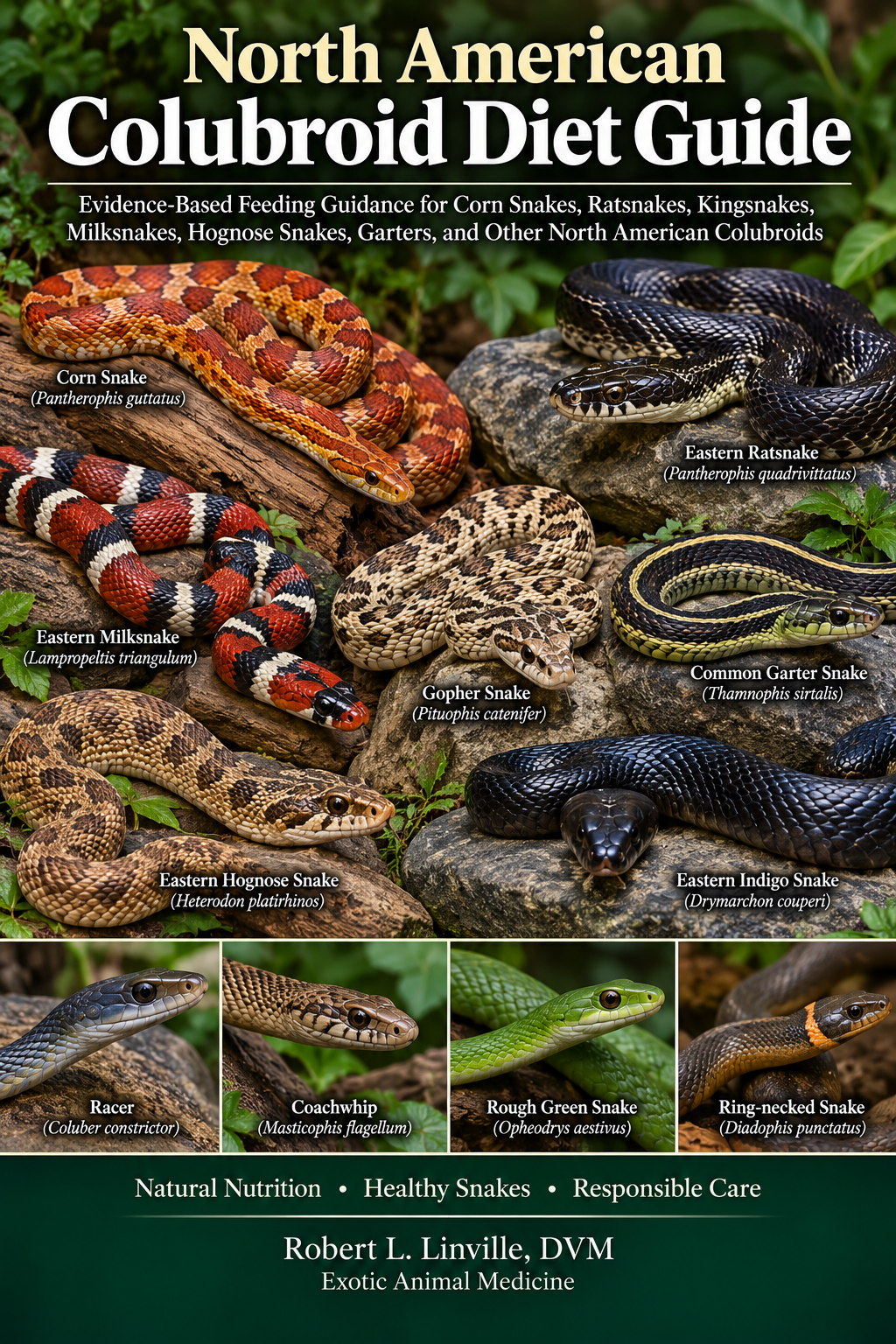
Reptile Nutrition
North American Colubroid Diet Guide
Detailed species- and ecology-based feeding guidance for the unusually diverse North American colubroid assemblage—from rodent-eating constrictors to fish, amphibian, reptile, insect, worm, mollusk, and crayfish specialists.
Scope and Taxonomy
This page covers the species grouped under North American colubroids on the site's Reptile Resources page. Modern taxonomy places these snakes across several families within Colubroidea, including Colubridae, Natricidae, and Dipsadidae. Because feeding ecology often crosses taxonomic boundaries, the guide is organized primarily by natural diet and foraging strategy.
Venomous elapids and vipers are excluded. Other non-North-American colubroids and rear-fanged species are addressed separately on the resource page.
Core Nutrition Principles
- Feed the ecology, not the label. Determine whether the species is primarily mammal-, reptile-, amphibian-, fish-, invertebrate-, worm-, mollusk-, or crayfish-eating before choosing a staple diet.
- Whole prey is preferred for vertebrate-feeding species. Intact prey supplies skeletal mineral, organs, muscle, fat, connective tissue, and water that plain meat does not.
- Do not use appetite as the feeding schedule. Many colubroids remain strongly food-responsive despite adequate or excessive energy intake.
- Use moderate prey size. Prey should be readily swallowed without extreme distension. The largest prey an animal can physically ingest is not necessarily appropriate.
- Adjust intake to body condition. Juveniles require energy for growth; adults generally need less frequent feeding.
- Husbandry is part of nutrition. Digestion and feeding behavior depend on thermal opportunity, hydration, security, seasonal cues, and stress.
- Prefer frozen-thawed or freshly killed vertebrate prey. Live rodents can cause severe injury.
- Do not routinely dust complete vertebrate prey. Supplementation is most relevant to insect-based or otherwise nutritionally incomplete diets and should be species-specific.
- Document meals. Record date, prey species, prey weight/size, response, regurgitation, body weight, shed, fecal output, and breeding/seasonal status.
Prey Categories and How They Differ
Rodents
Mice and rats are practical, nutritionally complete whole prey for many ratsnakes, kingsnakes, Pituophis, and some hognose and indigo snakes. Feeder quality matters; prey animals should have been raised on complete diets.
Birds and Eggs
Birds and eggs are natural prey for many generalist colubroids. Appropriately sized quail or poultry chicks can add whole-prey variety. Eggs alone should not replace whole prey in species that are not egg specialists.
Reptiles and Amphibians
These are important natural foods for kingsnakes, hognose snakes, racers, coachwhips, garter snakes, mud snakes, and others. Avoid routine use of wild-caught prey because of parasites, infectious agents, contaminants, and legal/conservation issues.
Fish
Natural for garter snakes and watersnakes, but fish species differ markedly in thiaminase content and nutrient composition. “Feeder fish” is not a sufficiently precise dietary category.
Earthworms, Slugs, and Snails
Important to garters and essential to many Storeria and Virginia. Use controlled, pesticide-free sources.
Insects and Spiders
Primary foods for green snakes and useful juvenile prey for racers and coachwhips. Insect-based diets require attention to gut loading, calcium, vitamins, and prey variety.
Crayfish
Essential natural prey for queen snakes and crayfish snakes. Soft, recently molted crayfish are especially important to queen snakes.
Specialized Aquatic Vertebrates
Amphiumas, sirens, salamanders, eels, and related prey characterize highly specialized snakes such as Farancia. These species cannot be responsibly reduced to a generic rodent diet.
Meal Size and Feeding Frequency
No scientifically validated universal percentage-of-body-weight rule applies across this group. Prey geometry, prey type, digestive burden, activity, age, and species ecology differ too much. Use the following only as starting frameworks.
| Feeding type | Young animals | Adults | Important adjustment |
|---|---|---|---|
| Rodent-eating generalists | About every 5–10 days | About every 10–21 days | Lengthen interval as growth slows and body condition rises. |
| Small fish/amphibian feeders | About every 3–7 days | About every 5–10 days | Small aquatic prey carry less energy per item than a mouse. |
| Invertebrate specialists | Several small meals/week | Usually 2–4 meals/week | Use prey variety and supplementation strategy rather than one large feeder. |
| Worm/mollusk specialists | Small meals 2–4 times/week | Usually 2–3 times/week | Base intake on actual prey biomass and body condition. |
| Large active generalists | About every 5–10 days | About every 10–21+ days | Captive activity is lower than wild activity; avoid compensatory overfeeding. |
Increase prey size only when the current meal is clearly small relative to the snake, digestion is consistently normal, and body condition remains lean and proportional. Increase the interval when adult weight trends upward, the body becomes cylindrical/soft with poor muscular definition, or the snake remains inactive between frequent large meals.
Feeding Neonates and Juveniles
Juvenile diet is where this group differs most from boas and pythons. Many hatchling colubroids naturally begin on prey very different from their adult captive staple.
- Pantherophis: some hatchlings may recognize lizard or amphibian scent before rodents.
- Lampropeltis: reptile scent can be a strong feeding cue because other snakes and lizards are common prey.
- Thamnophis: earthworms, amphibian scent, and suitable small fish are often biologically appropriate starter foods.
- Heterodon: amphibian scent may be critical, especially in Eastern/Southern hognose snakes.
- Racers/coachwhips: insects and small reptiles can be important early prey.
- Opheodrys: juveniles remain invertebrate feeders; rodents are not a developmental target.
- Storeria/Virginia: earthworms, slugs, and other small soft prey remain the core diet throughout life.
Repeated daily food offerings can condition stress and should not replace diagnosis of why a hatchling is refusing. Review enclosure security, temperature, hydration, seasonal timing, recent transport, shed cycle, and prey recognition. Force-feeding should be reserved for medically justified cases.
Fish, Thiaminase, and Aquatic-Feeding Colubroids
Avoid routine use of high-thiaminase fish such as goldfish, common carp and related cyprinids, fathead minnows/rosy-red minnows, creek chubs, suckers, freshwater smelt, whitefish, burbot, some bullheads/catfish, white bass, sauger, and herring. Fish should be positively identified rather than purchased under a vague label such as “feeder minnow.”
When fish are an important part of the diet, favor reliably identified species with a favorable nutritional profile and lower thiaminase risk, vary the prey source, maintain a cold chain, and avoid prolonged freezer storage. Merck notes that thiamine intake should be increased when frozen-thawed fish make up a substantial proportion of a reptile diet; in a clinical or zoological setting, this should be designed with a reptile veterinarian or zoo nutritionist rather than improvised.
Do not use wild-caught fish as routine feeders. Parasites, infectious agents, contaminants, and misidentification can outweigh any perceived benefit.
Frozen-Thawed Vertebrate Prey Preparation
- Keep prey frozen until needed and maintain a reliable freezer chain.
- Thaw under refrigeration rather than at room temperature for prolonged periods.
- Warm the fully thawed prey before offering; do not feed prey that remains cold or frozen internally.
- Use long feeding tongs and species-appropriate presentation.
- Do not repeatedly rewarm food that has been refused.
- Discard uneaten thawed prey rather than refreezing it.
- Remove uneaten fish, worms, insects, or crustaceans before they degrade water quality or injure the snake.
- Avoid unnecessary handling after a substantial meal; approximately 2–3 days is a reasonable conservative interval for many vertebrate-feeding species.
Detailed Species and Group Feeding Profiles
The following profiles are intentionally more detailed than the general tables. When a profile conflicts with a general rule, the species/group profile should take priority.
Corn Snakes and North American Ratsnakes — Pantherophis
Natural feeding ecology. Corn snakes and ratsnakes are flexible vertebrate predators. Rodents are often important, but natural diets also include birds, bird eggs, amphibians, reptiles, and other small vertebrates. Corn snakes may show strong regional shifts in prey use, and juveniles are more likely than large adults to use ectothermic prey.
Captive diet. Captive-bred mice are an appropriate staple for most healthy captive individuals. Rats may be used for larger adults, but there is no nutritional requirement to change from mice merely because a snake reaches a particular age. Quail chicks or other appropriately sized whole avian prey can provide occasional variety where desired.
Meal size and frequency. Neonates and small juveniles generally do well with modest whole prey every 5–7 days initially, moving toward 7–10 days as growth is established. Larger juveniles commonly fit a 7–14 day interval. Adults usually require substantially less frequent feeding, often about every 10–21 days, with longer intervals appropriate for large, sedentary, or easily overconditioned individuals. These are starting ranges, not fixed prescriptions.
Presentation. These snakes use both ambush and active searching. Offer warmed prey after dusk or during the snake’s normal active period, near a secure travel route or hide. Arboreal ratsnakes may accept prey from an elevated branch or shelf, but prey should be presented in a way that does not require risky climbing while swallowing.
Juvenile considerations. Difficult neonates may respond to lizard or amphibian scent because ectothermic prey can be important early in life. Scenting a mouse with captive-produced lizard/amphibian material is safer than routinely feeding wild prey.
Common errors. The most frequent nutrition problem is chronic overfeeding, especially when a large meal is offered every week throughout adulthood. Avoid judging need by feeding response alone.
Kingsnakes and Milksnakes — Lampropeltis
Natural feeding ecology. Lampropeltis are among the broadest-feeding North American colubroids. Depending on species and locality, natural prey can include snakes, lizards, rodents, birds, eggs, amphibians, and occasionally invertebrates. Ophiophagy is especially important in many kingsnakes.
Captive diet. Captive mice are a practical staple for many individuals, with rats or chicks used as size-appropriate alternatives. A rodent-only captive diet can maintain many common kingsnakes, but occasional whole-prey variety better reflects their generalist ecology. There is no need to feed venomous snakes or wild reptiles.
Meal size and frequency. Hatchlings commonly begin at 5–7 day intervals with small prey; juveniles can usually transition toward 7–10 or 7–14 days; adults often do well around every 10–21 days depending on size, season, sex, and condition. Large, food-driven adults may need even longer intervals.
Presentation. Strong prey responses and ophiophagy make feeding management especially important. Feed individually, never leave two snakes together with food, and wash hands/tongs after handling rodents or other snakes before handling the animal. A consistent target or feeding cue is useful in large individuals.
Juvenile considerations. Some hatchlings prefer reptile-scented prey. Scent transfer from shed skin or captive-produced prey can help transition them without introducing wild-caught reptiles.
Common errors. Overfeeding and accidental cannibalism are greater practical concerns than dietary insufficiency in well-established captive kingsnakes. Do not co-feed housed snakes.
Pine, Bull, and Gopher Snakes — Pituophis
Natural feeding ecology. Pituophis are powerful constrictors and active burrow-searching predators. Rodents and other small mammals are usually dominant prey, but birds, eggs, lizards, snakes, and occasional insects are also documented.
Captive diet. Mice and rats are appropriate staples. Chicks or quail can be offered periodically for dietary variety. Because these snakes naturally exploit mammal burrows, there is no need to mimic subterranean feeding by placing live prey into bedding.
Meal size and frequency. Hatchlings commonly fit 5–7 or 7-day intervals; juveniles 7–10 or 7–14 days; subadults 10–14 days; adults commonly 14–21 days or longer when body condition is high. Very large adults should not automatically remain on weekly meals.
Presentation. Offer thawed, warmed prey near the entrance of a hide or tunnel system. Their vigorous feeding response can be managed with long tongs and a predictable cue.
Juvenile considerations. Small mice usually establish feeding readily. If a neonate refuses repeatedly, first review temperature, hiding opportunities, enclosure security, hydration, and recent handling before escalating food manipulation.
Common errors. Rapid juvenile growth and excessive adult body mass from large weekly meals are common husbandry-driven nutritional problems.
Garter and Ribbon Snakes — Thamnophis
Natural feeding ecology. Thamnophis are highly diverse feeders. Depending on species and population, diets may include earthworms, amphibians, leeches, slugs, snails, insects, crayfish, fish, other snakes, and occasionally small mammals or nestling birds. Ribbon snakes are often more strongly associated with amphibian and aquatic prey than many terrestrial garter snakes.
Captive diet. A varied diet is preferable. Suitable components can include whole earthworms from controlled sources, appropriately selected fish, captive-produced amphibian prey where legal and available, and small whole rodents for species/individuals that readily accept them. Rodents are convenient but should not be assumed to be the sole biologically appropriate food for every Thamnophis.
Meal size and frequency. Small prey items are often taken more frequently than the large meals used for ratsnakes. Neonates may need small meals every 3–5 days initially; growing juveniles commonly every 4–7 days; adults often every 5–10 days depending on prey type and body condition. A meal composed of small worms or fish pieces is not calorically equivalent to a whole mouse, so interval must be adjusted to meal composition.
Presentation. These active foragers respond well to moving prey and strong chemical cues. Earthworms may be offered in a shallow feeding dish; fish can be offered with tongs or in shallow clean water; whole rodents can be warmed. Remove uneaten aquatic foods promptly.
Juvenile considerations. Neonatal garters may start most readily on earthworms, amphibian-scented prey, or small fish. Chopped prey can be useful briefly for tiny neonates, but intact appropriately sized prey is preferred as soon as practical.
Key nutritional caution. Fish-based diets require deliberate fish selection because thiaminase-rich species and prolonged use of frozen fish can cause thiamine deficiency. See the dedicated fish section below.
Watersnakes — Nerodia
Natural feeding ecology. Nerodia are aquatic or semi-aquatic predators whose diets vary markedly by species. Northern watersnakes consume fish and amphibians and may also take crayfish, large insects, leeches, reptiles, birds, and small mammals. Brown watersnakes are strongly piscivorous and may feed largely on catfish, whereas plain-bellied watersnakes can be heavily amphibian-oriented in some regions and more fish-oriented in others.
Captive diet. A diet based on appropriately selected whole fish, amphibian prey from safe captive sources where practical, and other whole prey that the species naturally uses is preferable to an arbitrary mouse-only program. Some individuals can be transitioned partly to rodents, but that should not erase the species’ nutritional and behavioral adaptation to aquatic prey.
Meal size and frequency. Juveniles typically take smaller meals every 3–7 days depending on prey size. Adults often fit about 5–10 day intervals when fed small fish/amphibian prey, or longer when fed larger, energy-dense whole vertebrates. Monitor body condition rather than using a fixed schedule.
Presentation. Offer fish with tongs at the water edge or in a shallow feeding container with clean water. Do not leave dead fish decomposing in the enclosure. Some species naturally herd or pursue fish, but captive feeding should not require uncontrolled live-fish release into the primary habitat.
Key nutritional caution. Thiaminase risk is especially important. Avoid routine use of unidentified feeder minnows, goldfish, rosy-red/fathead minnows, and other high-thiaminase species.
Husbandry interaction. Water quality is part of feeding management; residual fish oils and tissue rapidly degrade water quality and increase bacterial load.
Hognose Snakes — Heterodon
Natural feeding ecology. Hognose snakes are not simply small rodent-eating colubrids. Eastern hognose snakes are strongly associated with amphibian prey, especially toads; published natural-history summaries report toads making up a large proportion of the diet. Western hognose snakes are more flexible and may use amphibians, reptiles, small mammals, eggs, and invertebrates.
Captive diet. Many captive-bred Western hognose snakes thrive on appropriately sized mice, but species and individual history matter. Eastern and Southern hognose snakes can be much more prey-specialized, and rodent acceptance should not be assumed. For difficult animals, scenting with captive-produced amphibian material or using a nutritionally appropriate prey transition plan is preferable to repeatedly offering inappropriate large rodents.
Meal size and frequency. Hatchlings often fit 4–7 day intervals with small prey; established juveniles 5–10 days; adults often 7–14 days, with longer intervals for larger or overweight individuals. Because hognose snakes are relatively stout, visual width alone can encourage oversized meals; maintain moderate prey size.
Presentation. Offer prey at ground level near cover or a burrow entrance. Warm prey may improve rodent acceptance, while amphibian scent can be useful for specialists.
Juvenile considerations. Persistent hatchling refusal is often a prey-recognition issue. Avoid force-feeding as an early response. Confirm husbandry, allow appropriate acclimation, and use species-relevant scenting strategies.
Clinical caution. The evidence base for long-term exclusive mouse diets in strongly amphibian-specialized hognose species is limited. Where a species naturally eats predominantly amphibians, a reptile veterinarian should be involved in designing a sustainable captive diet if rodents are the only readily available prey.
Indigo Snakes and Cribos — Drymarchon
Natural feeding ecology. Drymarchon are large, active, nonconstricting predators with exceptionally broad vertebrate diets. Eastern indigo snakes consume mammals, frogs, lizards, fish, eggs, birds, turtles, and other snakes, including venomous species.
Captive diet. A varied whole-prey program is appropriate: rodents can form an important component, supplemented with chicks/quail and other safe captive-produced vertebrate prey. There is no need to feed venomous snakes or wild-caught reptiles. Avoid reliance on fatty prey or very large meals simply because these snakes are large and food-responsive.
Meal size and frequency. Juveniles commonly require moderate meals every 5–10 days. Subadults often transition toward 7–14 days. Adults usually benefit from conservative feeding, often around every 10–21 days, adjusted for body condition, activity, sex, and season.
Presentation. These are active, visually alert snakes with strong feeding responses. Use long tongs, target training or a consistent feeding cue, and ample space. They do not need prey dangled aggressively.
Variety. Multiple smaller prey types can sometimes better reflect natural foraging than one oversized rodent, but total caloric intake must still be controlled.
Common errors. Obesity from frequent large rodents is a major concern in captive active-foraging snakes whose natural energy expenditure is difficult to reproduce.
Racers — Coluber and Related Racer Lineages
Natural feeding ecology. Racers are fast, active, visually oriented predators. Juveniles often take insects, spiders, small frogs, lizards, snakes, and young rodents; adults broaden to larger reptiles, birds and eggs, mammals, and other vertebrates. They subdue prey by grasping and pinning rather than classic constriction.
Captive diet. A diverse diet is more biologically appropriate than a mouse-only plan, particularly for juveniles. Captive insects, appropriately sized rodents, chicks, and safe captive-produced reptile/amphibian-scented prey can be used depending on species and individual acceptance.
Meal size and frequency. Juveniles may need smaller meals every 3–7 days because many natural prey are small. Adults often fit 7–14 day intervals, with longer gaps when meals are larger or body condition is high.
Presentation. Movement is a major feeding cue. Use tongs to simulate short, natural movement rather than prolonged teasing. Provide visual barriers and room to forage.
Captive challenge. Some racers do poorly in cramped enclosures or under chronic handling stress; anorexia can be an environmental problem rather than a diet problem.
Coachwhips and Whipsnakes — Masticophis
Natural feeding ecology. Coachwhips are highly active pursuit predators. Lizards and other snakes are major prey, with insects, birds and eggs, amphibians, and occasional rodents also taken. Their foraging ecology is fundamentally different from sedentary rodent specialists.
Captive diet. Captive-bred individuals may accept mice, but dietary variety and prey-recognition cues are often important. Insect prey can be useful for juveniles, while appropriately sized chicks and rodents can broaden the adult diet. Reptile scenting may assist transitions.
Meal size and frequency. Small juveniles can be offered modest prey every 3–7 days. Adults generally fit 7–14 day intervals, adjusted for prey size and condition. Avoid compensating for limited captive exercise by feeding as though the snake were covering large daily distances in the wild.
Presentation. Offer during daytime or the species’ active period. These visually oriented snakes respond to movement; short tongs and controlled motion are appropriate, but repeated chasing can increase stress.
Common errors. Too-small enclosure, insufficient visual security, and lack of thermal opportunity can all present as feeding problems.
Rough and Smooth Green Snakes — Opheodrys
Natural feeding ecology. Green snakes are true arthropod specialists, not vertebrate-prey snakes. Rough green snakes consume crickets, grasshoppers, other insects, spiders, and similar mobile invertebrates while foraging visually in vegetation.
Captive diet. Offer a broad rotation of appropriately sized, gut-loaded invertebrates: small crickets, roaches where legal, grasshopper/locust-type feeders where available, silkworms, black soldier fly larvae, small hornworms, and other suitable captive-produced insects. Spiders may be natural prey but are not necessary and wild-caught spiders should not be routinely used.
Supplementation. Unlike whole-vertebrate diets, insect-based diets often have unfavorable calcium-to-phosphorus ratios. Feeder quality, gut loading, appropriate calcium/vitamin supplementation, and UVB/lighting should be managed deliberately with reptile-veterinary guidance.
Meal size and frequency. Because prey are small, juveniles may feed several times per week and adults often 2–4 times weekly depending on prey size, season, and condition. Avoid leaving large numbers of uneaten insects in the enclosure.
Presentation. Feed in planted/branched areas where the snake can visually hunt. Offer several small prey rather than one oversized insect. Ensure prey cannot injure the snake.
Common errors. Feeding only crickets without gut loading or supplementation, using prey that is too large, and trying to convert the species to mice are inappropriate.
Glossy Snakes and Long-Nosed Snakes — Arizona, Rhinocheilus
Natural feeding ecology. Glossy snakes are nocturnal desert predators with a major reptile component; lizards can constitute a large portion of prey, with small mammals and birds also used. Long-nosed snakes likewise consume lizards, small snakes, rodents, and other small vertebrates.
Captive diet. Many captive individuals can be established on mice, but reptile scent may be important for juveniles or newly acquired animals. A rodent-only diet is convenient, yet occasional safe whole-prey variety is reasonable for established adults.
Meal size and frequency. Hatchlings and small juveniles generally 5–7 days; larger juveniles 7–10 days; adults approximately 10–21 days depending on size and condition.
Presentation. Offer at dusk or after dark near a secure hide. Burrowing substrate and reduced disturbance are often more important to feeding success than repeatedly changing prey.
Juvenile considerations. Lizard scenting can be useful when rodents are not recognized. Avoid wild-caught lizards.
Ring-Necked Snakes — Diadophis
Natural feeding ecology. Ring-necked snakes are small predators of salamanders, frogs, lizards, earthworms, and juvenile snakes. Diet can vary strongly with locality; some populations feed heavily on salamanders.
Captive diet. These are not suitable candidates for a generic pinky-mouse regimen. Appropriate prey may include earthworms and species-relevant captive-produced amphibian/invertebrate prey. Long-term captive feeding is challenging because the natural diet may be narrow and the snakes are small.
Meal size and frequency. Very small prey can be offered every 3–7 days, with frequency adjusted to prey mass and body condition.
Presentation. Offer prey under cover or at the edge of moist hides during evening activity. Excessive disturbance can suppress feeding.
Clinical caution. Because standardized captive diets are poorly studied, long-term maintenance should be conservative and monitored for weight loss, poor sheds, weakness, or reproductive decline.
Brown Snakes, Red-Bellied Snakes, and Earth Snakes — Storeria, Virginia
Natural feeding ecology. These small secretive snakes are largely vermivorous and molluscivorous. Brown snakes feed heavily on earthworms, slugs, and snails, with smaller amounts of salamanders, grubs, and beetles. Their jaw and tooth morphology is adapted to soft-bodied prey.
Captive diet. Use pesticide-free earthworms from controlled culture, appropriately sized slugs/snails from safe captive sources where available, and other biologically appropriate soft prey. Rodents are not an appropriate staple.
Meal size and frequency. Small meals 2–4 times weekly may be appropriate because individual prey items are tiny; adjust to actual snake size and prey biomass.
Presentation. Feed in a shallow dish beneath cover or in a moist feeding area. Prevent worms from disappearing deeply into substrate where they cannot be monitored.
Nutritional caution. A single prey species may not provide adequate long-term micronutrient variety. Data are limited, so these snakes are better suited to experienced keepers with access to appropriate prey cultures.
Queen Snakes and Crayfish Snakes — Regina and Related Natricines
Natural feeding ecology. Queen snakes specialize heavily on crayfish and preferentially take freshly molted crayfish. Striped crayfish snakes are even more specialized and adults feed nearly exclusively on crayfish.
Captive diet. These species require access to appropriately sized, uncontaminated crayfish from controlled sources. Soft, recently molted crayfish are especially important for queen snakes. A mouse-based substitute is not biologically equivalent.
Meal size and frequency. Offer small prey multiple times per week for juveniles and roughly 1–3 times weekly for adults depending on prey size and condition. Because crayfish differ greatly in shell hardness and edible mass, body-condition monitoring is essential.
Presentation. Offer in shallow clean water with secure footing. Remove uneaten crustaceans promptly; live crayfish can injure small snakes.
Captive suitability. Long-term husbandry is specialized and should not be attempted without a reliable source of safe crayfish and good aquatic hygiene.
Mud Snakes and Rainbow Snakes — Farancia
Natural feeding ecology. Mud snakes are highly specialized predators of aquatic salamanders such as amphiumas and sirens; frogs, tadpoles, and occasional fish may also be taken. Rainbow snakes are likewise associated with highly specialized aquatic prey, especially eels in much of their range.
Captive diet. These are among the least suitable North American colubroids for a conventional captive diet. Rodents are not a biologically appropriate default. Sustainable long-term maintenance requires legal, disease-controlled access to species-relevant aquatic vertebrate prey or a carefully designed substitute program supervised by a reptile veterinarian or zoological nutritionist.
Meal size and frequency. There is insufficient evidence for a standardized captive schedule. Use small-to-moderate species-appropriate meals and monitor weight, hydration, fecal quality, and body condition closely.
Presentation. Prey should be offered in a manner consistent with aquatic/fossorial behavior, usually at night or in dim conditions, with meticulous water quality.
Clinical caution. These snakes should not be forced onto nutritionally unvalidated diets merely for convenience.
Seasonal, Reproductive, and Clinical Situations
Seasonal fasting
Temperate North American colubroids may reduce or stop feeding in response to photoperiod, temperature, reproductive state, or seasonal physiology. A stable adult with appropriate body condition may tolerate a seasonal fast, but fasting accompanied by progressive weight loss, dehydration, respiratory signs, oral disease, abnormal feces, regurgitation, neurologic signs, or persistent behavioral change warrants veterinary evaluation.
Breeding males
Males of many temperate species reduce food intake during courtship. Do not repeatedly disturb an otherwise healthy breeding male with daily prey offerings.
Gravid females
Some females reduce feeding late in follicular development or gravidity. Provide hydration and appropriate nesting conditions. After oviposition or parturition, resume feeding with a moderate meal rather than immediately offering an oversized “recovery” meal.
Regurgitation
Repeated regurgitation is not a normal feeding preference problem. Review prey size, post-feeding temperature, handling, infection, parasites, obstruction, gastrointestinal disease, and systemic illness. Repeatedly refeeding too soon can worsen esophageal/gastric irritation.
Assisted feeding
Assisted or tube feeding should be used only when medically indicated and when husbandry, dehydration, obstruction, oral disease, parasites, and systemic illness have been considered. It is not a substitute for identifying a species-specific prey preference.
Practices to Avoid
- Using a mouse-only diet for every North American colubroid regardless of ecology.
- Feeding live rodents when frozen-thawed or freshly killed prey is available.
- Routine use of goldfish, rosy-red/fathead minnows, or unidentified feeder fish.
- Wild-caught amphibians, reptiles, fish, worms, or insects from areas exposed to pesticides or pollutants.
- Plain muscle meat as a long-term substitute for intact vertebrate prey.
- Routine vitamin/mineral dusting of complete whole rodents or birds.
- Trying to “power feed” juveniles for maximum growth.
- Continuing weekly large meals throughout adulthood simply because the snake accepts them.
- Leaving live insects, crayfish, fish, or rodents unattended with a snake when they can cause injury.
- Force-feeding before correcting husbandry and identifying a medical indication.
Weight and Body-Condition Monitoring
| Finding | Interpretation | Response |
|---|---|---|
| Steady proportional juvenile growth | Usually appropriate intake | Continue; increase prey gradually rather than abruptly. |
| Rapid weight gain with soft/cylindrical body | Likely excessive calories | Reduce meal size or lengthen interval. |
| Adult continuing to gain weight month after month | Often overfeeding | Reassess total prey biomass and activity. |
| Prominent spine, reduced epaxial muscle, progressive weight loss | Underfeeding or disease | Review diet and husbandry; veterinary evaluation if persistent. |
| Repeated regurgitation | Abnormal | Stop routine feeding and investigate medically. |
| Fish-fed snake with tremor/ataxia/torticollis | Possible thiamine deficiency | Urgent reptile-veterinary evaluation. |
| Seasonal fast with stable adult weight | May be physiologic | Monitor weight, hydration, and behavior rather than force-feed. |
Selected References and Source Framework
- Merck Veterinary Manual. Nutrition in Snakes. Full review September 2025.
- Merck Veterinary Manual. Nutrition in Reptiles. Current online reference.
- Merck Veterinary Manual. Nutritional, Metabolic, and Endocrine Diseases of Reptiles. Thiamine deficiency in piscivorous snakes.
- Merck Veterinary Manual. Environmental Diseases and Traumatic Injuries of Reptiles. Live-prey trauma prevention.
- University of Michigan Animal Diversity Web: Pantherophis guttatus, Lampropeltis getula, Pituophis catenifer, Thamnophis sirtalis, Nerodia species, Heterodon, Drymarchon couperi, Coluber constrictor, Masticophis flagellum, Opheodrys aestivus, Arizona elegans, Diadophis punctatus, Storeria dekayi, Regina species, and Farancia abacura.
- The Reptile Database. Current taxonomy and nomenclature for North American colubroids.
- Dr. Bob's Pet Health Information. North American Colubroid Resources.
Evidence note: Controlled nutritional trials are limited for many uncommon colubroids. Where direct nutrient-requirement data are unavailable, recommendations are based on documented natural diet, veterinary snake-nutrition principles, zoological feeding practice, prey safety, body-condition monitoring, and conservative clinical judgment.