Snake Husbandry & Preventive Care
Boa and Related Snake Care Guide
A comprehensive husbandry and preventive-care guide for boas and other members of the booid radiation. It combines general principles for captive snakes with extensive group-specific guidance for boa constrictors, anacondas, tree boas, rainbow boas, Malagasy boas, sand boas, rosy boas, rubber boas, Pacific boas, and related species. Particular emphasis is placed on usable enclosure space, thermal and humidity gradients, lighting, climbing or burrowing opportunities, water, enrichment, handling safety, quarantine, reproduction, and recognition of common health problems.
Quick Care Guide
Good boa husbandry creates choices rather than one fixed environment. The snake should be able to select warmer or cooler, drier or more humid, exposed or concealed, elevated or ground-level locations appropriate to its ecology. Environmental gradients are more useful than attempting to make every part of an enclosure identical.
| Care area | General starting principle | Major exceptions |
|---|---|---|
| Space | Provide enough usable length for full-body extension and enough width/height for normal turning, locomotion, and species-appropriate climbing or burrowing. | Tree boas require substantial vertical and horizontal perch space; anacondas require professional-scale land-and-water systems; fossorial boas need deep usable substrate. |
| Heat | Create a thermostat-controlled warm zone and a cooler retreat; measure both air and relevant surfaces. | Rubber boas are cool-adapted; tropical Boa, Corallus, and Epicrates generally require warmer conditions. Chronic overheating is particularly dangerous to cool-adapted species. |
| Humidity | Match humidity to species and provide airflow. A humid hide can supplement, but not replace, appropriate environmental humidity. | Rainbow and many tree boas require high humidity without stagnant wet air; sand and rosy boas require much drier overall conditions. |
| Light | Provide a predictable day/night cycle and bright daytime illumination with shaded retreats. | UVB is not a substitute for correct diet or heat. Low-level UVB can be offered safely when exposure is species-appropriate and shade is always available. |
| Water | Fresh potable water should normally be continuously available in a stable, clean container. | Anacondas require a true aquatic component large enough for immersion and movement; arboreal species may benefit from elevated water access and misting but still need clean drinking water. |
| Security | Use escape-proof, lockable housing and protected heat sources. | Large constrictors require redundant locks, planned servicing procedures, and appropriately trained assistance. |
| Social housing | House singly as the default. | Temporary pairing for managed breeding is different from permanent cohabitation and requires close observation. |
| Health | Track weight, body condition, feeding, shedding, feces/urates, behavior, and environmental readings. | Unexplained respiratory signs, regurgitation, neurologic abnormalities, progressive weight loss, severe dysecdysis, burns, or trauma require veterinary evaluation. |
Scope, Taxonomy, and Identification
This guide follows the practical Booidea framework already used by the companion diet guide and the site's reptile resource page. Modern snake taxonomy continues to change, and older references may use different family, subfamily, species, or subspecies names. The husbandry question is not merely what family name appears on a label, but what ecological lineage the animal represents.
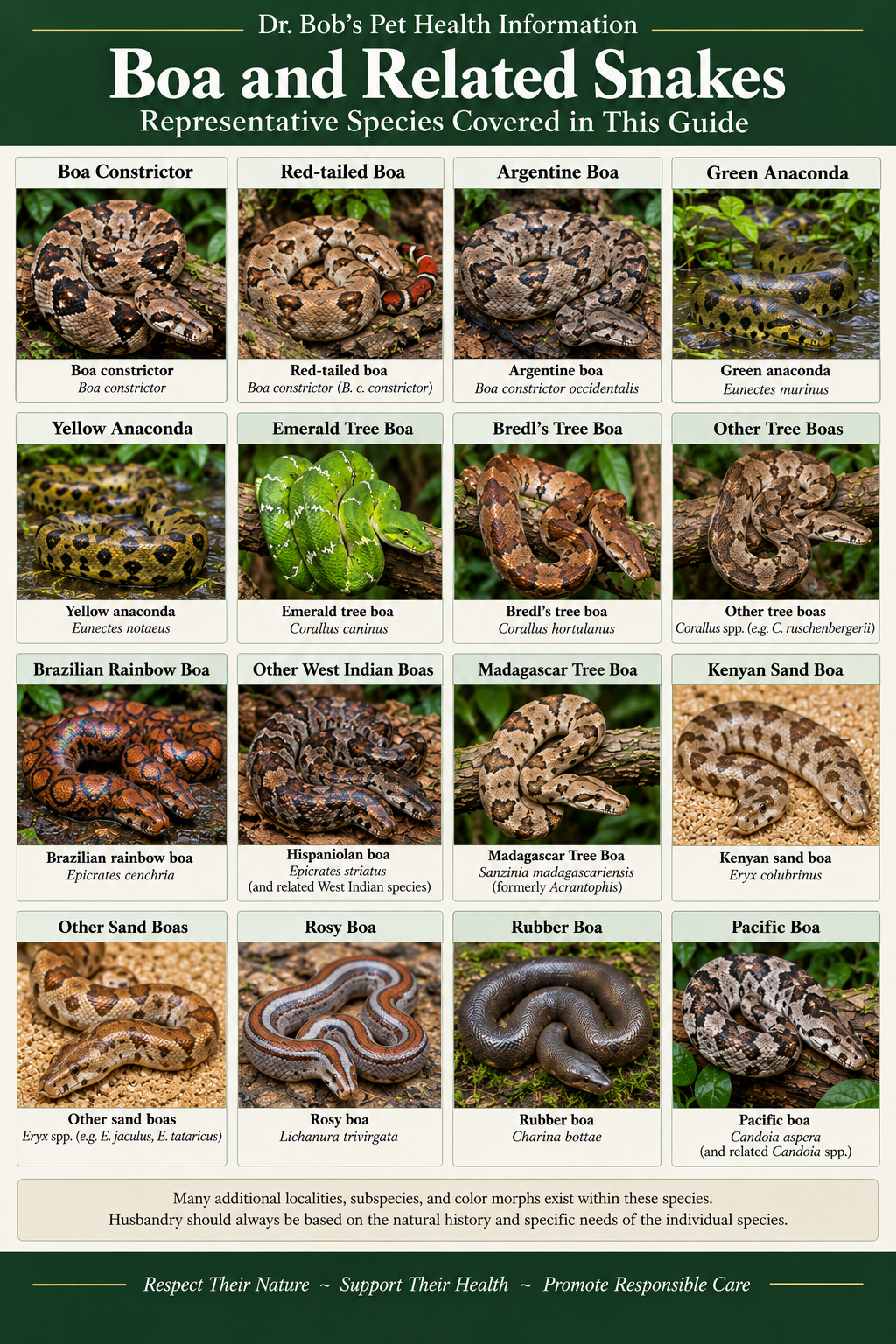
The principal groups covered are Boa; Eunectes; Corallus; Epicrates and related West Indian boids; Malagasy Acrantophis and Sanzinia; Eryx; Lichanura; Charina; and Candoia. They range from small temperate burrowers to giant tropical aquatic predators. The current reptile resource directory similarly emphasizes that the group spans small desert burrowers, arboreal rainforest snakes, and giant semi-aquatic anacondas.
Before the Snake Arrives
- Identify the animal accurately. Common names such as “red-tail boa,” “rainbow boa,” “tree boa,” and “sand boa” can hide important species or locality differences.
- Build the adult enclosure first whenever practical. A juvenile's temporary enclosure should not become a reason to postpone planning for adult size.
- Run the enclosure empty. Confirm daytime and nighttime temperatures, humidity cycling, ventilation, thermostat operation, lighting timers, and water stability before introducing the snake.
- Plan quarantine. New reptiles should not share equipment, airspace where practical, cleaning tools, water containers, or feeding implements with established reptiles until quarantine is complete.
- Locate an experienced reptile veterinarian. Establish this before an emergency.
- Plan for longevity. Many boas live for decades. Smithsonian sources report 20–30 years in wild boa constrictors, while other zoological data report captive lifespans extending substantially longer in some individuals.
- Plan for adult handling. Large boas and especially anacondas require more than a larger cage; they require a safe facility and a handling protocol.
Captive Origin, Conservation, and Legal Issues
Prefer documented captive-bred animals when available. Wild collection can carry conservation, welfare, parasite, and acclimation concerns. CITES status and local possession rules vary by species and jurisdiction. Some large constrictors are restricted in particular states, municipalities, housing situations, or facilities. Never release an unwanted captive snake. Smithsonian specifically cautions that released nonnative constrictors can become invasive and harm native ecosystems.
Housing Philosophy and Enclosure Size
Enclosure dimensions should be based on usable space, not gallons. A suitable enclosure lets the snake fully extend, turn without repeatedly contacting walls, move between thermal zones, use hides without blocking movement, and perform the locomotor behaviors expected for its species. Arboreal species need both vertical space and long, stable horizontal or diagonal perches; fossorial species need depth; semi-aquatic species need functional water volume plus dry land.
For common boa constrictors, the Royal Veterinary College recommends at least a 6 × 3 × 2 ft adult vivarium and emphasizes the largest practical enclosure, thermal gradient, ventilation, hides, and climbing branches. The Smithsonian describes boa constrictors as both terrestrial and arboreal, with juveniles more arboreal than adults. These observations support retaining meaningful climbing opportunities even for heavy adults.
Escape Prevention and Enclosure Safety
Boas are strong, persistent animals capable of exploiting surprisingly small weaknesses. Doors should latch positively; sliding panels should not spread under pressure; ventilation grilles must be mechanically secure; and cable penetrations should be too small for the snake's head. Large animals warrant redundant locking systems.
All heating equipment must be inaccessible or guarded. Thermostats regulate heat output but do not physically prevent a snake from contacting a dangerously hot bulb, ceramic emitter, heat panel edge, or damaged cable. Heat rocks should not be used. Electrical equipment around anaconda pools or large water systems requires appropriate ground-fault protection and professional installation.
Temperature and Thermoregulation
Snakes are ectotherms. They need access to a range of temperatures rather than a single “tank temperature.” Merck lists a preferred optimal temperature zone of approximately 28–31°C (82–88°F) for boa constrictors and 70–95% humidity as a broad veterinary reference range. The RVC recommends a maximum basking area around 32°C with a cool end around 24°C for boa constrictors. These values are useful for Boa, but they must not be copied to cool-climate rubber boas or all other booids.
Use overhead radiant heat for a broad warm zone where practical. Every primary heat source should be thermostat-controlled. Provide enough distance and enclosure volume that the cool end remains meaningfully cooler. Night temperatures may decline according to species, season, age, reproductive state, and health; tropical species should not be subjected to inappropriate chilling, while cool-adapted species should not be maintained at tropical boa temperatures.
Environmental Measuring Devices and Procedures
Boa husbandry should be based on measured conditions at the level actually occupied by the snake, not on heater settings, room temperature, or a single gauge mounted near the enclosure ceiling. Use separate instruments for air temperature, surface temperature, humidity, and—when ultraviolet lighting is used—UV Index. Recheck the enclosure whenever the room season, ventilation, substrate depth, lamp height, furnishings, or heating equipment changes.
Thermostats: controlling the heat source
- Every powered heat source should be thermostat controlled. Dimming or proportional thermostats are preferred for most radiant heat panels, deep-heat projectors, and non-light-emitting sources; use the thermostat type recommended for the device.
- Secure the thermostat probe so the snake cannot move, cover, or coil around it. Place it where it will reliably detect the hottest accessible effect of the controlled heater. Probe placement is part of the safety system and should not be treated as the enclosure's only temperature measurement.
- After installation, verify the thermostat with an independent thermometer and infrared surface readings. A thermostat controls equipment; it does not prove that the complete enclosure gradient is correct.
- Any lamp, emitter, panel, cable, or other hot component inside the enclosure must be protected by a rigid guard that the snake cannot push against the heat source.
Air temperature: digital probe thermometers
Use at least two independent digital probe thermometers: one in the warm zone and one in the cool retreat zone. Arboreal species should have an additional probe at the principal elevated resting/perching level because the upper enclosure can be substantially warmer than the floor.
- Place the warm-side air probe in free air near the warm hide or primary resting zone, not directly touching the heater, basking stone, wall, or substrate.
- Place the cool-side probe in the coolest regularly accessible retreat area.
- For tree boas, add a probe adjacent to a frequently used perch in the upper one-third of the enclosure.
- Allow the enclosure to operate for several hours before interpreting readings. Check morning, mid-day, evening, and overnight values during initial setup.
- Use maximum/minimum memory or a data logger when possible. This is particularly useful during hot weather, cold weather, seasonal cycling, and after equipment changes.
Surface temperature: infrared thermometer
An infrared thermometer is used to measure surface temperature, not air temperature. It is especially useful for basking shelves, rock surfaces, branches, hides, pool edges, and substrate directly beneath overhead heat.
- Measure from close enough that the instrument's measurement spot is smaller than the target surface; consult the meter's distance-to-spot specification.
- Check several points rather than a single spot, including the hottest surface the snake can physically contact.
- Shiny metal, reflective surfaces, glass, and some wet surfaces can produce misleading infrared readings. When a reading appears inconsistent, confirm it with a contact probe or a matte reference surface.
- Do not point the infrared thermometer through glass or acrylic and assume it is reading the surface behind the barrier.
Humidity: digital hygrometers and microclimates
Use a digital hygrometer rather than relying on an analog dial. For tropical or highly humidity-sensitive species, two sensors are preferable: one in the general enclosure and one in the cooler or more humid portion. Relative humidity changes with temperature, so record humidity together with temperature.
- Place the primary humidity sensor away from direct mist spray, the water bowl, and wet substrate unless the goal is specifically to measure that microclimate.
- After misting, note both the peak humidity and how quickly the enclosure returns toward baseline. A healthy cycle is usually more useful than keeping every surface continuously wet.
- Periodically compare duplicate sensors. A consistently abnormal reading should be checked against a known reference or replaced.
- A sealed saturated-salt check can be used to evaluate a questionable hygrometer: a properly prepared saturated sodium-chloride environment should stabilize close to 75% relative humidity at ordinary room temperature. This is a verification method, not an enclosure target.
UVB measurement when UVB is provided
If UVB lighting is used, a UV Index meter designed for reptile UVB assessment (for example, a Solarmeter 6.5) is the most useful way to determine the exposure that actually reaches the animal. Lamp percentage alone does not account for reflector design, mesh, distance, lamp age, or enclosure geometry.
- Measure at the height of the snake's back on the intended basking surface or perch, with the sensor aimed directly toward the lamp.
- Measure the center of the exposure zone and then several points outward to confirm that the animal has both a usable UV zone and deep shade approaching zero UV Index.
- Repeat after changing the lamp, reflector, mesh, perch height, or enclosure furniture, and periodically as the lamp ages.
- Never move a branch or shelf closer to a lamp without re-measuring the UV Index and the surface temperature at that new position.
Additional useful instruments
- Digital scale: obtain a baseline weight after acclimation and monitor growing juveniles and adults at regular intervals. Monthly weights are useful for most stable adult pets; more frequent monitoring may be appropriate during illness, reproductive management, or feeding problems.
- Timers: use timers for visible light and UVB so the photoperiod remains consistent and can be adjusted deliberately for seasonal species.
- Data logger: optional but very useful for recording 24-hour temperature and humidity patterns, especially in large enclosures or rooms.
- Pool thermometer and water-quality testing: essential for anacondas and other installations with large recirculating pools. Measure water temperature and follow the filtration system's testing requirements for waste products and disinfectant chemistry where applicable.
Lighting, Photoperiod, UVB, and Visible Light
A predictable light/dark cycle supports circadian and seasonal behavior. Day length can be adjusted modestly to reflect natural seasonality for species where this is appropriate. Bright daytime visible light improves environmental definition and can support natural activity patterns, while hides and shaded areas allow the snake to withdraw.
Snakes do not require high-output desert UVB. However, modern husbandry increasingly offers low-level UVB to many captive snakes as an optional component of a more naturalistic light environment. It should be installed only with correct distance, shielding, and shaded escape zones. UVB does not correct inappropriate diet, temperature, or calcium balance. Never place UV-emitting lamps behind ordinary glass or plastic that blocks UVB while assuming the animal is receiving useful exposure.
Humidity, Ventilation, and Hydration
Humidity should be thought of as a gradient and daily cycle. Constantly wet, poorly ventilated housing is not equivalent to tropical humidity. High-humidity species still need air exchange and surfaces that can dry. Conversely, desert and semi-arid boas should not be kept so dry that they develop chronic dehydration or repeated incomplete sheds.
Use calibrated digital hygrometers rather than relying on appearance. Humid hides are particularly useful for fossorial and semi-arid species and during ecdysis. For tropical Corallus and Epicrates, humidity must be balanced with ventilation; persistent condensation, saturated substrate, or a musty enclosure indicates that water input and air exchange need reassessment.
Water and Soaking
Provide clean drinking water continuously for most species. Use a container heavy enough not to overturn and large enough for the individual to drink comfortably. Many boas will occasionally soak, particularly during shedding, heat, or irritation, but repeated prolonged soaking can also signal mites, excessive heat, dehydration, or other husbandry problems.
Anacondas are fundamentally different: water is part of the enclosure, not merely a bowl. The aquatic area must permit meaningful immersion and movement while also allowing easy exit onto dry land. Water quality, filtration, drainage, and safe servicing become major husbandry systems in their own right.
Substrate Choices, Depth, and Drainage
Substrate should be selected for the snake's ecology, humidity requirement, burrowing behavior, sanitation needs, and life stage. No single bedding is ideal for every boa. The substrate should permit normal movement and resting behavior while helping create appropriate moisture gradients without remaining foul, compacted, or chronically waterlogged.
Paper for quarantine, illness, and short-term monitoring
Unprinted paper, butcher paper, or paper towels are the preferred temporary substrate for newly acquired, parasitized, medically compromised, or post-procedure snakes when close observation is important. Paper makes feces, urates, mites, regurgitated material, blood, and abnormal discharges easy to see. It is inexpensive and easily replaced, but it is not an ideal permanent substrate for species that normally burrow or use complex forest-floor microhabitats.
Humid tropical terrestrial substrates
For Boa constrictor, Boa imperator, rainbow boas, and many tropical ground-oriented boas, use approximately 3–5 in (8–13 cm) of a moisture-buffering substrate. Suitable choices include coconut husk/coir, cypress-type mulch, additive-free organic topsoil, fine orchid bark, or blended soil systems. A useful naturalistic mixture is topsoil combined with coconut fiber and a smaller amount of fine bark, covered with leaf litter. The lower layer can remain slightly moist while the exposed surface is allowed to dry between watering or misting.
Arboreal tropical substrates
Emerald tree boas, Amazon tree boas, and arboreal Candoia need a substrate that moderates humidity without turning the enclosure into a saturated box. Approximately 2–4 in (5–10 cm) of coconut husk, soil/coir blend, or another absorbent forest-floor substrate works well. Concentrate moisture in part of the enclosure and maintain strong cross-ventilation. Arboreal species still descend, so the floor should remain safe, clean, and usable.
Dry and seasonally dry terrestrial substrates
Argentine boas and other seasonally dry forms do well on a well-drained soil system rather than permanently damp tropical mulch. A mixture of additive-free topsoil, washed play sand, and a modest amount of excavator clay can create a firm but diggable surface. Keep the principal surface dry while providing a separate humid retreat during shedding or when the species needs a localized moist microclimate.
Fossorial sand-boa substrates
Kenyan and other sand boas should receive a deep, loose, structurally safe burrowing layer, commonly 4–6 in (10–15 cm) or deeper. Washed sand can be used, but a sandy-soil mixture often holds shallow burrows better and provides a more varied texture. The surface should be dry and friable; a small humid hide or deeper slightly moist pocket can provide the higher humidity that occurs below the surface in natural burrows.
Rocky desert and rosy-boa substrates
Rosy boas benefit from dry sandy soil, washed sand/soil blends, or soil/sand/clay mixes approximately 3–4 in (8–10 cm) deep. Secure cork, slate, and artificial-rock crevices should provide the principal shelter. Any heavy stone must rest on the enclosure floor or a fixed support—not on top of loose substrate where a burrowing snake could undermine it.
Cool woodland substrates for rubber boas
Rubber boas should not be set up as hot desert snakes. Use 4–6 in (10–15 cm) of cool, burrowable forest-floor substrate such as additive-free topsoil mixed with coconut fiber and leaf litter. Maintain part of the lower layer slightly moist and provide moss, cork, flat wood, and tight cool refuges while leaving other areas drier.
Bioactive and planted systems
Bioactive enclosures can work for suitable species, but they require more than adding soil and insects. The keeper must provide appropriate soil depth, drainage where needed, ventilation, plant safety, access for spot cleaning, and a plan for replacing contaminated substrate. A drainage layer or false bottom must be physically inaccessible to the snake. Bioactive systems are not recommended for initial quarantine because parasites, fecal abnormalities, and regurgitation are harder to detect and sanitation is more complicated.
Drainage and moisture management
- In humid enclosures, add water to selected areas rather than soaking the entire floor.
- Provide drainage only when the enclosure construction can safely contain and remove excess water. Standing water beneath substrate can become anaerobic and foul.
- For planted or heavily misted habitats, a sealed drainage layer may be useful, but it must be separated from the snake by a rigid barrier and maintained so water can be removed.
- Ventilation should not be sacrificed merely to keep the humidity number high. Increase substrate depth, humid refuges, plant cover, or controlled misting before sealing off necessary airflow.
- Spot-clean feces and urates promptly. Replace visibly contaminated substrate around waste rather than simply mixing it into the bedding.
Substrates and materials to avoid
- Cedar and aromatic pine shavings because volatile oils can be irritating or toxic.
- Corncob, crushed walnut shell, sharp gravel, or other hard ingestible particulate bedding that can injure the mouth or gastrointestinal tract.
- Very dusty substrates that coat the nostrils, mouth, eyes, or heat-sensing structures.
- Fertilized potting soil, soils containing pesticides, herbicides, manure, perlite, vermiculite, wetting agents, or unknown additives.
- Loose substrate contaminated with mold, mites, spilled prey fluids, persistent odor, or standing water.
- Adhesive shelf liners or exposed tape where the snake can contact the sticky surface.
Feeding around loose substrate
Loose substrate can adhere to wet prey. Present prey on a clean plate, flat piece of cork, feeding tile, or other substrate-free surface when practical. Avoid routine handling immediately before feeding merely to move a snake to a separate container; for many established snakes, a clean feeding surface within the normal enclosure reduces unnecessary handling while still limiting substrate ingestion.
Hides, Climbing, Burrowing, and Enrichment
At minimum, terrestrial boas should have secure hides in both warmer and cooler portions of the enclosure. A hide should allow close body contact without trapping the animal. Visual barriers, cork, sturdy branches, ledges, artificial or safe live plants, and changes in elevation increase usable complexity.
Climbing structures must support the snake's full weight. Tree boa perches require special attention to diameter, orientation, stability, and access to multiple thermal zones. Sand boas need deep substrate and should not be forced to remain exposed. Enrichment should encourage normal exploration, climbing, burrowing, scent investigation, and choice without compromising safety.
Handling and Restraint
Allow a new snake to acclimate before routine handling. Support the body rather than allowing long sections to hang unsupported. Approach predictably and avoid grabbing the head unless restraint is medically necessary. Arboreal boas may defend perches vigorously; forcing them off a branch can damage teeth, jaw, neck, or spine. Encourage voluntary movement onto a hook or support when possible.
Avoid routine handling immediately after feeding and during obvious digestive distention. A snake in shed may have reduced vision and increased defensiveness. Children should not handle large constrictors without close adult control, and very large snakes should never be treated as ordinary single-person pets.
Large-Constrictor Safety
Large boas and anacondas can cause serious injury even without aggression. Risk management should be based on the animal's actual size and strength rather than temperament history. Large individuals should be serviced with another capable adult present; very large specimens require a formal institutional-style protocol. Avoid placing a large constrictor around the neck. Do not allow free roaming around children, vulnerable adults, or other pets. Feeding should be performed with long tools and clear separation between food cues and routine husbandry.
Anacondas are especially unsuitable for conventional home housing because adult size, aquatic requirements, enclosure servicing, and restraint can exceed what a private keeper can safely provide.
Normal Behavior and Activity
Many boas are crepuscular or nocturnal, but captive activity depends on temperature, season, hunger, reproduction, security, and enclosure complexity. A healthy snake may spend long periods concealed. Normal resting is different from persistent immobility caused by inappropriate temperature, dehydration, pain, or systemic disease.
Boa constrictors are habitat generalists and may use ground, burrows, branches, and riparian areas; juveniles are often more arboreal. Amazon tree boas commonly occupy vegetation above ground and use branch-based ambush postures. Rainbow boas typically use low branches and ground-level rainforest habitat.
Sex Identification
Sexual dimorphism varies by group. Tail shape and spur size can suggest sex in some boas but are not always definitive. Probing or eversion should be performed only by an experienced person because incorrect technique can injure the hemipenes, cloaca, or tail. Ultrasonography can help identify reproductive anatomy and follicular activity in mature animals.
Reproduction and Neonatal Care
Most boas give birth to live young, but reproductive timing, gestation, litter size, and seasonal triggers vary greatly. Breeding should not be attempted simply because two animals are mature enough to reproduce. Females should have appropriate body condition and access to precise thermal choices before, during, and after gestation.
Gravid arboreal boas may alter basking behavior and require stable perches and minimal disturbance. Neonates should be housed securely with species-appropriate humidity and microclimates. Detailed neonatal feeding belongs in the companion diet guide. Record birth date, mass, first shed, first meal, defecation, and growth.
Species and Group Comparison
| Group | Primary ecology | Key husbandry emphasis | Captive-care level |
|---|---|---|---|
| Boa — B. imperator, B. constrictor, B. occidentalis | Terrestrial to semi-arboreal tropical and subtropical generalists; climate and seasonality vary by species/locality | Large floor area, climbing, warm gradient, species-specific humidity and seasonality; Argentine boas generally drier/more seasonal than equatorial red-tailed boas | Intermediate to advanced; size-dependent |
| Eunectes | Giant semi-aquatic | Professional-scale land/water enclosure, water quality, large-constrictor safety | Advanced/institutional |
| Corallus | Arboreal tropical | Perch design, vertical gradients, humidity-airflow balance, minimal forced handling | Intermediate to advanced |
| Epicrates | Humid tropical terrestrial/semi-arboreal | High but ventilated humidity, hydration, substantial floor space and low climbing | Intermediate |
| Malagasy boas | Terrestrial/semi-arboreal Madagascar habitats | Species-specific moisture, secure large enclosure, conservation awareness | Intermediate |
| Eryx | Fossorial arid/semi-arid | Deep substrate, dry surface conditions, warm gradient, secure hides | Beginner-intermediate by species |
| Lichanura | Rocky arid/semi-arid | Dry ventilated enclosure, secure crevices, moderate warmth, avoid chronic dampness | Generally manageable |
| Charina | Cool temperate, secretive/fossorial | Cooler temperatures, moisture refuges, seasonal biology, avoid overheating | Specialized |
| Candoia | Tropical Pacific terrestrial/arboreal | Species-specific humidity, secure cover, climbing where appropriate, careful acclimation | Intermediate to advanced |
1. Genus Boa — Common/Central American Boas, Red-Tailed Boas, Argentine Boas, and Related Forms
The genus Boa contains closely related but husbandry-relevant species and geographic forms. They share the general body plan of a large terrestrial to semi-arboreal constrictor, but adult size, rainfall pattern, seasonality, and humidity tolerance vary. Preserve reliable locality information and do not assume every snake sold as a “red-tail boa” is the same species.
General Boa habitat framework
- Provide enough floor area for full-body extension and purposeful movement, with sturdy climbing shelves or branches even for heavy adults.
- Provide at least a warm hide and cool hide, plus visual barriers or a third retreat so the snake can remain secure while moving through the thermal gradient.
- Use thermostat-controlled overhead radiant heat whenever possible; guard all internal heat sources.
- Keep the water basin on the cool half unless a species-specific reason dictates otherwise.
- Use substrate deep enough to buffer humidity and allow minor digging, but do not keep the entire floor wet.
Common and Central American Boa — Boa imperator
Adult size and origin: Boa imperator is native from Mexico through Central America into northwestern South America, including Colombia and Ecuador, with island populations as well. Adult size varies strongly with sex and locality. Many adults are approximately 5–8 ft (1.5–2.4 m); females are usually heavier and longer, while some locality forms remain distinctly smaller and occasional animals exceed these typical dimensions.
Habitat setup — step by step
- Select the adult enclosure early. A typical adult should have approximately 6 × 3 × 3 ft (183 × 91 × 91 cm); large females should receive 8 × 4 × 4 ft (244 × 122 × 122 cm) or larger. Smaller locality animals can use proportionally smaller housing only if the enclosure still permits full extension, climbing, hiding, and a true thermal gradient.
- Build the thermal end first. Install a guarded, thermostat-controlled overhead heater over one end. Place a broad, stable basking shelf or floor surface beneath it, then put the warm hide adjacent to—rather than directly against—the hottest surface.
- Create the cool retreat. Put the cool hide at the opposite end, with the water basin nearby. The snake should be able to reach the water and cool hide without crossing an exposed open floor.
- Add substrate. Use about 3–5 in (8–13 cm) of coconut husk, cypress-type mulch, or a soil/coir/bark blend. Keep the lower layer slightly moist as needed while allowing the surface to dry.
- Add climbing structure. Use at least one body-thick anchored branch, broad shelf, or cork structure 12–24 in (30–60 cm) above the floor. Juveniles use climbing structure heavily; adults often prefer broad shelves and low robust branches.
- Add visual cover. Cork flats, artificial or live nontoxic plants, and leaf litter reduce exposure. Leave a clear travel path long enough for the snake to extend.
Environmental targets
- Basking surface: about 88–90°F (31–32°C).
- Warm-side air: about 82–86°F (28–30°C).
- Cool-side air: about 75–80°F (24–27°C).
- Night: generally 75–80°F (24–27°C), with modest locality-appropriate seasonal variation.
- Relative humidity: usually 55–75%, with a humid retreat and temporary rise during shedding rather than continuously wet surfaces.
- Photoperiod: approximately 12 hours as a baseline, adjusted gradually for season/locality.
Ongoing care
Keep B. imperator singly housed. Monitor body condition carefully because chronic overfeeding and obesity are common. Continue offering climbing opportunities as the snake matures instead of converting the adult habitat into a bare floor box. Check locks, branch anchors, heater guards, and thermostat probes routinely because adult boas are strong enough to move inadequately secured equipment. A persistent change in soaking, climbing, hiding, respiratory sounds, appetite, or shed quality should trigger a full environmental review and veterinary assessment when indicated.
True Red-Tailed Boa — Boa constrictor
Adult size and origin: True red-tailed boas are South American Boa constrictor from tropical and subtropical regions east and west of the Andes, including the Guianas, Brazil, Peru, Bolivia, and adjacent areas depending on the population. Many adults are approximately 6.5–10 ft (2–3 m); females are generally larger and more massive, and exceptionally large individuals may exceed this range. Island/locality forms can be smaller.
Habitat setup — step by step
- Plan for a substantial adult enclosure. 8 × 4 × 4 ft (244 × 122 × 122 cm) or larger is appropriate for a large adult; smaller adults should still have enough length to extend and enough width to turn without folding tightly.
- Install overhead radiant heat at one end over a broad shelf or basking surface. Place the warm hide directly beside the main warm zone so security and warmth are available together.
- Build the cool half with a deep hide, large stable water basin, and dense visual cover. The water container should permit voluntary soaking but should not consume most of the floor area.
- Add 3–5 in (8–13 cm) of moisture-buffering substrate topped with leaf litter. Keep deeper layers slightly moist when needed while maintaining a dry, clean surface and good airflow.
- Install heavy horizontal/diagonal branches or shelves that can support the full adult body weight. Anchor them to structural walls or framing rather than relying on friction.
- Place bright visible lighting and optional measured low-to-moderate UVB over the warm/climbing end, leaving shaded retreats and a low-UV cool end.
Environmental targets
- Basking surface: 88–90°F (31–32°C).
- Warm ambient: 82–86°F (28–30°C).
- Cool retreat: 76–80°F (24–27°C).
- Night: usually mid-to-upper 70s°F (about 24–26°C).
- Humidity: commonly 60–80%, with reliable humid refuges for humid-origin forms and drying cycles that prevent stagnant wet conditions.
Ongoing care
True red-tailed boas often mature into large, powerful snakes. Use two-person handling precautions whenever the animal's size, feeding response, or temperament warrants it. Review body condition rather than feeding to maximum growth. During shedding, increase access to a humid refuge instead of soaking the entire enclosure. Large adults should be weighed periodically on an appropriate platform scale and their enclosure hardware inspected for fatigue or loosening.
Argentine Boa — Boa occidentalis
Adult size and origin: The Argentine boa is native primarily to the Gran Chaco and adjacent dry/semi-arid regions of Argentina and Paraguay, with records extending into neighboring areas. It is one of the larger Boa forms; males are often around 6–8 ft (1.8–2.4 m), while large females may approach or exceed 8–10 ft (2.4–3 m). It is a powerful, heavy-bodied snake and is more seasonal than equatorial rainforest boas.
Habitat setup — step by step
- Provide approximately 6 × 3 × 3 ft for a moderate adult and 8 × 4 × 4 ft or larger for large females. Prioritize floor area while retaining low climbing and basking structure.
- Use a well-drained 3–5 in (8–13 cm) soil/sand/clay or dry soil/coir substrate. The surface should not remain chronically damp.
- Put a broad warm basking stone or shelf at one end with a low warm hide immediately adjacent. Use a thermostat-controlled overhead heater.
- Create a cooler, heavily covered opposite end with a large ground-level hide and the main water basin.
- Add a separate humid hide filled with lightly damp sphagnum, soil, or other moisture-retentive material so the snake can select higher humidity without raising the entire enclosure.
- Use broad cork slabs, rooted-looking wood, low stout branches, and leaf litter/visual cover to mimic sheltered Chaco ground structure.
Environmental targets and seasonality
- Basking surface: 88–90°F (31–32°C).
- Warm-side air: about 80–84°F (27–29°C).
- Cool side: about 72–78°F (22–26°C).
- Healthy established adults can experience cooler nights, commonly into the upper 60s to low 70s°F (about 20–23°C), while regaining an appropriate daytime gradient.
- Ambient humidity: generally about 45–65%, with localized humidity and temporary increases during shed.
- Photoperiod can be more seasonal than for equatorial boas, approximately 13–14 hours in summer and 10–11 hours in winter when a controlled seasonal program is desired.
Ongoing care and conservation
Do not maintain Argentine boas under permanently hot, wet rainforest conditions. Seasonal adjustment should be gradual; intentional winter cooling is appropriate only for healthy, well-established animals and is not required simply to keep a pet. Preserve breeder and legal-origin documentation. Because this taxon has experienced habitat loss and historical collection pressure, current conservation and trade requirements should be confirmed before transfer or transport.
Other Boa localities and forms
Regional and island Boa populations can differ substantially in adult size, rainfall pattern, prey ecology, and seasonal temperature. Husbandry should follow reliable locality information whenever it is known. Keep breeder records even if taxonomy later changes; locality data remain biologically useful when scientific names shift.
Common husbandry problems across genus Boa
- Using the label “red-tail boa” for all Boa and assuming identical adult size or climate.
- Chronic overfeeding and obesity.
- Enclosures too short for full extension and normal locomotion.
- Removing climbing opportunities when the snake becomes heavy-bodied.
- Maintaining the entire enclosure at basking temperature instead of creating a gradient.
- Keeping all substrate continuously wet in an attempt to raise humidity.
- Thermal burns from unguarded lamps, emitters, panels, or displaced thermostat probes.
- Ignoring locality-specific seasonality, particularly in Argentine and other subtropical populations.
2. Anacondas — Eunectes
Anacondas are semi-aquatic boas whose adult size, water requirements, strength, and sanitation demands make them unsuitable for conventional home snake cages. The practical husbandry model is a secure room-sized or institutional land-and-water habitat. Recent taxonomic debate has proposed splitting northern and southern green-anaconda populations; the Reptile Database currently treats the proposed Eunectes akayima as a synonym of E. murinus. Husbandry should therefore be based on the animal's known geographic origin and size rather than the name alone.
Green Anaconda — Eunectes murinus
Adult size and origin: Green anacondas occur across tropical northern and central South America, especially the Orinoco and Amazon basins and seasonally flooded Llanos, with populations also in the Guianas, Peru, Bolivia, Paraguay, and Trinidad. Females are dramatically larger than males. Large females commonly reach several meters and may exceed 15 ft (4.5 m); exceptional animals are reported much larger. Males are generally much smaller. Adult mass and girth are as important as length when planning housing and handling.
Habitat setup — facility scale
- Design the enclosure before acquisition. The dry-land section should have at least one dimension approximately equal to the adult snake's length, enough width for unrestricted turning, and additional service space. For large females, this means a room-scale installation.
- Build a separate pool. The pool must allow complete submersion, turning, and purposeful swimming. Use sloped or stepped entry rather than a vertical wall that requires the snake to haul itself over an edge.
- Provide drainage and filtration. The pool should be plumbed so it can be drained, scrubbed, disinfected, rinsed, and refilled without moving the snake through public or unsecured areas. Mechanical and biological filtration may reduce waste between water changes but does not replace water-quality monitoring and periodic complete maintenance.
- Create multiple haul-out areas. Provide a broad dry warm shelf, a cooler dry retreat, and at least one covered hide or visual barrier large enough for the entire animal.
- Use protected overhead heat. Heating equipment should be inaccessible to the snake and serviceable from outside the enclosure. Large snakes can destroy ordinary lamp guards and unsecured fixtures.
- Provide keeper separation. Use a shift gate, lockable secondary holding area, or barrier system so cleaning and pool service do not require sharing an open enclosure with a large adult.
Environmental and water targets
- Warm dry basking surface: approximately 86–90°F (30–32°C).
- General air: approximately 78–84°F (26–29°C) with cooler retreats.
- Water: generally in the upper 70s°F to low 80s°F (about 25–28°C), adjusted to the individual, facility, and veterinary/zoological management plan.
- Humidity: tropical and moderate-to-high, but with strong air exchange and fully dry haul-out surfaces.
- Photoperiod: about 12 hours as a baseline, with seasonally appropriate adjustment.
Ongoing care and safety
Inspect skin folds and ventral surfaces routinely for dermatitis, retained shed, abrasions, and pressure injury. Monitor water quality, fecal contamination, appetite, body condition, and respiratory effort. Large green anacondas should be handled only under a written multi-person safety protocol with appropriate barriers and emergency procedures. They are best regarded as professional or institutional animals.
Yellow Anaconda — Eunectes notaeus
Adult size and origin: Yellow anacondas are native to the Paraguay–Paraná drainage and associated wetlands of southern South America, including Paraguay, Bolivia, Brazil, and northern Argentina. Adults commonly reach about 8–13 ft (2.4–4 m), with large females occasionally approaching 15 ft (4.6 m). They remain far smaller than the largest green anacondas but are still very strong semi-aquatic snakes.
Habitat setup
- Use a very large terrestrial enclosure or dedicated room with a separate pool large enough for full submersion and turning. A conventional 6-ft snake cage is not an appropriate adult habitat.
- Provide a dry basking shelf, a large cool hide, and a second sheltered land area so the snake does not have to choose between security and temperature.
- Construct the pool with rounded edges, reliable filtration, and an easy exit ramp. Keep electrical components and plumbing inaccessible to the snake.
- Use washable sealed flooring or a deep, replaceable terrestrial substrate in the dry area. Avoid loose bedding that will continually wash into filtration equipment.
- Provide substantial visual barriers and low, extremely strong structural furnishings rather than fragile decorative branches.
Care emphasis
Yellow anacondas experience strong seasonal wet/dry cycles in nature. Captive care should provide warm daytime conditions, cooler retreats, clean water, and secure dry resting surfaces without maintaining the entire enclosure as a constantly hot swamp. Monitor seasonal appetite changes without assuming prolonged anorexia is normal. Defensive feeding responses can be intense; establish consistent shift and feeding procedures and never rely on free handling of a large adult during routine service.
Other Eunectes
Bolivian and dark-spotted anacondas are less common in private collections. Their husbandry should be based on verified species identity, adult size, and local wetland ecology rather than copied directly from green-anaconda care. All require substantial water access, secure dry land, excellent sanitation, and large-constrictor safety planning.
3. Tree Boas — Corallus
Tree boas require enclosure design around usable perch geometry, vertical thermal gradients, high-quality ventilation, and behavioral security. Height alone is not enough. The snake must be able to rest in a normal coil on a stable horizontal perch without being forced into the hottest or brightest part of the enclosure.
Emerald Tree Boa — Corallus caninus
Adult size and origin: Emerald tree boas are native to lowland tropical forests of the Amazonian and Guianan regions of South America, including northern Brazil, the Guianas, southern Venezuela and Colombia, eastern Peru and Ecuador, and nearby areas. Adults commonly reach 5–7 ft (1.5–2.2 m), with females usually heavier.
Habitat setup — step by step
- Use an enclosure approximately 6 × 2 × 4 ft (183 × 61 × 122 cm) or larger for a typical adult. Length is important because a purely narrow vertical cage restricts movement and thermal choice.
- Install several removable, easily disinfected horizontal perches of different diameters. The principal resting perch should be approximately body thickness and positioned so the snake can form a relaxed saddle coil.
- Place the warmest perch under—but not excessively close to—a guarded overhead radiant heat source. A second perch should cross the middle zone and a third should remain cooler.
- Add dense visual cover around, but not directly on, resting sites. Artificial foliage and cork panels help the snake feel concealed while allowing the keeper to inspect it.
- Use 2–4 in (5–10 cm) of humidity-buffering substrate such as coconut husk or soil/coir. Allow the surface to dry between misting events.
- Provide a stable floor-level water bowl and, if the individual uses it, an elevated water cup near a common perch. Neither should create chronically wet surroundings.
Environmental targets
- Warm perch/surface: about 82–86°F (28–30°C); avoid intense hot spots.
- General daytime air: about 75–82°F (24–28°C).
- Night: commonly 72–76°F (22–24°C).
- Humidity: typically 60–80%, with short post-misting peaks and good drying/airflow cycles.
- Low-level UVB may be offered when measured, with abundant shade and no requirement that the snake sit directly beneath the lamp.
Ongoing care
Minimize unnecessary handling. Inspect the snout, labial pits, ventral body surface, and tail for abrasions or retained shed. Perches should be removable for cleaning and positioned so feces do not routinely contaminate lower perches or the water bowl. Chronic high temperatures and stagnant humidity are important preventable risks. Appetite and stool should be monitored because arboreal boas can conceal early weight loss beneath their resting coil.
Amazon / Garden Tree Boa — Corallus hortulanus
Adult size and origin: Amazon tree boas occur broadly through northern South America and parts of southern Central America and the southern Caribbean, including the Guianas, Amazonia, Brazil, Colombia, Venezuela, Trinidad and Tobago, and associated regions. Adults are usually around 4–5 ft (1.2–1.5 m), though individuals may approach 6 ft (1.8 m) or more.
Habitat setup
- Use approximately 4 × 2 × 4 ft (122 × 61 × 122 cm) or larger for most adults; larger, more active individuals benefit from additional length.
- Install a lattice of horizontal and diagonal branches from near floor level to the upper third. Unlike a display cage with one decorative branch, the enclosure should provide multiple routes through warm, neutral, and cool zones.
- Concentrate radiant heat over one upper side, leaving the opposite upper side cooler. Measure the temperature at each commonly used perch.
- Use dense foliage and at least one elevated sheltered retreat. Include a usable floor with 2–4 in (5–10 cm) of moisture-buffering substrate and cork cover.
- Provide floor and optional elevated water. Mist foliage lightly enough to create drinking droplets and a humidity rise, then allow surfaces to dry.
Environmental targets and care
- Warm perch: approximately 84–88°F (29–31°C).
- General daytime air: about 76–82°F (24–28°C).
- Night: approximately 72–76°F (22–24°C).
- Humidity: usually 60–80% with good ventilation and cycling rather than constant saturation.
Amazon tree boas are often more active and more defensive than emerald tree boas. Use a hook or target to move the snake rather than grasping it from a perch. Provide enough branch complexity that normal nocturnal exploration is possible; do not interpret daytime resting as proof that a small enclosure is adequate.
4. Rainbow Boas — Epicrates and Related West Indian Boas
Continental rainbow boas are humid tropical or seasonally humid terrestrial/semi-arboreal snakes. Current taxonomy separates several forms that were historically grouped under Epicrates cenchria. Brazilian and Colombian rainbow boas should therefore be identified separately rather than treated as interchangeable “rainbow boas.”
Brazilian Rainbow Boa — Epicrates cenchria
Adult size and origin: Brazilian rainbow boas occur through much of tropical South America, especially the Amazon basin and adjacent regions of Brazil, the Guianas, Peru, Bolivia, Colombia, Venezuela, and nearby areas. Adults are commonly 5–7 ft (1.5–2.1 m).
Habitat setup — step by step
- Provide approximately 6 × 3 × 3 ft (183 × 91 × 91 cm) or larger for a robust adult, with enough floor length for full extension.
- Use 4–6 in (10–15 cm) of moisture-retentive but aerated substrate such as soil/coir/bark with leaf litter. Keep lower layers slightly moist but do not leave the surface swampy.
- Place a warm hide at one end under a guarded overhead heater and a deep cool hide at the opposite end.
- Add a humid retreat on the middle/cool half, large cork rounds/flats, low branches, and dense cover. These snakes use the floor heavily but will climb, especially when younger.
- Place a large, stable water bowl on the cool side and keep it scrupulously clean.
Environmental targets
- Warm area/surface: about 84–88°F (29–31°C).
- Cool side: about 75–80°F (24–27°C).
- Night: low-to-mid 70s°F (about 22–24°C).
- Humidity: commonly 70–85%, particularly important for juveniles, but with strong ventilation and drying of exposed surfaces.
Ongoing care
The principal husbandry error is confusing high humidity with constant wetness. Monitor substrate odor, skin condition, and respiratory signs. Young rainbow boas can dehydrate quickly in overly dry conditions, while stagnant wet enclosures predispose to dermatitis and respiratory disease. Provide multiple secure hides and limit unnecessary handling during acclimation.
Colombian / Brown Rainbow Boa — Epicrates maurus
Adult size and origin: Epicrates maurus occurs from Costa Rica and Panama through northern South America, including Colombia, Venezuela, the Guianas, Trinidad and Tobago, and northern Brazil. Adults commonly measure about 4–6 ft (1.2–1.8 m), with some approaching 2 m.
Habitat setup and care
- Use approximately 4 × 2 × 2 ft (122 × 61 × 61 cm) for a modest adult and 5–6 ft (152–183 cm) long housing for large females or particularly active animals.
- Use 3–5 in (8–13 cm) of soil/coir/bark or comparable tropical substrate with leaf litter.
- Provide warm and cool hides, a humid retreat, low branches/cork structures, and visual barriers.
- Use a gentler warm zone than for desert boas: approximately 82–86°F (28–30°C) warm side and 74–79°F (23–26°C) cool side, with low-to-mid 70s°F nights for established adults.
- Maintain approximately 65–80% humidity with periodic higher peaks, while allowing the surface to dry between misting.
Colombian rainbow boas generally tolerate somewhat more seasonal variation and slightly less uniformly high humidity than Brazilian rainbow boas. Monitor actual shed quality and hydration rather than forcing a fixed number. Like other rainbow boas, they should have secluded daytime retreats and opportunities for nocturnal ground-level exploration.
West Indian boas — Chilabothrus and related Caribbean lineages
Many snakes historically called West Indian Epicrates are now placed in Chilabothrus. This group includes species with very different adult sizes—from relatively modest island boas to very large Cuban and Hispaniolan forms—so a single enclosure formula is inappropriate. Confirm the exact scientific name and island of origin before establishing temperature, humidity, enclosure dimensions, and legal documentation. In general, provide a secure enclosure with both floor and climbing space, moderate tropical temperatures, sheltered retreats, and humidity matched to the species' island ecology rather than copying Brazilian rainbow-boa targets.
5. Malagasy Boas — Acrantophis and Sanzinia
Madagascar's boas include large terrestrial species and semi-arboreal tree boas. They are not ecologically interchangeable: southwestern Dumeril's boas occur in considerably drier habitat than eastern green tree boas. Captive-bred, traceable origin is strongly preferred because of conservation and trade concerns.
Dumeril's Boa — Acrantophis dumerili
Adult size and origin: Dumeril's boas are native to southern and southwestern Madagascar, especially seasonally dry forest, spiny-thicket, and semi-arid habitats. Adults commonly reach 5–7 ft (1.5–2.1 m); large females may approach 8 ft (2.4 m) or more.
Habitat setup
- Use at least 6 × 3 × 2–3 ft (183 × 91 × 61–91 cm) for a typical adult; large females benefit from 8 × 4 ft floor area.
- Add 4–6 in (10–15 cm) of soil/sand/clay, dry tropical soil, or soil/coir mixture with a thick layer of leaf litter. The substrate should permit shallow burrowing and remain drier on top.
- Place a broad basking stone or shelf on the warm end with a low warm hide beside it.
- Provide a very large cool hide, cork slabs, root structures, and a separate humid retreat. Dumeril's boas often push under furnishings; heavy structures must rest on the enclosure base.
- Add low robust branches or shelves for occasional climbing but emphasize horizontal floor space.
Environmental targets and care
- Basking surface: 86–90°F (30–32°C).
- Warm ambient: 80–84°F (27–29°C).
- Cool zone: 72–78°F (22–26°C).
- Night: roughly 68–75°F (20–24°C) for healthy adults.
- Humidity: generally 50–70%, with a humid retreat and short-term rise during shed.
These boas are prone to obesity if fed for rapid growth. Maintain a defined waist/body contour and track weight over time. Because they often remain buried or concealed, check the snake's skin and body condition deliberately rather than assuming inactivity is normal health.
Madagascar Ground Boa — Acrantophis madagascariensis
Adult size and origin: This large boa is native to northern Madagascar, including the Nosy Bé region. Adults commonly reach about 7–9 ft (2.1–2.7 m), and large females may approach 10 ft (3 m). It is the largest native snake of Madagascar.
Habitat setup
- Plan for at least 8 × 4 × 3 ft (244 × 122 × 91 cm) for a large adult, with additional floor area whenever possible.
- Use 4–6 in (10–15 cm) of deep soil/coir/leaf-litter substrate with a drier exposed surface and a moist retreat zone.
- Install an overhead warm zone at one end with a broad shelf or stable stone and a large warm hide.
- At the cool end, provide a second very large hide, water basin, and dense cork/root cover.
- Add low, extremely strong branches and logs. Juveniles may climb more than heavy adults, but adults should retain access to low elevation structure.
Care
Use a moderate tropical gradient similar to Dumeril's boa but with somewhat greater access to humidity, particularly for northern/humid-origin animals. Keep the enclosure well ventilated and monitor for obesity, respiratory disease, dermatitis, and retained shed. Large adults warrant the same handling precautions used for other powerful 8–10 ft constrictors.
Madagascar Tree Boa — Sanzinia madagascariensis
Adult size and origin: Sanzinia madagascariensis is endemic to eastern Madagascar and nearby northern localities such as Nosy Bé. Adults are commonly 4–6 ft (1.2–1.8 m), with larger females possible. It is semi-arboreal rather than strictly canopy-dwelling and regularly uses the floor.
Habitat setup
- Use approximately 4 × 2 × 4 ft (122 × 61 × 122 cm) or larger for an adult, with both usable floor area and vertical structure.
- Install several thick horizontal and diagonal branches from near floor level to the upper third, plus high and low hides.
- Place the guarded warm source over one upper side so the animal can choose a warm perch without heating the entire upper enclosure.
- Use 3–4 in (8–10 cm) of moisture-retentive soil/coir/bark substrate and dense foliage; allow surface drying between misting events.
- Provide floor water and an elevated water cup if the individual uses it.
Environmental targets
- Daytime ambient: approximately 75–82°F (24–28°C).
- Warm perch: about 84–88°F (29–31°C).
- Cool areas: 72–77°F (22–25°C).
- Night: about 68–75°F (20–24°C).
- Humidity: cycle around 60–80%, rising temporarily after evening misting.
Do not keep the entire cage hot. Sanzinia are forest boas that require cool retreats and high-quality airflow. A low UVB zone may be provided if measured, with deep shade always available.
Western Madagascar / Nosy Komba Tree Boa — Sanzinia volontany
Adult size and origin: Sanzinia volontany is recognized by the Reptile Database as a distinct western Madagascar species associated with the Nosy Komba/Ankarafantsika region. It is generally more brown/orange and often more robust than the eastern green form. Adults commonly reach roughly 5–7 ft (1.5–2.1 m).
Habitat setup and care
Use a larger version of the S. madagascariensis habitat—approximately 5 × 2.5 × 4–5 ft (150 × 75 × 122–150 cm) or larger—with substantial floor area, multiple body-thick branches, and several covered retreats. Use the same moderate forest temperature philosophy, avoiding intense heat, and provide humidity around 60–80% with drying cycles. Preserve locality and legal-origin records because Malagasy boa taxonomy and conservation status make traceability particularly important.
6. Sand Boas — Eryx
Kenyan / East African Sand Boa — Eryx colubrinus
Adult size and origin: Eryx colubrinus occurs across arid and semi-arid parts of northeastern and eastern Africa, including Egypt, Sudan, Ethiopia, Eritrea, Kenya, Somalia, and Tanzania. Captive Kenyan forms are commonly 12–24 in (30–60 cm); large females may approach 30–36 in (75–90 cm), while males are usually smaller.
Habitat setup — step by step
- Use at least 30 × 18 × 18 in (76 × 46 × 46 cm) for an average adult; 36 × 18 × 18 in (91 × 46 × 46 cm) or larger is preferable for large females.
- Provide 4–6 in (10–15 cm) or more of loose burrowing substrate. A washed sand/soil mixture generally holds shallow tunnels better than very fine pure sand.
- Place an overhead heat source over one end. Put a flat stone or slate surface over or beside a partially buried warm retreat.
- Keep the opposite end cooler. Add a humid hide there with lightly damp moss or soil so the snake can reach a moist microclimate without wetting the entire habitat.
- Partly bury cork flats at different depths and add small stable wood or rock structure. The snake should be able to travel both below and above the surface.
- Use a small stable water bowl on the cool side to avoid unnecessarily elevating enclosure humidity.
Environmental targets
- Basking surface: 93–95°F (34–35°C).
- Cool zone: approximately 78–83°F (26–28°C), with a somewhat cooler night period.
- Ambient humidity: often around 30–50%, but with access to a humid retreat/deeper moist microclimate.
Ongoing care
Do not assume a fossorial snake needs no enrichment. Sand boas will surface, explore, and use buried cork and low cover. Check for compacted substrate, fecal contamination below the surface, stuck shed at the tail tip, and excessive weight gain. If the snake remains continuously at the extreme warm or cool end, remeasure the gradient rather than assuming that behavior is normal.
Other Eryx
Russian, Indian, Arabian, and other sand boas differ in adult size, winter cooling, and climate. The Kenyan values above are a starting framework only. Confirm species and locality before applying a seasonal cooling program or choosing the final enclosure size.
7. Rosy Boas — Lichanura
Rosy Boa — Lichanura trivirgata
Adult size and origin: Rosy boas are native to the rocky deserts, shrublands, washes, and chaparral of southern California, southwestern Arizona, Baja California, and western Sonora. Adults generally reach about 24–44 in (60–112 cm), with locality and sex influencing size.
Habitat setup — step by step
- For most adults, use 36 × 18 × 18 in (91 × 46 × 46 cm) or larger. Large locality forms approaching 40–44 in should receive about 48 × 24 × 24 in (122 × 61 × 61 cm).
- Provide 3–4 in (8–10 cm) or more of dry sandy soil or a topsoil/play-sand/clay mixture.
- Build two tight crevice-style hides using cork flats, secured slate, or artificial rock: one at the warm end and one at the cool end.
- Place a flat basking stone above or immediately beside the warm hide and heat it from overhead with a thermostat-controlled source.
- Add a separate humid hide on the cool half. The rest of the enclosure should remain dry and well ventilated.
- Add cholla, ghostwood, low branches, and sparse plant cover, leaving several sheltered pathways instead of a completely open desert floor.
- Keep the small water bowl on the cool side.
Environmental targets
- Basking surface: about 85–90°F (29–32°C).
- Cool zone: about 75–80°F (24–27°C).
- Night: heat can usually be reduced or off; healthy adults from appropriate localities can tolerate seasonal drops toward 60–70°F (16–21°C).
- Ambient humidity: generally below 60%, with a localized humid hide available.
Ongoing care and seasonality
Rosy boas are often excellent feeders and can become overweight. Maintain a lean muscular outline and avoid feeding simply because the snake remains willing to eat. Winter cooling is primarily a breeding/seasonal-management tool and is not required for every pet. If seasonal cooling is used, it should be gradual and restricted to healthy, appropriately prepared animals with known locality history.
8. Rubber Boas — Charina
Northern Rubber Boa — Charina bottae
Adult size and origin: Rubber boas are native to western North America from southern British Columbia through Washington, Oregon, California, Idaho, western Montana, Nevada, northern Utah, and western Wyoming. Adults are usually about 15–25 in (38–64 cm), although documented animals can range roughly 14–33 in (35–84 cm). They inhabit cool forests, meadows, riparian areas, rock outcrops, and deep moist soils.
Habitat setup — step by step
- Use approximately 36 × 18 × 18 in (91 × 46 × 46 cm) or larger, emphasizing floor area and microhabitat diversity rather than heat.
- Add 4–6 in (10–15 cm) of additive-free topsoil mixed with coconut fiber and leaf litter. Keep part of the lower layer slightly moist while leaving other areas drier.
- Provide multiple tight cool hides using cork bark, flat wood, leaf litter, and moss. A partly buried damp hide should be available year-round.
- If room temperature is low, provide only a gentle thermostat-controlled warm retreat at one end. The majority of the enclosure must remain cool.
- Place the water bowl on the cool side and shield the enclosure from direct window sun.
- Add low branches, bark slabs, and rooted-looking cover; rubber boas can climb and should not be treated as strictly subterranean.
Environmental targets
- General active-season air: about 65–75°F (18–24°C).
- Optional warm retreat during digestion/gestation: approximately 78–82°F (26–28°C).
- Cool retreat: about 55–65°F (13–18°C) when seasonally available.
- Avoid sustained high temperatures approaching 85–90°F (29–32°C). The snake must always be able to escape warmth.
- Provide moderate ambient humidity and distinctly moist cool refuges rather than a uniformly wet cage.
Ongoing care and winter biology
Rubber boas are the major thermal exception in this guide. Overheating is a more immediate risk than failure to provide tropical warmth. Winter dormancy around 40–50°F (4–10°C) has been used by experienced keepers and researchers, but it is a specialized seasonal or breeding technique and should not be attempted casually. Verify local wildlife laws before acquiring native-origin animals; collection and possession rules can differ substantially by jurisdiction.
9. Pacific Boas — Candoia
Pacific boas vary from heavy ground-oriented snakes to slender, strongly arboreal forms. Common names are inconsistent, and historically imported animals were often sold without precise locality. Confirm the scientific name whenever possible before selecting the enclosure.
Solomon Island Ground Boa — Candoia paulsoni
Adult size and origin: Candoia paulsoni occurs through the Solomon Islands and associated Melanesian islands. Males are commonly smaller; many adults are approximately 3–4.5 ft (0.9–1.4 m), while large females can be substantially longer and heavier.
Habitat setup
- Use approximately 4 × 2 × 2 ft (122 × 61 × 61 cm) for a typical adult and increase enclosure length/width for a large female.
- Provide 3–5 in (8–13 cm) of tropical soil/coir/coconut-husk substrate with leaf litter. Maintain moisture in part of the substrate while allowing surface drying.
- Install warm and cool ground hides, multiple cork flats, root structures, and low stout branches.
- Use dense foliage or visual barriers so this cryptic snake can move end to end without remaining fully exposed.
- Place the main water bowl on the cool side; use light evening misting as needed to create a humidity cycle.
Environmental targets and care
- Warm area: about 82–86°F (28–30°C).
- Cool area: about 74–78°F (23–26°C).
- Night: roughly 72–76°F (22–24°C).
- Humidity: generally 60–80% with ventilation and drying cycles.
Newly acquired or historically imported Candoia may arrive dehydrated, parasitized, or highly stressed. Begin on paper in a quiet quarantine enclosure with multiple opaque hides, obtain baseline weight and fecal testing as indicated, and transition to naturalistic substrate only after the animal is stable and feeding.
Pacific / New Guinea Tree Boa — Candoia carinata
Adult size and origin: Candoia carinata occurs in New Guinea, the Bismarck Archipelago, the Moluccas, Sulawesi and nearby Indonesian/Papuan islands. Adults are generally about 3–4 ft (0.9–1.2 m), with some reaching roughly 4.3 ft (1.3 m). This species is partly arboreal and typically more slender than C. paulsoni.
Habitat setup
- Use at least 3 × 2 × 3 ft (91 × 61 × 91 cm) for a modest adult; larger animals benefit from 4 × 2 × 4 ft or more.
- Install multiple horizontal and diagonal branches from near floor level to the upper third. Include at least one elevated hide and dense foliage around resting areas.
- Place a gentle guarded heat source over one upper side rather than creating an intense hot basking spot.
- Use 2–4 in (5–10 cm) of tropical humidity-buffering substrate and leaf litter. Maintain moist pockets but permit exposed surfaces to dry.
- Provide a floor water bowl and, when used by the individual, an elevated cup.
Environmental targets and care
Maintain a moderate tropical gradient similar to other Candoia: warm perch/area about 82–86°F (28–30°C), cooler areas 74–78°F (23–26°C), and humidity around 60–80% with strong airflow. Low-level measured UVB may be offered, but extensive shade is essential. Because these boas can be defensive and stress-sensitive, minimize forced handling and use removable perches or a hook/target to shift them for cleaning.
Other Candoia
Other Pacific boas differ in adult size, island climate, and degree of arboreality. Do not extrapolate one Candoia setup to every species. Verify identity and origin first, then scale the enclosure and humidity/temperature cycle to that taxon.
Seasonality and Environmental Cycling
Seasonality should reflect species biology. Temperate rosy and rubber boas may experience meaningful seasonal cooling and photoperiod change. Tropical species may experience wet/dry cycles rather than cold winters. Boa constrictors can experience seasonal changes in rainfall and temperature across their broad range. Artificial cycling should be gradual and should never expose a sick, underweight, dehydrated, or newly acquired snake to stressful extremes.
Skin, Shedding, and Retained Spectacles
A healthy shed is usually completed in one piece or several large intact sections, including the spectacles and tail tip. Persistent patchy shedding is a husbandry warning, not simply a cosmetic issue. Review hydration, humidity, access to rough surfaces, temperature, ectoparasites, and systemic health.
Do not forcibly peel retained spectacles. Confirm whether the spectacle is actually retained; normal spectacle layers can be mistaken for retained shed. Persistent retention, ocular swelling, discharge, trauma, or repeated abnormal sheds warrant veterinary examination.
Cleaning and Sanitation
- Remove feces, urates, shed, and prey remains promptly.
- Clean water containers whenever contaminated and at least regularly enough to prevent biofilm.
- Use reptile-safe disinfectants at correct dilution and contact time.
- Rinse or dry surfaces as required by the product before the snake is returned.
- Do not mix feeding tools, water bowls, or cleaning equipment between quarantine and established animals.
- For bioactive systems, sanitation still requires removal of large waste, monitoring of substrate condition, and periodic replacement or renovation when the system becomes contaminated.
Salmonella and Household Hygiene
Healthy reptiles can carry Salmonella and other enteric organisms without appearing ill. Wash hands with soap and water after handling the snake, enclosure, substrate, feces, water bowl, or equipment. Do not clean reptile equipment in food-preparation areas. Children, older adults, pregnant people, and immunocompromised individuals require particular attention to hygiene and exposure risk.
Quarantine and Biosecurity
Quarantine new snakes in a separate area whenever possible. A practical quarantine period is measured in months rather than days and should be individualized to collection risk. Use easily monitored substrate initially. Record weight, meals, regurgitation, feces, urates, sheds, respiratory signs, and neurologic behavior.
Boid collections deserve particular attention to inclusion body disease/boid inclusion body disease and other transmissible pathogens. Mites can mechanically spread pathogens and should be treated as a collection-level biosecurity event. New or suspicious animals should not share tools, water, feeding tongs, or handling sequence with established snakes.
Routine Health Monitoring
| Monitor | What to record | Why it matters |
|---|---|---|
| Body weight | Regular weights using the same scale | Detects growth, obesity, reproductive change, or unexplained loss. |
| Body condition | Muscle contour, spinal prominence, tail-base fat, symmetry | Weight alone can hide obesity or muscle loss. |
| Feeding | Date, prey type/size, acceptance, refusal, regurgitation | Separates normal seasonal variation from progressive disease. |
| Shedding | Date, completeness, retained spectacle/tail tip | Repeated dysecdysis often identifies hydration or health problems. |
| Feces/urates | Frequency, consistency, abnormal blood/mucus, parasite testing | Supports gastrointestinal and hydration assessment. |
| Respiration | Open-mouth breathing, wheeze, bubbles, excessive saliva | Respiratory disease can progress rapidly. |
| Neurologic behavior | Righting, head control, coordination, abnormal stargazing | Important in boids because infectious, toxic, metabolic, and neurologic disease can present subtly. |
| Environment | Warm/cool temperatures, humidity, photoperiod, equipment changes | Allows clinical signs to be interpreted in husbandry context. |
Common Diseases and Health Problems
Respiratory disease
Signs include nasal discharge, bubbles, wheezing, open-mouth breathing, abnormal head elevation, lethargy, or reduced appetite. Husbandry review should include temperature, ventilation, humidity, stress, and recent introductions. Bacterial, viral, fungal, and parasitic causes are possible; antibiotics should not be selected without diagnostic reasoning.
Stomatitis
Redness, swelling, caseous material, bleeding, excessive saliva, or failure to close the mouth normally warrants veterinary evaluation. Trauma, systemic disease, inappropriate environment, and infection may contribute.
Dysecdysis
Repeated incomplete shedding suggests inadequate hydration/humidity, mites, scarring, malnutrition, systemic disease, or inappropriate temperature. Treat the cause rather than repeatedly soaking and peeling the snake.
Thermal burns
Burns may initially appear deceptively mild. Any suspected burn should prompt immediate correction of the heat source and veterinary assessment, especially when blistering, ulceration, discoloration, or deep tissue injury is present.
Regurgitation
Regurgitation can follow oversized meals, handling, low digestive temperatures, stress, gastrointestinal disease, parasites, or systemic illness. Repeated regurgitation is not normal and can rapidly cause dehydration and esophageal injury.
Obesity and hepatic disease
Large constrictors are commonly overfed in captivity. Excessive body fat reduces mobility and can contribute to reproductive and hepatic problems. Feeding should be adjusted using the companion diet guide and objective body-condition monitoring.
Ectoparasites
Snake mites can cause irritation, anemia in severe infestations, prolonged soaking, and disease transmission. Treat the animal and environment and institute collection-wide biosecurity.
Internal parasites
Wild-caught or previously exposed snakes may harbor protozoal or metazoan parasites. Fecal testing and treatment should be directed by a veterinarian rather than routine indiscriminate deworming.
Inclusion body disease and neurologic syndromes
Boid inclusion body disease is a major concern in boa collections. Clinical presentations can include regurgitation, weight loss, stomatitis, abnormal shedding, immunosuppression, and neurologic abnormalities. Suspect animals should be isolated and evaluated by a reptile veterinarian; diagnostic testing and interpretation depend on species, clinical signs, and available laboratory methods.
Reproductive disease
Follicular stasis, dystocia, retained fetuses, reproductive tract infection, and post-parturient complications can occur. Abdominal enlargement, persistent straining, abnormal discharge, weakness, or prolonged reproductive behavior warrants evaluation.
Warning Signs Requiring Veterinary Attention
- Open-mouth breathing, wheezing, bubbles, or nasal/oral discharge.
- Repeated regurgitation or inability to retain meals.
- Progressive weight loss or marked loss of muscle despite eating.
- Neurologic signs: loss of righting, head tremors, corkscrewing, stargazing, poor coordination, or abnormal head posture.
- Burns, deep wounds, swelling, bite injuries, or suspected fractures.
- Persistent mouth redness, caseous material, bleeding, or inability to close the mouth.
- Severe or recurrent incomplete sheds, retained tail constriction, or ocular swelling.
- Heavy mite infestation or unexplained prolonged soaking.
- Abdominal distention, persistent straining, prolapse, abnormal reproductive discharge, or suspected dystocia.
- Sudden major behavioral change, profound lethargy, or inability to thermoregulate normally.
Safe Transport
Transport snakes in a secure cloth snake bag placed inside a rigid, ventilated, escape-proof container. The rigid container protects against crushing and prevents escape if the bag opens. Maintain species-appropriate temperature using external climate control; never place a snake directly against a heat pack. Large constrictors require appropriately sized containers and enough trained people to move them safely.
Equipment Checklist
- Secure species-appropriate enclosure with positive locks.
- Thermostat-controlled heat source and guarded fixtures.
- Digital warm- and cool-zone thermometers plus infrared thermometer.
- Digital hygrometer(s).
- Timer-controlled visible lighting; appropriate low-level UVB if used.
- At least two hides for terrestrial species; multiple stable perches for arboreal species.
- Species-appropriate substrate and humid refuge where indicated.
- Stable water container; engineered aquatic system for anacondas.
- Long feeding tongs and snake hook appropriate to animal size.
- Gram/kilogram scale suitable for the snake's expected weight.
- Separate quarantine tools and disinfectant.
- Secure transport bag and rigid transport container.
- For large constrictors: redundant locks, barrier tools, written handling plan, and trained assistance.
- Two or more independent digital probe thermometers; add an elevated probe for arboreal habitats.
- Digital hygrometer(s), preferably with maximum/minimum memory or a separate data logger.
- Infrared thermometer for basking surfaces, branches, hides, and other contact surfaces.
- Appropriate thermostat for every powered heat source, with securely fixed probe and spare unit available for critical systems.
- UV Index meter designed for reptile UVB assessment when UVB is used or when lamp output must be verified.
- Digital gram/kilogram scale or platform scale appropriate to the snake’s adult body size.
- Programmable lighting timers; optional environmental data logger for 24-hour temperature/humidity trends.
- For anacondas: pool thermometer, water-quality test equipment appropriate to the filtration system, drainage/cleaning equipment, and a secure shift/holding area.
Selected References and Source Framework
This guide was developed to match the structure and detail of the site's established reptile care guides. The Tortoise Care Guide, for example, separates general husbandry from a companion diet article, uses a detailed linked table of contents, quick-care table, environmental measurement sections, preventive care, disease, warning signs, equipment, and extensive species-group sections; that structure was retained and adapted for booid snakes. The current reptile resource page also specifically organizes Booidea into boa constrictors, anacondas, tree boas, rainbow boas, Malagasy boas, sand boas, rosy boas, rubber boas, Pacific boas, and related lineages.
- Merck Veterinary Manual. Management and Husbandry of Reptiles. Current veterinary reference; includes environmental guidance for boa constrictors.
- Royal Veterinary College, Beaumont Sainsbury Animal Hospital. Boa Constrictor Care. Reviewed December 2022.
- Smithsonian's National Zoo and Conservation Biology Institute. Boa constrictor. Natural history, habitat, behavior, diet, reproduction, longevity, and conservation.
- Smithsonian's National Zoo and Conservation Biology Institute. Green anaconda. Natural history and feeding ecology.
- Animal Diversity Web, University of Michigan. Boa constrictor. Habitat, behavior, longevity, and natural history.
- Animal Diversity Web. Corallus caninus. Emerald tree boa distribution and arboreal rainforest ecology.
- Animal Diversity Web. Corallus hortulanus. Amazon/garden tree boa habitat, arboreality, reproduction, and prey ecology.
- Animal Diversity Web. Epicrates cenchria. Rainbow boa distribution, habitat, and natural history.
- Animal Diversity Web. Eunectes notaeus. Yellow anaconda habitat, size, feeding ecology, and seasonality.
- Animal Diversity Web. Charina bottae. Rubber boa behavior, moisture association, longevity, and natural history.
- ReptiFiles. Boa Constrictor Care Guide. Evidence-oriented husbandry synthesis including enclosure, lighting, heating, humidity, substrate, enrichment, feeding, and health.
- ReptiFiles. Northern Emerald Tree Boa Care Sheet. Arboreal enclosure and husbandry synthesis.
- ReptiFiles. Brazilian Rainbow Boa Care Sheet. Tropical enclosure, humidity, furnishings, and care synthesis.
- ReptiFiles. Dumeril's Boa Care Guide. Species-specific husbandry and natural-history synthesis.
- ReptiFiles. Rosy Boa Care Sheet. Species/locality size and husbandry synthesis.
- San Diego Zoo Wildlife Alliance. Boa. Family-level zoological background.
- Merck Veterinary Manual. Providing a Home for a Reptile. Updated June 2026; enclosure, substrate, temperature, humidity, thermometers, and sanitation.
- Baines F. UVB Lighting for Reptiles. LafeberVet. Veterinary professional review of reptile lighting and UVB measurement principles.
- The Reptile Database. Boa imperator. Current taxonomic treatment and geographic distribution.
- The Reptile Database. Eunectes murinus. Current taxonomic treatment, including the status of the proposed northern green-anaconda name.
- The Reptile Database. Epicrates cenchria. Current taxonomy and geographic range of the Brazilian rainbow boa complex.
- The Reptile Database. Epicrates maurus. Current taxonomy and geographic range of the Colombian/brown rainbow boa.
- The Reptile Database. Acrantophis dumerili. Current taxonomy and southern Madagascar distribution.
- The Reptile Database. Acrantophis madagascariensis. Current taxonomy and northern Madagascar distribution.
- The Reptile Database. Sanzinia madagascariensis. Current taxonomy and eastern Madagascar distribution.
- The Reptile Database. Sanzinia volontany. Current recognition and western Madagascar distribution.
- The Reptile Database. Eryx colubrinus. Current taxonomy and African distribution.
- Oakland Zoo. Kenyan Sand Boa. Natural range, burrowing ecology, and size background.
- Los Angeles Zoo. Rosy Boa. Southwestern U.S. natural history and rocky/desert ecology.
- The Reptile Database. Charina bottae. Current western North American distribution.
- The Reptile Database. Candoia paulsoni. Current taxonomy of the Solomon Island ground boa.
- The Reptile Database. Candoia carinata. Current taxonomy and Indo-Papuan distribution of the Pacific/New Guinea tree boa.
Veterinary examination and treatment should be individualized. Husbandry targets are starting ranges, not substitutes for species identification, direct environmental measurement, body-condition assessment, and clinical judgment.
Social Housing
Routine cohabitation is not recommended. Most boas are solitary outside reproductive interactions. Shared housing makes it harder to know which animal ate, defecated, shed, or developed early disease; it can also produce competition for preferred hides, heat, perches, or water. Temporary breeding introductions should be deliberate, supervised, and followed by separation when appropriate.