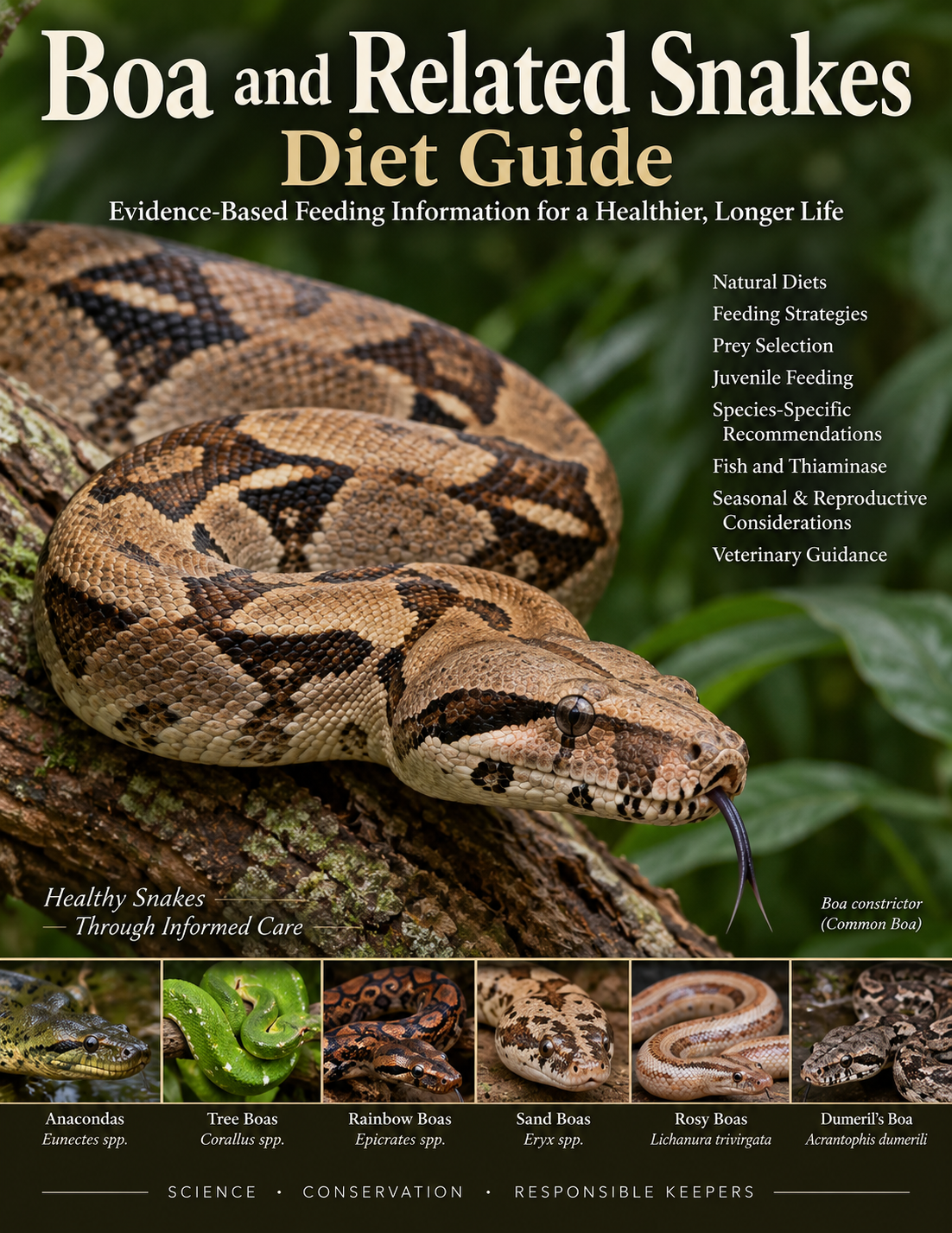
Reptile Nutrition
Boa and Related Snake Diet Guide
Species- and ecology-based feeding guidance for boas and other members of the booid radiation, from small fossorial sand and rubber boas to arboreal tree boas, rainbow boas, boa constrictors, Malagasy boas, Pacific boas, and giant semi-aquatic anacondas.
Which Snakes This Guide Covers
This guide is organized around Booidea, the boa superfamily. Modern classifications differ in whether several lineages are treated as subfamilies within Boidae or as separate families, so common names are often more stable for pet owners than family-level labels. The practical groups covered here include:
- Boa constrictors and close relatives — Boa constrictor, Boa imperator, and related Boa.
- Anacondas — Eunectes species.
- Tree boas — Corallus, including emerald and Amazon tree boas.
- Rainbow boas — principally Epicrates.
- Caribbean boas — Chilabothrus and related West Indian forms.
- Malagasy boas — Acrantophis and Sanzinia.
- Sand boas — Eryx and related Old World sand-boas.
- Rosy and rubber boas — Lichanura and Charina.
- Pacific boas — Candoia.
- Other small booids, including dwarf and burrowing lineages that are less commonly maintained in captivity.
Pythons are not included. Although boas and pythons are both constricting snakes and are frequently discussed together, they are distinct evolutionary groups and should receive their own feeding guide.
Core Feeding Principles
- Feed whole prey. Intact vertebrate prey provides muscle, bone, organs, fat, connective tissue, vitamins, minerals, and water in proportions that isolated meat cannot reproduce.
- Use body condition, not appetite, as the main guide. Many boas are opportunistic feeders and will accept food more often than is metabolically appropriate.
- Increase intervals as the snake matures. Rapidly growing juveniles usually require smaller, more frequent meals than adults. Large adult boas often benefit from substantially longer intervals than traditional weekly feeding schedules.
- Avoid oversized meals. A snake's ability to swallow a prey item does not mean the meal is appropriate. Very large meals increase the physiologic burden of digestion and the risk of regurgitation, trauma, obesity, and excessive growth.
- Feed only after husbandry is correct. Digestion depends on appropriate temperature, hydration, humidity, security, and the opportunity to thermoregulate.
- Frozen-thawed prey is generally preferred. It avoids rodent bite injuries and is easier to store, standardize, and handle safely.
- Do not routinely add vitamin or calcium powder to nutritionally complete whole prey. Whole, properly raised vertebrate prey is generally designed to supply the mineralized skeleton and organs that carnivorous snakes need. Supplements are best reserved for a specific veterinary or nutritional indication.
Whole Prey, Prey Quality, and Variety
Most captive boas can be maintained successfully on appropriately sized rodents, but a controlled amount of prey variety can better reflect natural feeding ecology and can reduce dependence on a single feeder source. Suitable prey may include mice, rats, African soft-furred rats, hamsters, gerbils, quail, chicks, and, for very large species, appropriately sized rabbits or other professionally raised whole prey.
Prey quality matters
Feeder animals should come from a reputable source, be raised on nutritionally complete diets, and be stored and thawed correctly. The nutrient content and hydration of the prey animal are influenced by how that animal was raised. Long freezer storage and repeated thawing can reduce food quality.
Rodents versus birds
Rodents are convenient and nutritionally useful staples for many species. Birds such as quail or chicks can be used periodically for species that naturally take avian prey or for dietary variety. The objective is not to make every meal different; it is to avoid an unnecessarily narrow diet while keeping total calories appropriate.
Fish and aquatic prey
Anacondas and some other semi-aquatic snakes may consume fish opportunistically in nature, but captive boas do not require fish if they receive an otherwise appropriate, nutritionally complete whole-prey diet. If fish are offered, use correctly identified feeder species from controlled, reputable sources rather than wild-caught fish.
Thiaminase is an important consideration when selecting fish. Thiaminase is an enzyme that destroys thiamine (vitamin B1). Repeated feeding of raw or frozen-thawed fish with substantial thiaminase activity can contribute to thiamine deficiency. Clinical consequences can include reduced appetite, weight loss, weakness, abnormal posture or movement, tremors, incoordination, seizures, and potentially death.
Goldfish and rosy-red/fathead minnows should not be used as routine feeder fish. Their ready availability in pet stores does not make them appropriate dietary staples. When fish are considered for occasional dietary enrichment, favor a reliably identified, low-thiaminase species obtained from a controlled source. Wild-caught fish add concerns about parasites, infectious agents, environmental contaminants, and uncertain species identification.
Heating can inactivate thiaminase, but routinely cooking fish is not necessary or preferred for boas that can be maintained on appropriate whole vertebrate prey. For a snake that consumes substantial amounts of fish because of its species, medical needs, or a professionally designed zoo diet, prey selection and thiamine adequacy should be reviewed with a reptile veterinarian or qualified zoo nutritionist.
Amphibians, reptiles, and wild prey
Some small booids and juvenile tree boas naturally consume lizards, amphibians, or other reptiles. These prey types may be important when establishing a difficult feeder, but wild-caught reptiles and amphibians carry substantial risks of parasites, pesticides, infectious disease, and conservation or legal problems. Captive-produced prey is strongly preferred.
Natural Feeding Strategy: Ambush vs. Active Foraging
Many boas are adapted to obtain food by waiting for prey rather than continuously searching for it. Others use a mixed strategy, and the same snake may change tactics with age, habitat, season, or prey availability. Understanding this natural feeding ecology can make captive feeding calmer and more appropriate.
Boa constrictors are a good example of behavioral flexibility. They commonly hunt as ambush predators when prey is available, waiting at a productive location for a suitable animal to pass. When prey becomes scarce, however, they may increase active searching. Young Boa also tend to be more arboreal than large adults, so the location from which they hunt can change as they mature.
| Group | Typical strategy | Captive implication |
|---|---|---|
| Tree boas — Corallus | Strongly ambush-oriented; usually waits from an arboreal perch. | Offer warmed prey near the snake's established perch rather than requiring pursuit. |
| Rainbow boas — Epicrates | Primarily ambush-and-constrict feeding, with opportunistic searching. | Present prey near cover or an established hunting location. |
| Sand boas — Eryx | Fossorial ambush predator, often waiting beneath loose substrate. | Present prey near the surface, hide, or burrow entrance; do not routinely dig the snake out. |
| Dumeril's boas — Acrantophis | Cryptic terrestrial ambush feeding is important. | Quiet presentation near cover is generally more natural than prolonged prey movement. |
| Anacondas — Eunectes | Semi-aquatic opportunistic ambush predation. | Use controlled presentation and strict keeper safety; captive animals do not need to reproduce dramatic natural predation. |
| Boa, rosy boas, rubber boas, and several other terrestrial boas | Mixed strategy: ambush plus active investigation of prey trails, nests, crevices, or productive sites. | Offer prey near a secure location; gentle movement may stimulate feeding but prolonged teasing is unnecessary. |
Meal Size and Feeding Frequency
No single prey-to-body-weight percentage has been established as an ideal rule for every booid. Prey should be proportional to the individual snake. Veterinary guidance emphasizes prey diameter in relation to the snake's size and head rather than a universal percentage. For boas, choose a meal that is readily manageable and produces no more than a modest temporary swelling rather than the largest prey the snake is physically capable of swallowing.
Prey weight can still be useful for record keeping and for making gradual changes, but it should be interpreted together with prey diameter, snake body condition, growth trajectory, digestion, species, and life stage. As a boa matures, the normal progression is generally larger prey offered at progressively longer intervals rather than larger prey offered at the same juvenile frequency.
| Life stage | General starting interval | Adjustment |
|---|---|---|
| Neonate / small juvenile | About every 7–14 days | Use small prey and steady growth; avoid “power feeding.” |
| Growing juvenile / subadult | About every 10–21 days | Gradually lengthen the interval as growth slows. |
| Adult medium-sized boa | About every 2–4 weeks | Body condition should determine whether meals become smaller or less frequent. |
| Large, sedentary adult boa | About every 3–8 weeks | Some mature Boa and giant constrictors need surprisingly infrequent feeding. |
These are starting ranges, not prescriptions. A lean, actively growing juvenile may require the shorter end of the range. A mature sedentary adult, especially a large female, may require much longer intervals. Persistent roundness, fat folds, loss of visible muscle definition, or rapid weight gain indicate that the total energy intake is excessive.
Feeding Neonates and Small Juvenile Boas
Feeding a small boa is not simply a miniature version of feeding an adult. Neonates and juveniles are growing, but the objective is steady, proportional growth rather than maximum growth. Species, locality, sex, birth size, temperature, activity, and individual metabolism can produce large differences between snakes of the same age. For that reason, prey selection should be based on the individual animal rather than an age chart.
Choosing the first prey
Many mammal-eating boa neonates can begin with an appropriately sized whole mouse. Very small species or unusually small neonates may require a newborn mouse, while a large newborn Boa may be capable of taking a fuzzy or larger mouse. Smithsonian reports that newborn boa constrictors may be about 20 inches (50 cm) long, illustrating that even a neonatal Boa can be substantially larger than the neonates of small booid species.
Start conservatively. The feeder should be easy for the snake to grasp, constrict, swallow, and digest. A meal that can physically be swallowed is not automatically an appropriate routine meal.
Example mouse and rat feeder sizes
The following table is an illustrative shopping and progression guide, not an age schedule. Feeder names are not standardized; weights can differ considerably among suppliers. When possible, purchase prey by actual weight as well as the supplier's size name.
| Common feeder description | Approximate example weight | Typical use in a growing boa |
|---|---|---|
| Newborn / pinky mouse | about 1.5–3 g | Exceptionally small neonates and small boa species. |
| Large pinky mouse | about 3–4 g | Small neonates ready for a modest increase. |
| Fuzzy mouse | about 4–7 g | Many young boas after initial growth. |
| Hopper mouse | about 7–12 g | Growing juveniles. |
| Small / adolescent mouse | about 12–18 g | Larger juveniles. |
| Adult mouse | about 18–30 g | Substantial juveniles or adults of smaller boa species. |
| Rat pinky | about 5–8 g | Optional rat-based alternative when appropriately sized. |
| Rat fuzzy | about 8–15 g | Growing juvenile when its dimensions fit the snake. |
| Rat pup | about 15–30 g | Larger juvenile; useful during a mouse-to-rat transition. |
| Weaned / small young rat | about 30–60+ g | Larger growing Boa and other appropriately sized boids. |
| Small rat | about 50–90 g | Large juvenile or subadult when body dimensions and condition justify it. |
| Medium rat | about 90–150 g | Many appropriately sized subadult or adult Boa; not a target size that every snake must reach. |
| Large rat | about 150–275+ g | Only for genuinely large individuals for which the prey remains appropriately proportioned. |
Important: These weight ranges are examples rather than nutritional standards. Supplier categories overlap. Always inspect the actual feeder and the snake rather than relying on the label printed on the prey package.
When to move up one prey size
Do not increase prey size simply because the snake swallowed the previous meal quickly or because it continues to show a feeding response. Consider moving up modestly when the current feeder has become clearly small relative to the snake, the snake has shown consistent normal digestion without regurgitation, growth remains lean and proportional, and body condition indicates that additional energy is appropriate.
A practical progression might be 4 g fuzzy mouse → 7 g large fuzzy → 10 g hopper → 15 g small mouse → 20–25 g adult mouse → 25–30 g rat pup → 40–50 g weaned rat. This is an example of gradual increments, not a schedule. A snake may remain on one feeder size for many meals, skip a commercial category, or require a different progression entirely.
Mouse-to-rat transition
There is no nutritional age at which a boa must “graduate” from mice to rats. Both can serve as useful whole vertebrate prey when they are healthy, properly raised, and appropriately sized. Rats eventually become convenient for a growing Boa constrictor or B. imperator because one appropriately sized rat can replace the need to offer several mice.
A typical size-based transition might be adult mouse (20–25 g) → rat pup (20–30 g) → weaned rat (30–50 g) → small rat (50–90 g) → medium rat (90–150 g). There is no requirement to use every step. Choose the feeder whose actual dimensions fit the snake.
Prey size and feeding interval must change together
One of the most common errors is increasing prey size while continuing the frequent schedule used for a tiny juvenile. As the meal becomes more substantial and growth begins to slow, the interval should generally lengthen. A healthy boa therefore tends to progress from small meals at relatively shorter intervals toward larger meals at longer intervals.
If a neonate refuses its first meals
First review husbandry: correct temperature gradient, humidity, hiding security, disturbance, shedding status, and whether the prey type and presentation match the species' natural feeding ecology. Some small booids naturally begin life feeding heavily on lizards, amphibians, or other nonrodent prey and may need scenting or an appropriate captive-produced alternative before conversion to rodents. Repeated force-feeding should not be the first response. Persistent refusal accompanied by weight loss, weakness, dehydration, abnormal stools, respiratory signs, oral disease, or other abnormalities warrants reptile-veterinary evaluation.
Preparing and Presenting Frozen-Thawed Prey
- Keep prey frozen until needed. Store in well-sealed packaging at appropriate freezer temperature and rotate stock so it is not kept indefinitely.
- Thaw under refrigeration. Slow thawing in a sealed container or bag reduces bacterial growth and preserves moisture better than leaving prey at room temperature for hours.
- Warm before presentation. Once fully thawed, warm the sealed prey in warm water until the body surface is approximately mammalian body temperature. Do not cook it.
- Never microwave feeder prey. Microwaving can produce dangerous internal hot spots, rupture tissues, and partially cook the prey.
- Offer with long feeding tongs. Keep hands away from the strike zone, especially with large boas, tree boas, and anacondas.
- Use species-appropriate movement and position. Terrestrial boas may respond to prey moved along the ground. Arboreal boas often respond better when prey is presented at perch height. Fossorial snakes may feed most readily when the prey is placed near the entrance of a hide or burrow.
- Feed in the home enclosure unless there is a specific reason not to. Moving a snake immediately before and after feeding can add stress and handling-related regurgitation risk. Good hook or target routines can distinguish feeding from normal enclosure access.
- Allow quiet digestion. Avoid routine handling for at least 48 hours after a normal meal and longer after a large meal. Merck veterinary guidance advises avoiding handling for about 3 days after feeding to reduce regurgitation risk.
Species- and Group-Specific Feeding Guidelines
Boa Constrictors — Boa constrictor, Boa imperator, and related Boa
Natural pattern: Small to moderate mammals and birds predominate, with reptiles and other vertebrates also taken. Juveniles are more arboreal and tend to use smaller prey.
Captive staple: Appropriately sized mice and rats, with occasional quail, chicks, or other whole prey.
Frequency: Neonates and young juveniles about every 10–14 days; older juveniles every 2–3 weeks; adults commonly every 3–6 weeks. Large mature individuals may require intervals of 4–8 weeks depending on body condition and meal size.
How: Offer prey no larger than necessary to produce a modest, temporary body bulge. Avoid repeated very large meals. These snakes are particularly prone to obesity when fed on an aggressive growth schedule.
Anacondas — Eunectes
Natural pattern: Opportunistic semi-aquatic predators. Juveniles consume fish, birds, and small mammals; large adults may take much larger vertebrate prey.
Captive staple: Rodents, rabbits, and birds sized to the individual. Fish are optional rather than required.
Frequency: Juveniles generally every 1–2 weeks; subadults about every 2–4 weeks; large adults often every 4–6 weeks or longer. Smithsonian reports roughly monthly feeding for its green anaconda.
How: Feeding should be conducted under a formal safety protocol. Giant specimens should not be fed or managed by a single person. Do not use prey size as a challenge; smaller, safer meals at longer intervals are preferable to extreme meals.
Emerald and Other Tree Boas — Corallus
Natural pattern: Arboreal ambush predators. Adults primarily take mammals such as rodents and bats; juveniles of some species also consume lizards and other small vertebrates.
Captive staple: Mice and small rats; occasional quail or other whole prey may be used.
Frequency: Juveniles about every 7–14 days; subadults every 10–20 days; adults about every 2–4 weeks.
How: Present prey at perch height with long tongs. Avoid oversized prey, excessive feeding, and handling soon after meals. Tree boas can regurgitate when feeding, temperature, hydration, or stress management is poor.
Rainbow Boas — Epicrates
Natural pattern: Small mammals, birds, eggs, reptiles, and amphibians are recorded natural prey.
Captive staple: Mice and rats with periodic birds or alternative rodents.
Frequency: Juveniles about every 1–2 weeks; adults about every 2–4 weeks.
How: Feed after the enclosure has reached correct humidity and temperature. Rainbow boas should not be heavily fed simply because they accept food readily. Monitor the contour of the spine and lateral musculature as they mature.
Dumeril's and Madagascar Ground Boas — Acrantophis
Natural pattern: Terrestrial ambush predators of mammals and other vertebrates with relatively slow adult metabolism.
Captive staple: Mice and rats, with quail, chicks, or other whole prey for variety.
Frequency: Small juveniles about every 7–10 days; subadults every 2–3 weeks; adults approximately every 3–4 weeks, sometimes less often when body condition is generous.
How: Maintain slow, controlled growth. Dumeril's boas are especially easy to overfeed because their naturally heavy build can hide excess fat.
Madagascar Tree Boas — Sanzinia
Natural pattern: Arboreal or semi-arboreal predators that take small mammals, birds, and other vertebrates.
Captive staple: Mice, young rats, and appropriately sized birds.
Frequency: Juveniles around every 7–14 days; adults generally every 2–4 weeks.
How: Present prey from a secure perch or elevated position when possible. Ensure adequate warmth for digestion without overheating this humid-forest species.
Kenyan and Other Sand Boas — Eryx
Natural pattern: Fossorial ambush predators of small mammals, lizards, and other small vertebrates.
Captive staple: Mice are usually sufficient; small alternative rodents can be used when appropriately sized.
Frequency: Juveniles about every 1–2 weeks; adults about every 2–4 weeks.
How: Feed near the hide or burrow entrance or present prey just above the substrate. Avoid repeatedly digging the snake out to feed. Small males may require considerably less food than large females.
Rosy Boas — Lichanura
Natural pattern: Small mammals are major prey, with lizards, birds, amphibians, and other snakes also recorded.
Captive staple: Appropriately sized mice, with occasional alternative small whole prey.
Frequency: Growing juveniles commonly every 7–10 days; adults about every 10–21 days depending on body condition and seasonal activity. Very small meals may be used at the shorter interval.
How: Offer prey near a secure hide. Do not assume a strong feeding response means the snake needs a larger or more frequent meal.
Rubber Boas — Charina
Natural pattern: Specialized predators of nests of small mammals, including rodents, voles, and shrews; eggs and small reptiles are also taken occasionally.
Captive staple: Small mice or other appropriately sized rodents, often smaller than owners expect.
Frequency: Juveniles generally every 7–14 days during active growth; adults often every 2–3 weeks during the active season. Seasonal appetite reduction is normal when husbandry intentionally follows the species' temperate cycle.
How: Maintain cooler species-appropriate temperatures. Do not increase feeding to compensate for inactivity caused by temperatures outside the preferred range.
Pacific Boas — Candoia
Natural pattern: Highly variable among species and life stages. Small individuals may take lizards, frogs, and small mammals; larger forms may become more mammal-oriented.
Captive staple: Appropriately sized rodents once established. Some neonates may require scenting or captive-produced lizard/amphibian-type prey to begin feeding.
Frequency: Small juveniles about every 5–10 days; adults roughly every 2–3 weeks, adjusted for species size and body condition.
How: Avoid aggressive force-feeding of newly acquired animals. Correct humidity, security, nighttime conditions, and prey scent first. Persistent refusal requires veterinary evaluation.
Caribbean Boas — Chilabothrus
Natural pattern: Mammals and birds are important prey, with bats especially significant in several island species.
Captive staple: Rodents plus occasional birds. Very large species can be transitioned to larger prey while maintaining conservative meal size.
Frequency: Juveniles every 7–14 days; subadults every 2–3 weeks; adults usually every 3–5 weeks.
How: Give highly arboreal or cave-associated species elevated feeding opportunities and adequate post-feeding security.
Other Small Booids
Natural pattern: Small mammals, lizards, amphibians, eggs, or other small vertebrates depending on the lineage.
Captive approach: Species-level natural-history research is essential before selecting prey. Many of these snakes are uncommon in captivity, and reliable feeding information may be limited.
Frequency: Do not extrapolate directly from large boa constrictors. Smaller species may need smaller meals at shorter intervals, but their total caloric intake must remain modest.
How: When a species is poorly studied, use repeated weight measurements, fecal quality, growth rate, and body condition to refine the plan rather than relying on anecdotal feeding schedules.
Special Feeding Situations
Neonates and juveniles
Young boas should grow steadily, not as rapidly as possible. See the detailed Feeding Neonates and Small Juvenile Boas section for feeder-size examples, mouse-to-rat transitions, and criteria for increasing prey size. Avoid combining larger prey with a persistently short juvenile feeding interval.
Breeding females
Reproduction is energetically expensive in viviparous boas. Females should enter breeding season in good but not obese condition. Some gravid females reduce or stop feeding. Do not repeatedly offer large meals to a late-gestation female that is refusing food. After parturition, refeeding should begin conservatively with smaller meals before returning to the normal schedule.
Seasonal fasting
Healthy boas may reduce appetite seasonally, during reproductive cycles, around shedding, after relocation, or when environmental conditions change. A fasting snake with stable weight and normal behavior should not automatically be force-fed. Husbandry, seasonality, and reproductive state should be reviewed first.
When refusal is abnormal
Veterinary evaluation is appropriate when fasting is accompanied by weight loss, dehydration, regurgitation, abnormal feces, respiratory signs, oral lesions, weakness, swelling, parasites, poor shedding, or a substantial change from the animal's normal pattern.
Assisted feeding
Force-feeding and tube-feeding should be reserved for specific medical situations and performed under veterinary direction. They can cause aspiration, oral or esophageal injury, severe stress, and delayed diagnosis of the underlying problem.
Foods and Practices to Avoid
- Live rodents as routine prey. A rat or mouse can inflict severe bites, especially when a snake is not immediately interested in feeding.
- Pieces of plain meat, chicken breast, hamburger, or organ meat as a staple. These are not nutritionally equivalent to whole prey.
- Wild-caught rodents, birds, amphibians, reptiles, or fish. Parasites, infectious agents, pesticides, anticoagulant rodenticides, heavy metals, and legal or conservation issues make them unsuitable routine feeders.
- Oversized prey. “As large as the snake can swallow” is not an appropriate feeding standard.
- Routine weekly feeding of mature large boas. This is a common pathway to obesity in adult Boa, Acrantophis, and other slow-metabolism species.
- Excessive fatty prey. Very young or unusually obese rodents can deliver more fat and energy than needed.
- Routine vitamin or mineral dusting of complete vertebrate prey. Unnecessary supplementation can create nutrient imbalances; use supplements only for a defined reason.
- Handling immediately after feeding. Allow the animal to digest in a secure enclosure with appropriate temperatures.
- Repeated refreezing and thawing. Discard uneaten thawed prey rather than refreezing it for later use.
Weight and Body-Condition Monitoring
Because feeding intervals are naturally long, written records are particularly valuable for boas. Record the date, prey type, prey weight or size, feeding response, regurgitation, shedding, defecation, and snake weight. Juveniles can be weighed every 2–4 weeks; stable adults can often be weighed monthly or every 1–2 months.
Signs the snake may be overfed
- Rapid weight gain after growth should have slowed.
- Fat folds when the snake bends.
- A uniformly round, soft body with reduced muscle definition.
- Heavy fat accumulation around the tail base or cloacal region.
- Difficulty climbing or reduced activity in normally active species.
Signs the snake may be too thin
- Prominent spine or sharply triangular cross-section.
- Loss of epaxial muscle mass.
- Loose skin unrelated to dehydration or a recent large weight change.
- Progressive weight loss over repeated measurements.
Body condition should always be interpreted with species anatomy in mind. A naturally stout Dumeril's boa should not be judged by the same outline as an Amazon tree boa, and a gravid female should not be scored as though she were a nonreproductive adult.
Selected References and Further Reading
- Merck Veterinary Manual — Nutrition in Snakes
Veterinary review of whole prey, prey size, frozen-thawed feeding, feeding intervals, prey warming, regurgitation prevention, and assisted feeding. - Merck Veterinary Manual — Nutrition in Reptiles
Veterinary nutrition principles, prey quality, freezer storage, hydration, and the importance of natural feeding ecology. - Smithsonian's National Zoo — Boa Constrictor
Natural prey, ambush feeding behavior, and zoo diet of mice, rats, and chicks. - Smithsonian's National Zoo — Brazilian Rainbow Boa
Natural prey and documented ambush-and-constrict feeding behavior. - Smithsonian's National Zoo — Green Anaconda
Natural feeding ecology and zoo feeding pattern for giant semi-aquatic anacondas. - University of Michigan Animal Diversity Web — Boa Constrictor
Natural history, habitat, feeding ecology, reproduction, and life history. - University of Michigan Animal Diversity Web — Emerald Tree Boa
- University of Michigan Animal Diversity Web — Rainbow Boa
Natural prey includes mammals, birds, eggs, reptiles, and amphibians. - University of Michigan Animal Diversity Web — Rubber Boa
Temperate ecology and specialization on small nesting mammals. - ReptiFiles — Boa Constrictor Feeding
Detailed modern husbandry-based feeding intervals and body-condition approach. - ReptiFiles — Northern Emerald Tree Boa
- ReptiFiles — Brazilian Rainbow Boa
- ReptiFiles — Kenyan Sand Boa
- ReptiFiles — Rosy Boa
- ReptiFiles — Dumeril's Boa Feeding
- The Reptile Database
Current taxonomy and species-level distributional reference for booid snakes.
Note: Many booid snakes are poorly studied nutritionally in controlled settings. Feeding recommendations therefore combine veterinary nutrition principles, natural-history information, zoological practice, and careful monitoring of body condition rather than relying on exact laboratory-derived nutrient requirements.