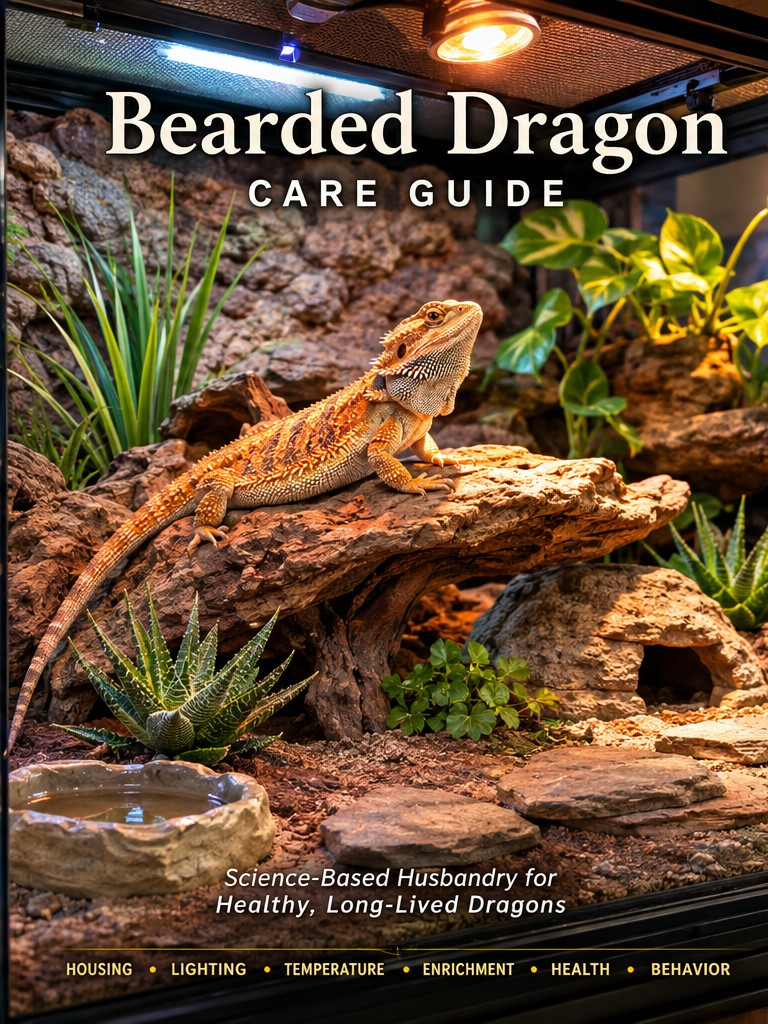
Reptile Husbandry & Preventive Care
Bearded Dragon Care Guide
A comprehensive husbandry guide for captive bearded dragons, with emphasis on enclosure design, temperature and UVB measurement, humidity, substrate, enrichment, handling, social behavior, sex identification, brumation, preventive care, and common health problems.
Quick Care Guide
| Parameter | Practical target | Notes |
|---|---|---|
| Adult enclosure | At least 48 × 24 × 24 in (120 × 60 × 60 cm); larger preferred | Provide usable floor space, climbing structure, thermal gradient, shade, and secure retreats. A larger enclosure is beneficial when it can still be heated and lit correctly. |
| Social housing | One bearded dragon per enclosure | Central bearded dragons are naturally solitary. Cohabitation can cause chronic stress, unequal access to heat/UVB/food, bite wounds, toe or tail loss, and severe fighting. |
| Basking surface | About 100–108°F (38–42°C) | Measure the actual basking surface with an infrared thermometer. Individual preference and life stage may justify modest adjustment within the broader safe range. |
| Cool-zone air | About 75–80°F (24–27°C) | Measure ambient air with a digital probe thermometer positioned where the dragon actually spends time. |
| Night temperature | Approximately 68–75°F (20–24°C) | Turn visible lights off at night. If the enclosure becomes persistently colder than about 68°F (20°C), use thermostatically controlled non-light-emitting supplemental heat. |
| Humidity | Usually 30–40% ambient relative humidity | Measure at the cool end with a digital hygrometer. A localized, slightly more humid digging/shedding microclimate can be useful without keeping the whole enclosure damp. |
| UV exposure | UVI about 3–5 at the principal basking site, grading toward 0 in deep shade | Measure at the height of the dragon’s back using a UV Index meter when available. UV-sensitive cards are useful only as qualitative screening tools. |
| Photoperiod | About 12 hours light / 12 hours dark for a simple household schedule | A timer improves consistency. Seasonal variation is acceptable when husbandry is intentionally adjusted. |
Published husbandry sources do not all use identical numbers. The targets above are intended to provide a practical central range while preserving a real thermal and light gradient so the animal can choose among microclimates.
Natural History and Why It Matters in Captivity
The central or inland bearded dragon, Pogona vitticeps, is the species most commonly kept as a pet. It is native to arid and semi-arid regions of inland eastern Australia, including open woodland, shrubland, and grassland with scattered trees. Wild bearded dragons are active by day, bask conspicuously, climb low branches and shrubs, retreat from extreme heat, dig, and use postures and color changes to communicate.
These natural behaviors explain many of their captive requirements. A bearded dragon does best when it can move between bright heat and shade, climb onto broad elevated perches, retreat into secure hides, dig in an appropriate substrate, and choose among warmer, cooler, brighter, darker, drier, and somewhat more humid microclimates. A small enclosure with a single temperature and little structural variety cannot provide those choices.
Before Bringing a Bearded Dragon Home
Set up and operate the enclosure before the dragon arrives. Allow several days, and ideally about a week, to confirm that daytime and nighttime temperatures, humidity, basking-surface temperature, UV Index, and lighting schedules are stable. This also gives time to discover whether a screen top, room temperature, window, heating vent, or lamp placement is changing conditions unexpectedly.
Have a reptile-experienced veterinarian examine a newly acquired dragon, particularly if its prior husbandry and parasite status are unknown. Bring a fresh fecal sample when possible. Many reptiles hide illness well, and a normal-looking new pet can still have parasites, nutritional bone disease, oral disease, dehydration, reproductive disease, or infectious conditions.
Housing and Enclosure Size
For one typical adult central bearded dragon, a 48 × 24 × 24 inch (120 × 60 × 60 cm) enclosure should be treated as a minimum. Larger enclosures are preferred when heat, UVB, visible light, and shade can still be delivered correctly. The enclosure should allow the dragon to turn freely, walk and run, climb onto broad perches, obtain full-body exposure to the basking zone, and move completely out of the heat and UVB when desired.
Front-opening PVC, wood-based reptile enclosures, or appropriately designed glass enclosures can all work. Good ventilation is essential, but an enclosure should not be so open that it becomes impossible to maintain a proper thermal gradient. All doors and screens must be secure.
Provide at least one secure retreat in the warm half and one in the cooler half. Hides should be large enough for the dragon to enter comfortably but close-fitting enough to feel secure. Broad branches, cork, rocks, ledges, and platforms must be anchored so they cannot shift or collapse.
Do not use electrically heated rocks. Reptiles can sustain severe contact burns from malfunctioning or poorly regulated heat rocks.
Substrate: Safety, Cleanliness, and Digging Behavior
There is no single substrate that is ideal in every circumstance. The animal’s age, health, quarantine status, enclosure design, temperature, and tendency to ingest substrate all matter.
For a healthy, established adult
A naturalistic reptile-safe sand or sand/soil mixture can support normal digging behavior when the enclosure is correctly heated, the dragon is healthy, and food is presented in a way that limits accidental ingestion of substrate. Clean children’s play sand can be used as a component of an appropriate mix. Naturalistic substrate should be deep enough to permit useful digging rather than functioning as a thin decorative layer.
For quarantine or medical care
Paper towels, unprinted paper, or another easily replaced nonparticulate surface is usually preferable for newly acquired, ill, debilitated, postsurgical, or gastrointestinally compromised dragons because feces, urates, blood, regurgitated material, parasites, and abnormal discharges are easier to observe and remove.
Solid flooring
Textured slate or other non-slip washable surfaces can be practical, especially in portions of the enclosure. If most of the floor is solid, provide a sufficiently large dig box containing an appropriate sand/soil mixture so normal digging behavior is not eliminated.
Avoid
- calcium-based “calci-sand”;
- crushed walnut shell;
- corn-cob bedding;
- large bark or wood chips that can be swallowed;
- cat litter;
- cedar or aromatic wood shavings;
- frayed carpet or fabric that can catch nails and harbor debris.
Impaction is not caused by substrate alone. Low temperature, dehydration, parasites, nutritional disease, ingestion of large indigestible material, and other medical problems can all contribute. This is why an animal with constipation or suspected obstruction should be evaluated rather than simply having the substrate changed.
Temperature, Basking Heat, and the Thermal Gradient
Bearded dragons are ectothermic. Their digestion, activity, immune function, muscle performance, and vitamin D/calcium physiology depend on access to appropriate environmental temperatures.
Create a bright, overhead basking zone at one end of the enclosure and a cooler shaded zone at the other. For a typical healthy adult, aim for a basking surface around 100–108°F (38–42°C) and cool-zone air around 75–80°F (24–27°C). The dragon must be able to move completely away from the basking heat.
An incandescent or halogen-style reptile basking lamp is well suited to daytime basking because it provides radiant heat from above in a manner that more closely resembles solar warming. The beam should be broad enough to warm most of the body at one time rather than producing a tiny intensely hot spot.
Use a thermostat or other appropriate temperature controller as a safety and control device where compatible with the heat source. Lamp guards should prevent the dragon from contacting hot bulbs or ceramic emitters.
All visible light should be off at night. A modest nighttime temperature drop is normal. If the enclosure remains below approximately 68°F (20°C), supplemental heat can be provided with a thermostatically controlled ceramic heat emitter or another non-light-emitting source. Non-light-emitting heaters are useful for background or nighttime warmth but should not replace the bright overhead daytime basking lamp.
How to Measure Temperature Correctly
Temperature recommendations are only useful when the correct type of temperature is being measured. A basking rock can be much hotter than the surrounding air, and a thermometer attached to a wall can read differently from the location where the dragon’s body actually rests.
| Device | Best use | Important limitations |
|---|---|---|
| Digital thermometer with a wired probe | Continuous measurement of air temperature in the cool zone and, ideally, a second unit in the warmer ambient zone. | Place the probe at approximately dragon height and not directly against a hot basking surface. Do not assume a wall-mounted reading represents the basking surface. |
| Infrared thermometer / temperature gun | Spot-checking surface temperatures, especially the basking rock or platform and other accessible surfaces. | It measures surface temperature, not air temperature. Readings can be affected by distance, very shiny surfaces, and the instrument’s distance-to-spot ratio. |
| Thermostat with probe | Controlling a compatible heat source and limiting excessive temperature. | A thermostat is primarily a controller, not the only independent thermometer. Verify actual temperatures with separate measuring devices. |
| Digital hygrometer/thermometer | Monitoring cool-side humidity and ambient temperature. | Cheap units can drift; compare or replace units that give implausible readings. |
Simple adhesive analog dial thermometers are convenient but should not be the primary method for managing a high-heat reptile enclosure. A practical setup is two digital probe thermometers plus an infrared temperature gun, with a separate digital hygrometer if humidity is not included.
Check temperatures after changing a bulb, moving a fixture, altering substrate depth, changing basking furniture, changing room heating or air-conditioning, or moving the enclosure.
UVB, UVA, Visible Light, and the Basking Zone
Bearded dragons require reliable ultraviolet B exposure for normal vitamin D3 synthesis and calcium metabolism. They also use ultraviolet A and visible light as part of normal vision and behavior. A good enclosure therefore provides not merely “a UV bulb,” but a bright basking zone that combines appropriate heat, visible light, and UV radiation.
A high-quality linear T5-HO UVB fluorescent system is commonly the most practical way to create a broad UVB zone for an adult enclosure. Lamp percentage alone does not determine the dose reaching the animal. Fixture quality, reflector, lamp age, distance, mesh, angle, and the exact basking height all affect the UV Index.
For a typical central bearded dragon, a practical target is a UVI of about 3–5 at the main basking site, with a gradient toward very low or zero UV in a shaded retreat. The basking area should be large enough for full-body exposure rather than illuminating only the head or a small patch of the back.
Do not place UVB behind ordinary window glass or clear acrylic. These materials block most useful UVB. Mesh screens and guards also reduce output to varying degrees, so lamp distance should be based on the actual UV reaching the animal rather than on distance alone.
Lamps lose UVB output with use even while they continue to emit visible light. Follow manufacturer guidance when a meter is unavailable. When a UV Index meter is used regularly, lamp replacement can be based more intelligently on measured output rather than appearance alone.
Checking UV Output: Test Cards Versus UV Index Meters
Owners now have inexpensive card-type UV indicators as well as calibrated handheld meters. They are useful for different purposes and should not be considered interchangeable.
UV-sensitive test cards
Reusable photochromic cards change color when exposed to ultraviolet radiation. They can be useful for a quick screening check that ultraviolet energy is reaching the basking location and for comparing the same lamp, fixture, mesh, distance, and card position over time.
Use the card at the level of the dragon’s back while basking, not directly beside the lamp. A card that reacts strongly beside the bulb does not prove that adequate UV reaches the animal below.
These cards are qualitative. They do not provide an exact UV Index and many inexpensive cards respond to a broad ultraviolet range rather than measuring only biologically useful UVB. A color change therefore should not be interpreted as proof that the basking site is at UVI 3–5 or that the exposure is safe.
UV Index meter
A calibrated UV Index meter is the preferred quantitative tool. A reptile-oriented meter such as the Solarmeter 6.5 or 6.5R, or another suitable calibrated UV Index radiometer, allows the owner to measure the actual UVI reaching the dragon.
Measure at the height and approximate orientation of the dragon’s back. Check the main basking zone, the edges of the basking zone, and the shaded retreat. Repeat after changing lamps or fixtures and periodically as the lamp ages. Monthly measurements provide a useful record of output decline.
Humidity, Water, and Hydration
Most central bearded dragon enclosures should remain relatively dry, with ambient humidity around 30–40% at the cool end. Chronically high humidity combined with poor ventilation can contribute to skin and respiratory problems.
Provide a stable shallow dish of fresh water, preferably at the cooler end. Replace the water at least daily and whenever soiled. Some dragons drink readily from bowls while others obtain substantial moisture from food; a lack of observed drinking does not justify eliminating access to fresh water.
A slightly moister dig box or shedding microclimate may be useful, especially when a dragon is shedding, as long as the entire enclosure is not kept damp. Routine heavy misting of the whole habitat is unnecessary.
Furnishings and Environmental Enrichment
Enrichment should allow natural behavior rather than simply decorate the enclosure. Bearded dragons benefit from choice, movement, climbing, digging, basking, hiding, and visual exploration.
- Broad basking platforms: large enough for most of the body to receive heat and UV simultaneously.
- Branches, cork, and low climbing structures: securely anchored and sized so the dragon can grip and rest comfortably.
- Warm and cool retreats: at least one secure hide in each thermal region.
- Digging area: a deep safe substrate zone or dedicated dig box.
- Visual barriers: help the dragon feel secure and reduce constant exposure to household movement or reflections.
- Texture and elevation: rock, cork, wood, soil, and stable ledges create different surfaces and viewpoints.
- Supervised exploration: a secure reptile-safe area outside the enclosure can provide exercise and novelty without prolonged chilling.
Changes should be gradual. An enrichment item that can fall, trap a limb, expose sharp edges, or allow access to a heat lamp is not safe enrichment.
Handling and Human Socialization
A newly acquired dragon should first be allowed to become comfortable in its enclosure. Avoid unnecessary handling during approximately the first week unless medical care requires it.
Approach slowly from the front or side rather than suddenly from overhead. Slide both hands beneath the dragon and support the chest, abdomen, pelvis, and all four limbs. Bearded dragons may remain calm without gripping securely, so do not assume the animal will hold onto you.
Start with brief sessions. A dragon that repeatedly backs away, gapes defensively, struggles, darkens its beard, or attempts to escape should be returned to the enclosure and approached again later. Handling should be cooperative rather than forced.
Do not keep the dragon out of its heated enclosure long enough to become chilled. During supervised outdoor exposure, provide shade, prevent escape, and protect the dragon from dogs, cats, birds, toxic plants, pesticides, and overheating.
Normal Behavior and Communication
Understanding normal behavior helps owners distinguish communication from illness.
- Basking: normal thermoregulatory behavior after lights come on and at other times during the day.
- Open-mouth basking or gaping: can be normal when the dragon is regulating body temperature, but persistent gaping away from heat may indicate respiratory or other disease.
- Beard expansion and darkening: can occur with arousal, territorial display, courtship, fear, or stress; persistent black beard combined with lethargy or pain is concerning.
- Head bobbing: a visual display often associated with dominance, territorial behavior, or courtship.
- Arm waving: commonly functions as a submissive or social signal.
- Digging: can be normal exploration, thermoregulation, preparation for egg laying, or seasonal behavior.
- Seasonal slowing: may accompany brumation, but illness must be considered if there is weight loss or other abnormalities.
Sex Identification
Sexing very young bearded dragons can be difficult and should not be forced. Accuracy improves as the animal matures.
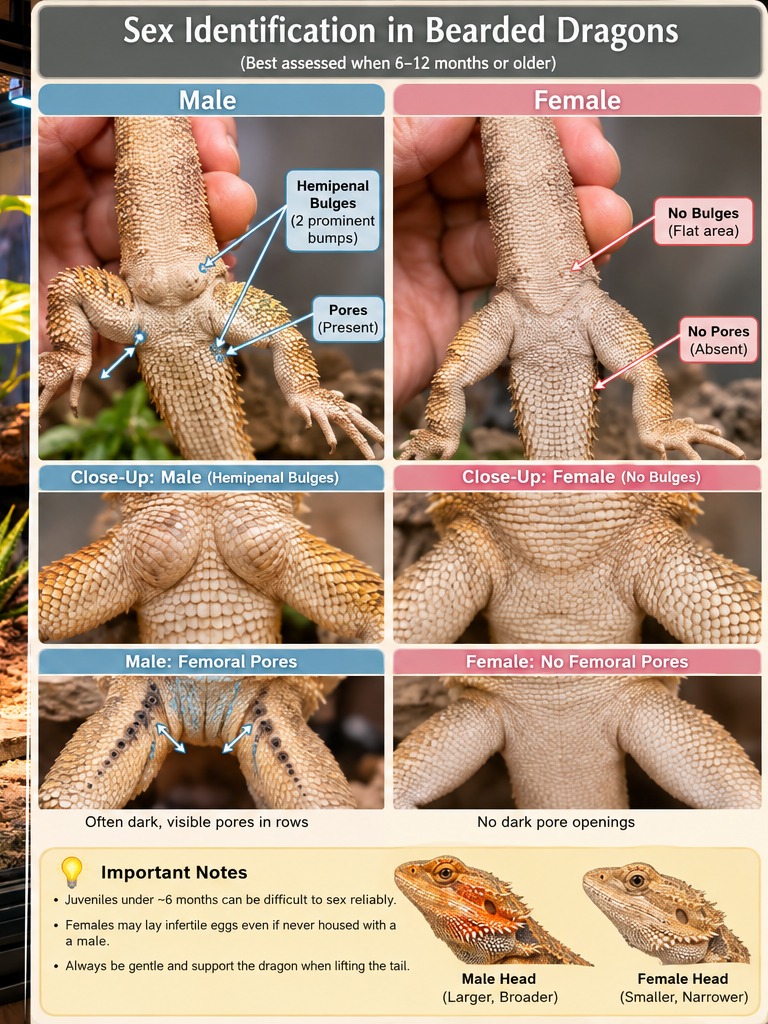
In a mature male, the base of the tail commonly shows paired hemipenal bulges to either side of the midline just behind the vent, and femoral/preanal pores are usually more prominent. Mature males also often have broader heads. Females generally lack the paired hemipenal contour and have less prominent pores, although external appearance is not perfectly reliable in every animal.
To inspect the tail base, support the animal and gently lift the tail only enough to view the area behind the vent. Do not forcefully bend the tail forward, probe the cloaca, or attempt to evert hemipenes at home. A reptile-experienced veterinarian can confirm sex when the appearance is uncertain.
Reproductive Considerations
Adult females may develop and lay eggs even if they have never been housed with a male. Every mature female should therefore have access to an appropriate digging/laying area when reproductive behavior is suspected.
Repeated digging, restlessness, reduced appetite, abdominal enlargement, or repeated attempts to escape can occur before laying, but similar signs may accompany disease. A female that strains without producing eggs, becomes weak or nonresponsive, develops marked abdominal enlargement, or stops behaving normally requires prompt veterinary evaluation.
Important reproductive disorders include preovulatory follicular stasis, dystocia (egg binding), and yolk coelomitis. These conditions can become life-threatening and cannot be managed safely by simply increasing heat or giving supplements at home.
Shedding and Skin Care
Bearded dragons usually shed in patches rather than removing the skin in one complete piece. Juveniles shed more often because they are growing rapidly.
Do not pull firmly attached shed from the skin. Retained skin around toes, the tail tip, or constricted areas can impair circulation. Review hydration, humidity, enclosure abrasiveness, and overall health when shedding is repeatedly abnormal.
A localized slightly humid dig area and brief shallow lukewarm soaking can sometimes help loosen retained shed, but persistent retained skin, swelling, discoloration, pain, or tissue damage should be examined by a veterinarian.
Brumation
Brumation is a period of seasonal slowing and dormancy in reptiles. It is similar in outward appearance to hibernation but is physiologically distinct. Captive adult bearded dragons may become less active, sleep more, and eat less during cooler or shorter-day periods.
Do not assume that every lethargic or non-eating dragon is brumating. Parasites, metabolic bone disease, reproductive disease, constipation, infection, low enclosure temperatures, dehydration, organ disease, and other disorders can look similar.
A dragon entering seasonal dormancy should have a stable or closely monitored body weight and no signs of disease. Weight loss during apparent brumation, abnormal stool, respiratory signs, swelling, weakness, persistent black beard, dehydration, or failure to resume normal activity warrants veterinary evaluation.
There is usually no need to deliberately induce deep brumation in a nonbreeding household pet. Owners who intentionally alter temperatures and photoperiod for breeding or managed seasonal cycling should do so only with a healthy animal and a clear plan.
Cleaning, Disinfection, and Routine Maintenance
- Remove feces, urates, uneaten food, shed skin, and contaminated substrate promptly.
- Wash the water dish daily and whenever soiled.
- Clean food dishes after each use.
- Replace or refresh substrate according to the housing system and contamination level.
- Periodically remove furnishings for cleaning and inspection.
- Use a reptile-appropriate disinfectant at the correct concentration and contact time; rinse when the product label requires it.
- Never mix disinfectants or cleaning chemicals.
- Allow cleaned surfaces to dry before reassembling the enclosure when practical.
If an infectious disease such as Nannizziopsis is suspected, routine household cleaning may be inadequate. Follow the treating veterinarian’s isolation and disinfection plan.
Salmonella and Household Hygiene
Healthy-appearing bearded dragons can carry Salmonella bacteria and shed them in feces. The bacteria can contaminate the dragon’s skin, enclosure, furniture, cleaning tools, and surfaces where the animal is allowed to roam.
- Wash hands thoroughly with soap and water after touching the dragon, its food, enclosure, water bowl, feces, or equipment.
- Do not clean reptile equipment in kitchen sinks or food-preparation areas.
- Do not allow reptiles on kitchen counters, dining tables, or other food-preparation surfaces.
- Do not kiss reptiles or bring them close to the face.
- Children younger than 5 years, adults 65 years or older, and immunocompromised people have a higher risk of serious salmonellosis and require particular caution around reptiles.
The CDC completed another multistate outbreak investigation linked to pet bearded dragons in 2025, reinforcing the importance of these measures.
Quarantine for a Newly Acquired Dragon
If reptiles are already present in the household, house a new bearded dragon separately with separate tools and equipment. Use easily cleaned substrate during the observation period. Wash hands and service established reptiles before the new animal when possible.
A veterinary examination and fecal parasite evaluation early in quarantine are recommended. Do not introduce a new dragon into the same enclosure as another bearded dragon after quarantine; the species should normally remain singly housed.
Routine Health Monitoring and Preventive Veterinary Care
Observe the dragon every day and record body weight regularly. A gram scale suitable for the dragon’s size is useful because gradual weight change may be detected before it is obvious visually.
At home, monitor:
- body weight and overall body condition;
- appetite and drinking behavior;
- activity, basking, and climbing;
- gait and ability to lift the body normally;
- jaw firmness and limb shape;
- eyes, nostrils, and oral cavity;
- skin, toes, tail tip, and shedding;
- femoral pores;
- fecal and urate appearance;
- respiratory effort;
- persistent beard darkening or other behavioral change.
Preventive examinations are valuable even when no problem is apparent. In a large Australian veterinary study, a substantial proportion of dragons presented simply for a health check were found to need husbandry correction, medical treatment, or surgery.
Common Diseases and Health Problems
Many of the most important bearded dragon diseases are directly or indirectly influenced by husbandry. Others are infectious, parasitic, reproductive, traumatic, or degenerative. The list below emphasizes conditions commonly encountered in veterinary practice or particularly important for owners to recognize.
| Problem | What owners may notice | Important associations / prevention |
|---|---|---|
| Metabolic bone disease / nutritional secondary hyperparathyroidism | Weakness, tremors, soft or deformed jaw, swollen or deformed limbs, abnormal gait, inability to lift the body, fractures, paresis or paralysis. | Strongly associated with inadequate UVB, low dietary calcium or poor calcium balance, and inappropriate temperatures. Correct lighting, measured UVI, appropriate basking heat, and proper nutrition are preventive foundations. |
| Endoparasites, including coccidia and other intestinal parasites | Abnormal stool, diarrhea, weight loss, reduced appetite, poor growth, dehydration, or sometimes no obvious signs. | Fecal testing is useful in new animals and when gastrointestinal signs or unexplained weight loss occur. Treatment should be based on diagnosis rather than routine blind deworming. |
| Constipation / gastrointestinal impaction or obstruction | Reduced or absent stool, straining, decreased appetite, lethargy, abdominal discomfort or enlargement. | Potential contributors include low temperature, dehydration, parasites, nutritional bone disease, ingestion of inappropriate substrate or foreign material, and other medical disease. Persistent constipation should not be managed by repeated home soaks alone. |
| Periodontal disease / stomatitis | Red or swollen gums, plaque or calculus, oral discoloration, bad odor, reduced appetite, difficulty eating, loose teeth, or oral swelling. | Bearded dragons have acrodont dentition and can develop significant periodontal disease. Oral examination should be part of routine veterinary care. |
| Agamid adenovirus-1 (adenovirus) | Failure to thrive, weight loss, weakness, gastrointestinal signs, neurologic abnormalities, or sudden decline; some infected dragons may appear normal. | Especially important in young dragons and collections. Diagnosis requires veterinary testing. Good quarantine and avoiding shared equipment reduce transmission risk. |
| Nannizziopsis guarroi dermatomycosis (“yellow fungus disease”) | Yellow, brown, gray, crusted, thickened, ulcerated, or poorly healing skin lesions; lesions may spread and become severe. | This is a serious contagious fungal disease requiring prompt diagnosis and systemic management. Isolate affected animals and follow veterinary disinfection instructions. |
| Reproductive disease | Persistent digging, abdominal enlargement, reduced appetite, weakness, repeated straining, inability to lay, or sudden decline. | Females can develop follicles or eggs without mating. Important disorders include preovulatory follicular stasis, dystocia, and yolk coelomitis. Appropriate nesting opportunity and early veterinary evaluation are important. |
| Respiratory infection | Nasal or oral discharge, wheezing, increased respiratory effort, persistent gaping away from the basking zone, lethargy, or appetite loss. | Chronically cool temperatures, excessive humidity, poor ventilation, and systemic illness can increase risk. Respiratory signs require veterinary examination. |
| Obesity and overconditioning | Excess body fat, reduced activity, very broad abdomen, excessive fat pads, or difficulty moving normally. | Commonly associated with energy-dense feeding and inadequate activity. Enclosure size and enrichment matter as well as diet. Long-term obesity may contribute to hepatic and reproductive disease. |
| Trauma, bite wounds, fractures, and burns | Open wounds, missing toes or tail tissue, swelling, lameness, abnormal limb position, blistering, dark damaged skin, or sudden pain. | Cohabitation is an important preventable source of bite injuries. Other risks include falls, unstable furniture, contact with hot lamps or heaters, other household pets, and electrical heat devices. |
| Dysecdysis / retained shed | Persistent bands of old skin, especially around toes or tail tip, constriction, swelling, or discoloration. | Review hydration, microclimate, enclosure surfaces, and underlying health. Constricting retained shed can impair blood supply and should not be ignored. |
| Masses and neoplasia | New skin, eyelid, oral, or body lumps; nonhealing lesions; unexplained swelling. | Not every mass is cancer, but masses were a recurring presentation in veterinary case series. Early examination allows cytology, biopsy, imaging, or treatment when indicated. |
Warning Signs That Require Veterinary Attention
Safe Transport
Transport a bearded dragon in a secure, well-ventilated container that prevents climbing and falling. Line the bottom with an absorbent towel or paper. Keep the carrier out of direct sun and protect it from cold drafts.
If supplemental warmth is necessary, place a wrapped heat source so the dragon cannot contact it directly and has room to move away from the warm area. Overheating a small closed carrier can be as dangerous as chilling it.
Recommended Equipment Checklist
- adult enclosure at least 48 × 24 × 24 in, or larger;
- secure doors and appropriate ventilation;
- broad overhead basking lamp and safe fixture/guard;
- high-quality linear UVB fixture and lamp;
- timer for the light cycle;
- thermostat or compatible temperature controller for heat sources where appropriate;
- at least two digital probe thermometers;
- infrared thermometer / temperature gun;
- digital hygrometer;
- preferably a calibrated UV Index meter such as a Solarmeter 6.5/6.5R or equivalent;
- optional reusable UV-sensitive test card for quick qualitative checks and comparison over time;
- large stable basking surface;
- secure climbing branches, cork, ledges, or platforms;
- warm-side and cool-side hides;
- safe digging substrate or dig box;
- stable shallow water dish;
- food dishes or feeding surfaces appropriate to the diet plan;
- gram scale for routine weight monitoring;
- reptile-safe cleaning and disinfection supplies.
Feeding and Nutrition — Reserved for Integration
The comprehensive feeding section is intentionally omitted from this version. Use the current Bearded Dragon Diet Guide for life-stage feeding, feeder insects, greens and vegetables, calcium and vitamin supplementation, hydration, seasonal appetite, and body-condition guidance.
When this care guide is finalized, the diet article can either remain as a clearly linked companion article or be incorporated as a full chapter.
Selected References and Source Material
- Doss G. Clinical Medicine of Bearded Dragons. LafeberVet. Updated December 10, 2025.
- Baines FM. UVB Lighting for Reptiles. LafeberVet. August 20, 2024.
- UC Davis School of Veterinary Medicine. Bearded Dragon Care.
- Washington State University Veterinary Teaching Hospital. Bearded Dragon Husbandry. March 2, 2026.
- RSPCA. How to Care for Your Bearded Dragon.
- Australian Museum. Central Bearded Dragon — Pogona vitticeps.
- Sollom J, et al. Clinical presentation and disease prevalence of captive central bearded dragons (Pogona vitticeps) at veterinary clinics in Australia. Australian Veterinary Journal. 2023.
- Centers for Disease Control and Prevention. Salmonella Outbreak Linked to Bearded Dragons. Investigation closed December 19, 2025.
- Solar Light Company. Solarmeter Model 6.5R Reptile UV Index Meter — technical information.
- ReptiFiles. Bearded Dragon Care Guide. Used as a detailed contemporary husbandry reference and compared with veterinary sources.
- Kaplan M. Dragons Down Under: The Inland Bearded Dragon. Herp Care Collection. Historical husbandry source; last updated 2014. Used selectively where consistent with current evidence.
- Linville RL. Bearded Dragon Diet Guide. Dr. Bob's Pet Health Information. Updated and evidence-reviewed August 2026.
Social Housing: Keep Bearded Dragons Separately
Bearded dragons should generally be housed one per enclosure. Although they use visual signals when encountering other dragons, this does not mean they need a cage mate. Central bearded dragons are naturally solitary, and veterinary data document frequent bite wounds and injuries associated with cohabitation.
Even when obvious fighting is not seen, one dragon can dominate access to the best basking position, UVB, hiding site, or food. Chronic visual intimidation can be subtle. Housing sexes together also creates reproductive pressure and risk of injury.
Human interaction, environmental complexity, supervised exploration, and varied enclosure use are preferable forms of enrichment to adding another bearded dragon.