Reptile Nutrition
Python and Related Snake Diet Guide
Species- and ecology-based feeding guidance for pythons, from small Antaresia to arboreal green tree pythons, ball pythons, carpet pythons, short-tailed pythons, Australian reptile-specialists, and giant Burmese, rock, and reticulated pythons.
Which Snakes This Guide Covers
This guide is organized around Pythonidae. Modern python taxonomy continues to change as molecular studies refine relationships, so owners may encounter different genus names in older literature. The practical groups covered here include:
- Ball or royal python — Python regius.
- Burmese, Indian rock, and African rock pythons — large members of Python.
- Reticulated and Timor pythons — Malayopython.
- Carpet, diamond, and related pythons — principally Morelia, including carpet-complex forms and Bredl's python.
- Green tree python — Morelia viridis.
- Short-tailed and blood pythons — the short-tailed python group, including blood, Borneo, and Sumatran short-tailed pythons.
- Children's, spotted, Stimson's, and pygmy/anthill pythons — Antaresia.
- Black-headed and woma pythons — Aspidites.
- Water, olive, Macklot's, and related Australasian pythons — Liasis and related lineages.
- Amethystine/scrub, Boelen's, Oenpelli, and related Australasian pythons — Simalia and allied taxa.
- Other less commonly maintained pythonids whose feeding should follow their documented natural history and the principles in this guide.
Boas are not included here. Although boas and pythons are both constricting snakes with many similar captive feeding principles, they are distinct evolutionary groups and differ in natural history, reproduction, and species-specific feeding ecology.
Core Feeding Principles
- Use intact whole prey as the nutritional foundation. Whole vertebrate prey provides muscle, organs, bone, connective tissue, fat, vitamins, minerals, and water in proportions that isolated muscle meat cannot reproduce.
- Use body condition and growth trend—not appetite alone—to decide how much to feed. Many pythons are opportunistic feeders and may accept meals after their energy needs have already been met.
- Increase feeding intervals as the snake matures. Small juveniles generally receive smaller meals more often; mature pythons usually require progressively longer intervals.
- Avoid oversized meals. Pythons are anatomically capable of swallowing very large prey, but maximum gape is not a feeding target.
- Correct husbandry before interpreting poor appetite as a dietary problem. Temperature, humidity, security, photoperiod, reproductive cycling, stress, and handling can all alter feeding behavior.
- Frozen-thawed or freshly killed prey is generally preferred over live prey. Live rodents can inflict severe bite wounds.
- Routine vitamin or calcium dusting of nutritionally complete vertebrate prey is generally unnecessary. Supplementation should be reserved for a defined nutritional or veterinary indication.
- Record every meal. Date, prey species, prey weight/size, acceptance, regurgitation, shed, defecation, and periodic snake weight are more useful than memory.
Whole Prey, Prey Quality, and Variety
Most captive pythons can be maintained successfully on appropriately sized mammals and/or birds from reputable feeder sources. Appropriate prey can include mice, rats, African soft-furred rats, hamsters, gerbils, quail, chicks, and—only for genuinely large animals—appropriately sized rabbits or other professionally raised whole prey.
Prey quality matters
Feeder animals should themselves have been raised on nutritionally complete diets. The vitamin, mineral, fat, and water content of a mouse or rat depends in part on how that animal was raised. Use reliable commercial feeder producers, maintain an unbroken freezer chain, avoid repeated thawing and refreezing, and discard prey that has freezer damage, decomposition, or abnormal odor.
Storage and thawing
Veterinary nutrition guidance favors refrigerated thawing rather than leaving prey for prolonged periods at room temperature. Frozen prey should be protected from dehydration and freezer burn. Once thawed, it should be warmed sufficiently to be recognized as prey—especially by species using heat-sensitive labial pits—but not overheated.
Rodents versus birds
Rodents are practical staples for many python species. Birds such as quail or chicks are useful additions for species that naturally take avian prey, including many arboreal and larger pythons. Variety is useful when it reflects natural feeding ecology and helps avoid dependence on a single feeder source, but variety should not become a reason to increase total calories.
Reptiles and amphibians
Some pythonids naturally consume substantial numbers of reptiles or amphibians. This is especially important for Aspidites, many juvenile arboreal species, and some Antaresia. However, wild-caught prey can introduce parasites, infectious organisms, pesticides, and conservation/legal problems. Captive-produced prey is strongly preferred when natural-prey scenting or a specialized feeder is needed.
Fish
Fish are not a routine nutritional requirement for the major python species maintained in captivity. They should not be added merely for variety. If a particular natural-history or medical situation calls for fish, prey identification, parasite risk, and thiaminase status should be considered just as carefully as in other reptile diets.
Day-old versus mature prey
Neonatal mice and rats differ nutritionally from mature rodents. Adult whole rodents have a more fully mineralized skeleton and different fat and protein composition. This does not mean neonates should never be used; rather, very young prey should be used when appropriately sized, and the diet should progress as the snake grows.
Natural Feeding Strategy: Ambush, Active Search, and Prey Specialization
Many pythons are best described as sit-and-wait or ambush predators, but this is not universal. Habitat, body size, age, prey availability, and species ecology affect how much a python moves while hunting. Captive prey presentation is usually most successful when it takes advantage of the snake's normal hunting position rather than forcing prolonged pursuit.
| Group | Typical natural strategy | Captive implication |
|---|---|---|
| Ball python — Python regius | Predominantly ambush-oriented, often using rodent burrows or secure cover; prey includes small mammals and birds. | Offer warmed prey after dark or during the snake's normal active period, near a secure hide. Avoid repeated disturbance. |
| Green tree python — Morelia viridis | Strong arboreal ambush predator; juveniles may use caudal luring. Natural prey shifts with age. | Present warmed prey near the established perch. Do not repeatedly remove the snake from the perch to feed. |
| Antaresia | Ambush along prey routes, cave entrances, rock crevices, and other productive sites; some populations exploit bats. | Small prey, quiet presentation, and scent appropriate to the individual are more useful than prolonged teasing. |
| Black-headed python — Aspidites melanocephalus | Fossorial/terrestrial predator strongly biased toward reptiles. | A healthy captive may accept rodents, but difficult feeders may respond better to prey scent that matches natural ecology. |
| Woma python — Aspidites ramsayi | Terrestrial/fossorial predator of reptiles and small mammals; may enter burrows. | Offer prey near cover or burrow-like retreats; do not overfeed a highly food-responsive individual. |
| Carpet pythons — Morelia | Mixed ambush and active searching; arboreal use is common, especially in some forms and younger snakes. | Offer prey from an appropriate terrestrial or elevated position without forcing a chase. |
| Short-tailed/blood pythons | Heavy-bodied terrestrial ambush predators. | Use conservative meal size and frequency; these snakes are especially easy to overcondition in captivity. |
| Burmese/rock/reticulated pythons | Opportunistic ambush with active movement when searching; capable of taking increasingly large mammals and birds. | Use controlled target/tong feeding, conservative adult energy intake, and strict large-constrictor safety procedures. |
Meal Size and Feeding Frequency
No single prey-to-body-weight percentage has been validated as ideal for every python. Veterinary guidance emphasizes prey size proportional to the snake and notes that prey generally should not be much larger in diameter than the snake's head. For routine captive feeding, a modest meal that is readily swallowed and digested is preferable to the largest meal anatomically possible.
Prey weight is still valuable for record keeping. Interpret it together with prey diameter, snake body condition, growth rate, activity, sex, reproductive status, and species. The usual progression is larger prey at progressively longer intervals as maturity is reached.
| Life stage / type | General starting interval | How to adjust |
|---|---|---|
| Small neonate / small juvenile | About every 7–10 days | Choose conservative prey and aim for steady growth. |
| Growing juvenile | About every 7–14 days | Lengthen gradually as prey size and body mass increase. |
| Medium subadult python | About every 10–21 days | Use growth rate and body condition rather than age alone. |
| Adult ball python / many medium pythons | Often about every 2–4 weeks | Some adults need longer intervals, especially if sedentary or overweight. |
| Adult short-tailed/blood python | Often about every 2–4+ weeks | These robust snakes often require less food than their body mass suggests. |
| Large adult Burmese, rock, reticulated, or other giant python | Often about every 3–6+ weeks | Large adults may require very long intervals. Body condition and safety are more important than maintaining a calendar. |
These ranges are starting points, not prescriptions. Veterinary references note that most snakes are often fed every 1–2 weeks, while some large, less-active snakes may go approximately six weeks between feedings. Individual python schedules may therefore fall outside the ranges above.
Do not “power feed”
Feeding oversized meals or shortening intervals to produce rapid growth can create an unnaturally fast growth trajectory, excess fat deposition, and greater physiologic burden. The objective is a well-muscled, proportionate snake—not maximum size at the youngest age.
Feeding Neonates and Small Juvenile Pythons
Young pythons require more detail than the instruction “feed a small mouse.” Hatchling sizes differ dramatically among python species. A hatchling Antaresia may need very small prey, while a hatchling Burmese or reticulated python can start substantially larger. Age is therefore a poor way to select prey; use the individual snake's size and body condition.
Choosing the first prey
For mammal-feeding species, start with a whole mouse or rat small enough to be easily grasped, constricted, swallowed, and digested. Do not begin with an oversized prey item simply because the hatchling can swallow it. For naturally reptile-biased species, prey scenting may occasionally help initiate feeding, but this should be done with captive-produced material and good biosecurity.
Example feeder sizes
The table below is an illustrative progression guide, not an age chart. Commercial terms such as “fuzzy,” “hopper,” “small,” and “medium” are not standardized. Actual weight should be checked whenever possible.
| Common feeder description | Approximate example weight | Possible use |
|---|---|---|
| Newborn / pinky mouse | about 1.5–3 g | Very small hatchlings, including some Antaresia and other small pythonids. |
| Large pinky mouse | about 3–4 g | Small hatchlings ready for a modest increase. |
| Fuzzy mouse | about 4–7 g | Small growing juveniles. |
| Hopper mouse | about 7–12 g | Growing juveniles. |
| Small/adolescent mouse | about 12–18 g | Larger juvenile of a small/medium species. |
| Adult mouse | about 18–30 g | Many juvenile ball, carpet, and related pythons; adults of some small species. |
| Rat pinky | about 5–8 g | Rat-based alternative when dimensions fit the hatchling. |
| Rat fuzzy | about 8–15 g | Growing juvenile. |
| Rat pup | about 15–30 g | Useful transition size for medium/large growing pythons. |
| Weaned / young rat | about 30–60+ g | Larger juveniles and subadults when appropriate. |
| Small rat | about 50–90 g | Larger juvenile/subadult of medium or giant species. |
| Medium rat | about 90–150 g | Some adults and large subadults; not a target every python must reach. |
| Large rat | about 150–275+ g | Only for genuinely large individuals whose body condition and dimensions justify it. |
When to increase prey size
Move upward when the present feeder has become clearly small relative to the snake, is swallowed easily, digestion is normal, and the snake remains lean with an appropriate growth trajectory. Increase gradually rather than jumping several prey categories at once.
A practical progression might be: 5-g fuzzy mouse → 9-g hopper → 15-g small mouse → 22-g adult mouse → 25–30-g rat pup → 40–50-g weaned rat. The snake may skip steps or remain at one size longer. This sequence is a demonstration of gradual change, not a timetable.
Mouse-to-rat transition
There is no nutritional birthday at which a python must change from mice to rats. Rats become convenient as medium and large pythons grow because one properly sized rat can replace multiple mice. Transition when the rat of appropriate size fits the snake, not because of age. A python eating a nutritionally complete whole mouse diet does not become deficient merely because it has not yet been switched to rats.
Neonates that refuse food
Before changing prey repeatedly, review temperature, humidity, hide security, handling, shed cycle, recent transport, enclosure exposure, and species-specific natural history. Newly hatched snakes may not feed immediately. Repeated handling and daily offerings can make the situation worse. Persistent refusal accompanied by weight loss, dehydration, respiratory signs, oral disease, abnormal stools, neurologic signs, or poor body condition warrants reptile-veterinary evaluation.
Frozen-Thawed Prey: Preparation and Presentation
- Keep prey frozen until needed. Use a dedicated sealed container or bag.
- Thaw under refrigeration. This reduces prolonged bacterial growth compared with countertop thawing.
- Warm after complete thawing. Warm water around a sealed bag can raise prey temperature without soaking the prey itself. Do not cook the prey.
- Verify that the center is fully thawed. Large prey can remain frozen internally even when the surface feels warm.
- Use long feeding tongs. Keep hands away from the strike zone.
- Present prey in a species-appropriate position. Near a hide for ball pythons, near a perch for green tree pythons and arboreal carpets, near cover/burrow areas for fossorial species.
- Use only gentle prey-like motion if needed. Prolonged teasing is unnecessary and may cause repeated striking or stress.
- Remove uneaten prey. Do not leave thawed prey to decompose in the enclosure.
- Avoid handling after feeding. Veterinary guidance recommends avoiding handling for approximately 3 days to reduce regurgitation risk; very large meals may justify an even more conservative approach.
Feeding in the enclosure versus moving to a feeding box
Routine movement to a separate “feeding tank” is not required to prevent a snake from becoming aggressive. For many pythons, moving them immediately before and after a meal adds handling and regurgitation risk. Feeding in the normal enclosure with tongs and using a consistent target or cue is generally practical. A separate enclosure may be useful in selected situations, but it is not mandatory.
Species- and Group-Specific Feeding
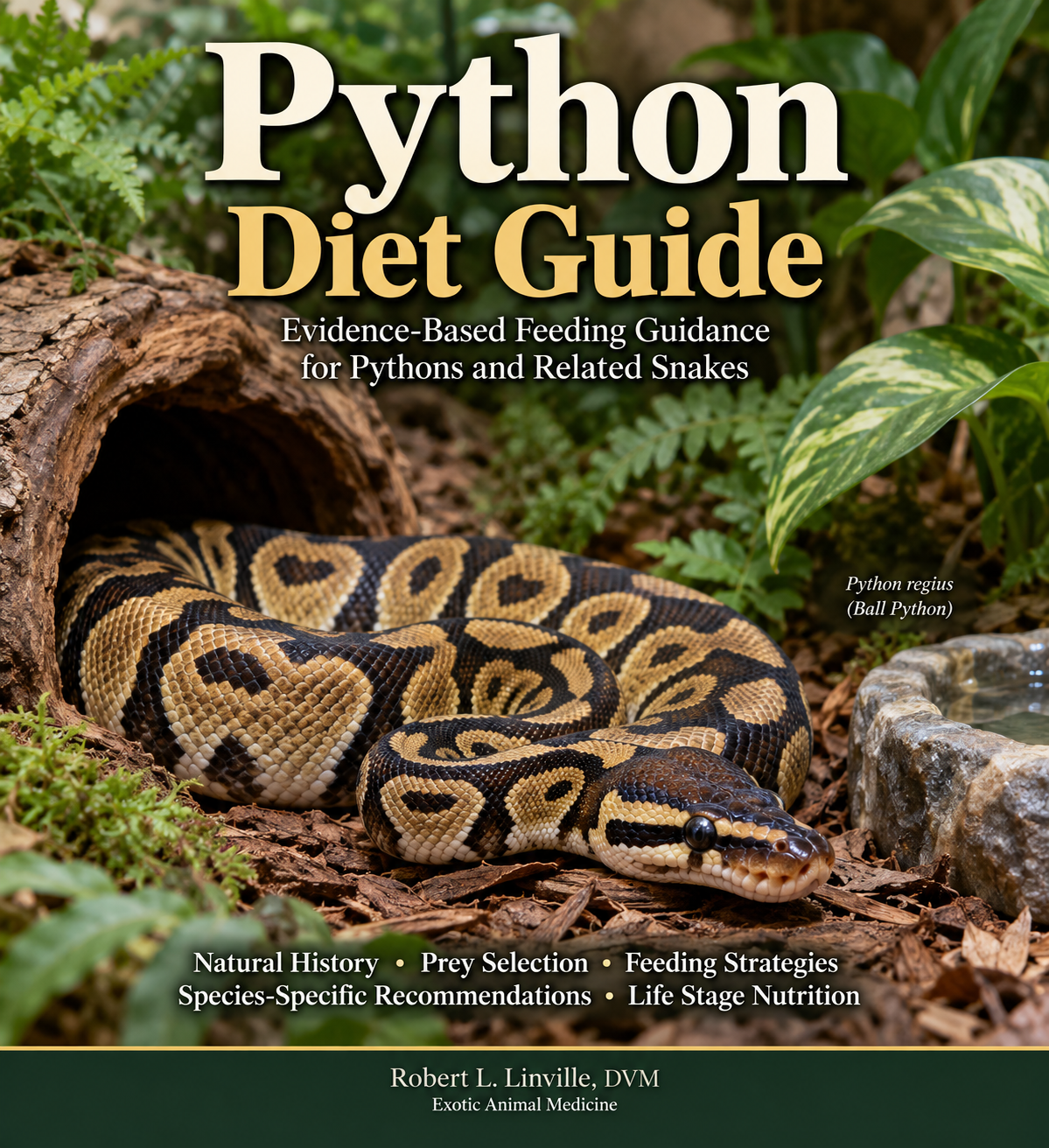
Ball / Royal Python — Python regius
Natural diet: Small mammals and birds, with prey use influenced by sex, size, habitat, and burrow ecology.
Captive staple: Appropriately sized mice, rats, or African soft-furred rats from reliable sources. Birds may be used for controlled variety.
Frequency: Small juveniles often begin around every 7–10 days; larger juveniles around 7–14 days; many adults do well around every 2–4 weeks, adjusted to body condition.
When: Evening or early night often matches normal activity.
Where: Offer near a secure hide or usual hunting position.
How: Warm prey well and present quietly with tongs. Avoid repeatedly opening the enclosure or handling a reluctant feeder.
Important: Seasonal or reproductive fasting can occur. Stable weight and good condition matter more than an arbitrary number of missed meals.
Burmese Python — Python bivittatus
Natural diet: Mammals, birds, and reptiles. Smithsonian notes that wild animals may go days or weeks between successful meals.
Captive staple: Rats when young; larger rodents, rabbits, poultry, or other professionally raised whole prey only as body size truly requires.
Frequency: Juveniles may begin around every 7–14 days. As prey size increases, lengthen toward every 2–4 weeks; large adults often require 3–6 weeks or longer.
How: Use long tongs, a consistent feeding cue, and strict handling protocols. Never hand-feed.
Important: Chronic overfeeding of giant pythons is a major preventable problem. Rapid growth should not be the goal.
Indian Rock Python — Python molurus
Natural diet: Mammals and birds, with prey size increasing substantially as the snake grows.
Captive feeding: Similar principles to Burmese pythons: whole rodents and birds when young; larger whole prey only when needed.
Frequency: Small juveniles 7–14 days; subadults 2–3 weeks; large adults commonly need much longer intervals.
Important: Large-adult feeding should prioritize lean body condition and safe prey presentation rather than matching the animal's maximum swallowing capacity.
African Rock Pythons — Python sebae / P. natalensis
Natural diet: Broad opportunistic vertebrate diet including mammals and birds.
Captive feeding: Rodents when young; larger whole prey as appropriate. Avoid live prey and excessive meal size.
Frequency: Similar to other giant Python species, with progressively longer intervals as maturity is reached.
Safety: Feeding and routine care of large individuals require experienced handlers, secure enclosures, and a large-constrictor safety protocol.
Reticulated Python — Malayopython reticulatus
Natural diet: Birds and mammals ranging from small species to very large prey as body size increases.
Captive staple: Rats, rabbits, poultry, and other appropriately sized whole prey depending on snake size.
Frequency: Juveniles may start around 7–14 days; subadults 2–3 weeks; large adults often 3–6 weeks or longer depending on body condition.
Important: Reticulated pythons can be intensely food-responsive. Target training and a consistent feeding cue are particularly useful. Appetite is not an appropriate reason to feed more frequently.
Timor Python — Malayopython timoriensis
Natural diet: Small reptiles, birds, mice, and rats.
Captive feeding: Smithsonian reports feeding mice to young animals and transitioning adults to rats.
Frequency: Small juveniles around 7–10 days; larger juveniles around 10–14 days; adults often around 2–3 weeks, adjusted to body condition.
How: Offer warmed prey in a quiet enclosure with minimal disturbance.
Carpet / Diamond / Bredl's Pythons — Morelia
Natural diet: Mammals, birds, and sometimes reptiles; younger animals and some forms make substantial use of elevated hunting sites.
Captive staple: Mice and rats; quail or chicks can provide controlled variety.
Frequency: Small juveniles around 7–10 days; growing juveniles 10–14 days; adults commonly every 2–4 weeks depending on size and activity.
Where: Arboreal or semi-arboreal individuals may respond best when prey is presented near a secure perch.
Important: Carpet pythons are often vigorous feeders and can become overweight if fed weekly into adulthood.
Green Tree Python — Morelia viridis
Natural diet: Juveniles consume smaller animals including reptiles; adults primarily take mammals and birds. Caudal luring and prolonged ambush-site use are documented.
Captive staple: Appropriately sized mice or rats; chicks/quail may be used for variety.
Frequency: Hatchlings/small juveniles about every 7–10 days; larger juveniles around 10–14 days; adults often every 2–3+ weeks.
Where: Present prey at the established perch. Avoid removing the snake solely to feed it.
Important: Oversized prey and excessive handling are especially undesirable because regurgitation can be difficult to manage in arboreal pythons.
Blood Python — Python brongersmai
Natural ecology: Heavy-bodied terrestrial ambush predator of vertebrate prey.
Captive staple: Mice or rats sized conservatively.
Frequency: Juveniles often every 7–14 days; adults commonly every 2–4+ weeks.
Important: A thick-bodied python is not necessarily a well-conditioned python. This group can become obese while still appearing “normal” to an inexperienced keeper.
Borneo / Sumatran Short-tailed Pythons
Captive staple: Appropriately sized mice and rats.
Frequency: Similar to blood pythons: conservative juvenile feeding, then longer adult intervals.
Important: Avoid the traditional assumption that a heavy-bodied snake should receive proportionally massive meals. Muscularity and body contour are better indicators than bulk.
Antaresia — Children's, Spotted, Stimson's, Pygmy/Anthill Pythons
Natural diet: Small mammals, amphibians, lizards, and occasional birds; ambush feeding along prey routes is documented, and some populations take bats.
Captive staple: Small mice are convenient for most adults; very small hatchlings may need pinky mice or scenting.
Frequency: Hatchlings about every 5–10 days depending on size; juveniles 7–10 days; adults commonly every 10–21 days.
Important: Small body size does not mean these snakes should remain on neonatal mice indefinitely. Progress toward appropriately mature whole prey as size allows.
Black-headed Python — Aspidites melanocephalus
Natural diet: Strongly reptile-based, including skinks, geckos, dragons, legless lizards, and snakes; mammals and birds are less frequent.
Captive feeding: Many captive individuals accept rodents readily. Difficult hatchlings may respond to scenting with captive-produced reptile material rather than repeated live-prey exposure.
Frequency: Juveniles around every 7–10 days; adults commonly every 2–3 weeks depending on condition.
Important: A rodent diet may be practical in captivity, but natural-history specialization should be considered when solving feeding refusal.
Woma Python — Aspidites ramsayi
Natural diet: Reptiles and small mammals, often associated with burrows and arid habitats.
Captive staple: Mice and rats are commonly accepted; scenting may help selected hatchlings.
Frequency: Juveniles about every 7–10 days; adults commonly every 2–3 weeks.
Important: Womas can be strong feeders. Maintain a lean, muscular contour and avoid using feeding response as the schedule.
Water Pythons — Liasis fuscus and relatives
Natural diet: Mammals, birds, reptiles, and other vertebrates depending on habitat and size.
Captive staple: Rodents with optional bird variety.
Frequency: Juveniles 7–14 days; adults about 2–3 weeks, lengthened if body condition increases.
Important: Despite their association with water, fish are not required as a staple for captive water pythons.
Olive Python — Liasis olivaceus
Natural diet: Broad vertebrate diet; adults can take substantial prey.
Captive feeding: Rodents, rabbits, and birds as appropriate to body size.
Frequency: Juveniles 7–14 days; adults generally 2–4+ weeks.
Important: Large adults should be managed like other powerful constrictors, with controlled prey presentation and conservative energy intake.
Macklot's and Related Pythons — Liasis
Captive staple: Appropriately sized rodents with occasional bird prey.
Frequency: Juveniles about every 7–14 days; adults commonly every 2–3 weeks.
How: Use tongs and an established feeding cue; some individuals are extremely food-responsive.
Amethystine / Scrub Pythons — Simalia
Natural diet: Mammals and birds, often taken from elevated or forest-edge hunting locations.
Captive feeding: Rodents and birds; prey size and interval should increase conservatively with growth.
Frequency: Juveniles 7–14 days; adults commonly every 2–4+ weeks depending on species and size.
Important: Large scrub pythons require experienced keepers and large-constrictor safety procedures.
Boelen's Python — Simalia boeleni
Natural-history note: A montane python with comparatively limited captive nutrition data.
Captive feeding: Appropriate whole rodents and birds; avoid extrapolating giant-python feeding rates to this species simply because it is a substantial snake.
Important: Temperature, security, and environmental suitability are particularly important when appetite is inconsistent.
Oenpelli Python — Simalia oenpelliensis
Natural-history note: Large, slender Australian python associated with rocky habitats and vertebrate prey.
Captive principle: Where maintained legally and responsibly, use whole vertebrate prey, conservative meal size, and long adult intervals guided by body condition.
Special Situations: Fasting, Reproduction, Obesity, and Illness
Seasonal and reproductive fasting
Some pythons—especially ball pythons—may undergo prolonged periods of reduced appetite associated with season, reproductive activity, or individual history. A healthy adult that refuses food but maintains weight and body condition is very different from a juvenile losing weight or an adult with concurrent respiratory, gastrointestinal, oral, or neurologic abnormalities.
Breeding males
Males of several species may reduce food intake during breeding season. Avoid force-feeding a healthy, stable adult solely because it has missed a few scheduled meals.
Gravid females and egg attendance
Females may reduce or stop feeding before oviposition and while brooding eggs. Green tree python females, for example, may not eat during gestation. Nutritional planning should therefore begin before breeding with appropriate—but not obese—body condition.
After egg laying
A post-oviposition female may have a strong appetite. Reintroduce food conservatively rather than immediately offering an oversized compensatory meal. Hydration and husbandry should be restored first.
Obesity
Common signs include excessive roundness, loss of the normal muscular contour, thick fat deposition around the tail base and cloaca, visible folds when coiled, and progressive weight gain despite maturity. Heavy-bodied species such as short-tailed pythons require particular care because obesity can be mistaken for normal build.
Illness or unexplained anorexia
Do not mask an underlying disease by repeatedly changing prey. Veterinary evaluation is indicated when anorexia is accompanied by weight loss, dehydration, regurgitation, diarrhea, constipation with systemic illness, oral lesions, wheezing or nasal discharge, abnormal posture, weakness, mites, neurologic signs, reproductive concerns, or persistent failure of a juvenile to establish feeding.
Assisted feeding
Force-feeding or tube-feeding should be reserved for appropriate medical situations and performed by or under the direction of a reptile veterinarian. Repeated unnecessary force-feeding adds stress and can injure the mouth, esophagus, or respiratory tract.
Practices to Avoid
- Routine live-rodent feeding. Rodent bites can cause severe wounds and secondary infection.
- Power feeding. Do not deliberately accelerate growth with oversized prey or unusually short intervals.
- Using a percentage rule as the only feeding rule. Body condition, prey diameter, species, and life stage matter.
- Feeding multiple small prey solely to “make up” the equivalent of one oversized meal. Total calories still count.
- Feeding butchered muscle meat as a staple. It lacks the balanced bone, organ, and connective-tissue components of whole prey.
- Routine calcium or vitamin dusting of complete whole prey. Supplement only for a defined reason.
- Feeding cold or partially frozen prey.
- Refreezing thawed prey.
- Handling immediately after feeding.
- Assuming every refusal is behavioral. Rule out husbandry and disease when the pattern is abnormal.
- Wild-caught feeder reptiles or amphibians. Parasite, infectious-disease, contaminant, legal, and conservation concerns are substantial.
- Offering prey with bare hands. Use long feeding tongs and a predictable feeding cue.
Weight and Body-Condition Monitoring
A feeding plan is only useful if its effect on the snake is monitored. Weigh growing juveniles periodically on the same scale. Adults can be weighed less often, but enough to identify gradual obesity or clinically important loss.
| Finding | Interpretation | Possible response |
|---|---|---|
| Steady juvenile growth with good muscle tone | Usually appropriate energy intake | Continue and increase prey size gradually as needed. |
| Rapid juvenile weight gain with increasing roundness | Possible excess calories / power feeding | Reduce meal size and/or lengthen interval. |
| Adult continues gaining after mature size | Often excessive energy intake | Lengthen feeding interval and reassess prey size. |
| Prominent spine, reduced muscle mass, progressive weight loss | Underfeeding or disease | Review intake and husbandry; obtain veterinary evaluation if unexplained. |
| Repeated regurgitation | Oversized prey, low temperature, handling, infection, parasitism, obstruction, or other disease | Stop routine feeding and seek reptile-veterinary evaluation. |
| Prolonged fast with stable adult weight | May be seasonal or reproductive in some species | Monitor; review husbandry; do not force-feed solely because of the calendar. |
| Prolonged fast with weight loss | Potential medical or husbandry problem | Veterinary evaluation is indicated. |
Selected References and Further Reading
- Merck Veterinary Manual. Nutrition in Snakes. Reviewed 2025.
- Merck Veterinary Manual. Nutrition in Reptiles. Updated 2025.
- Merck Veterinary Manual. Management and Husbandry of Reptiles.
- Smithsonian's National Zoo and Conservation Biology Institute. Burmese Python.
- Smithsonian's National Zoo and Conservation Biology Institute. Green Tree Python.
- Smithsonian's National Zoo and Conservation Biology Institute. Black-headed Python.
- Smithsonian's National Zoo and Conservation Biology Institute. Timor Python.
- Smithsonian's National Zoo and Conservation Biology Institute. Animal Nutrition Science.
- San Diego Zoo Wildlife Alliance. Python.
- Animal Diversity Web, University of Michigan. Antaresia.
- Animal Diversity Web, University of Michigan. Black-headed Python.
- Animal Diversity Web, University of Michigan. Green Tree Python.
- Animal Diversity Web, University of Michigan. Reticulated Python.
- The Reptile Database. Current taxonomy and species accounts for Pythonidae.
- Dr. Bob's Reptile and Amphibian Species Resources — curated python, snake-health, veterinary, university, zoological, and herpetology links.