Chelonian Husbandry & Preventive Care
Box Turtle Care Guide
A comprehensive husbandry guide for North American Terrapene and selected Asian Cuora box turtles, with general chelonian-care principles followed by species- and group-specific recommendations. Particular emphasis is placed on large usable floor area, outdoor versus indoor housing, thermal and moisture gradients, UVB and daylight, deep substrate and leaf litter, soaking and semiaquatic systems, shell and beak health, seasonal biology, reproduction, biosecurity, preventive care, and common health problems.
Quick Care Guide
There is no single “box turtle setup.” The common name includes temperate woodland turtles, prairie and semidesert burrowers, a uniquely aquatic Mexican Terrapene, and multiple Asian Cuora adapted to humid forest floors or semiaquatic wetlands. Correct identification should come before enclosure design.
| Care area | Practical starting principle | Important qualification |
|---|---|---|
| Space | Provide a large floor-oriented enclosure with room for temperature, moisture, substrate, cover, and behavioral choice. | Outdoor pens are often superior for appropriate North American species in suitable climates; Asian and semiaquatic species may require substantially different systems. |
| Outdoor housing | Use solid, escape-resistant walls, buried barriers, shade, drainage, hides, vegetation, and predator protection. | Free roaming in a yard exposes turtles to dogs, mowers, pesticides, drowning, escape, theft, and wildlife contact. |
| Temperature | Provide a measured basking zone plus cooler retreat rather than uniform heat. | Woodland, subtropical, prairie, semidesert, montane Asian, and aquatic species need different gradients. |
| UVB and daylight | Provide broad-spectrum daylight and species-appropriate UVB that overlaps the basking zone. | Outdoor unfiltered sunlight can be excellent, but shade must always be available. Indoor lamp percentage alone does not tell you the UV exposure at shell height. |
| Substrate | Use deep, safe, diggable substrate with leaf litter and species-appropriate moisture. | Box turtles use soil and litter for hiding, thermoregulation, moisture conservation, nesting, and overwintering. Bare hard floors are poor long-term housing. |
| Humidity | Create a moisture gradient and humid retreats rather than making the entire enclosure uniformly wet or dry. | Adult ornate/desert box turtles tolerate drier surface conditions than woodland Terrapene; hatchlings of most terrestrial species require more humidity than adults. |
| Water | Terrestrial species need a shallow dish large enough for the turtle to enter and soak comfortably. | Coahuilan and Malayan/Amboina box turtles require much more aquatic habitat than typical terrestrial box turtles. |
| Social housing | One turtle per enclosure is the safest companion-animal default. | Group housing requires much more space, multiple resources, sex-ratio management, and close observation for chronic intimidation or mating trauma. |
| Handling | Support the entire shell with two hands and keep handling brief. | Never drill the shell, tether a turtle, or carry it by a limb or tail. Wash hands after handling. |
| Seasonality | Respect seasonal changes in activity, photoperiod, rainfall, and temperature. | Brumation is not appropriate for every species or every individual and should not be improvised in unhealthy, newly acquired, juvenile, or poorly characterized turtles. |
| Nutrition | Use the companion Box Turtle Diet Guide. | North American and Asian box turtles differ in animal-food use, plant foods, feeding location, and seasonal appetite. |
Box Turtle Diversity and Taxonomy
Box turtles are members of the reptile order Testudines (chelonians). The common name “box turtle” describes turtles with a strongly hinged plastron capable of partially or completely closing the shell, but it does not represent one single evolutionary lineage.
North American box turtles belong to the genus Terrapene in the family Emydidae. Asian box turtles belong primarily to the genus Cuora in the family Geoemydidae. The two groups differ in ancestry, climate, habitat use, water dependence, conservation status, and husbandry.
Taxonomy within Terrapene continues to be interpreted differently by authorities. For example, three-toed box turtles are traditionally treated as Terrapene carolina triunguis, while some modern databases recognize Terrapene triunguis as a species. The IUCN/SSC Tortoise and Freshwater Turtle Specialist Group account still discusses the common-box-turtle complex broadly. This guide uses names familiar to keepers while noting important alternative treatments rather than implying that the taxonomy is completely settled.
Turtle, Tortoise, Terrapin, and Box Turtle Terminology
- Turtle is the broad English term for members of Testudines and can include terrestrial, freshwater, and marine species.
- Tortoise is most accurately used for terrestrial members of the family Testudinidae. Box turtles are not tortoises, even though older veterinary and husbandry references sometimes use “box tortoise.”
- Terrapin is an informal regional common name, usually applied to certain freshwater or brackish-water turtles. It is not a formal taxonomic category.
- Box turtle refers to turtles whose plastral hinge allows substantial shell closure. It includes North American Terrapene and Asian Cuora, which should not be assumed to share one husbandry plan.
Because the site’s larger Reptile Resources page organizes Testudines under “Chelonians — turtles, tortoises, and terrapins,” this guide uses chelonian when discussing anatomy or medical principles that apply broadly across turtles and tortoises, and box turtle when discussing the animals covered here.
Natural History and Ecological Groups
Box-turtle husbandry makes more sense when the major ecological types are recognized:
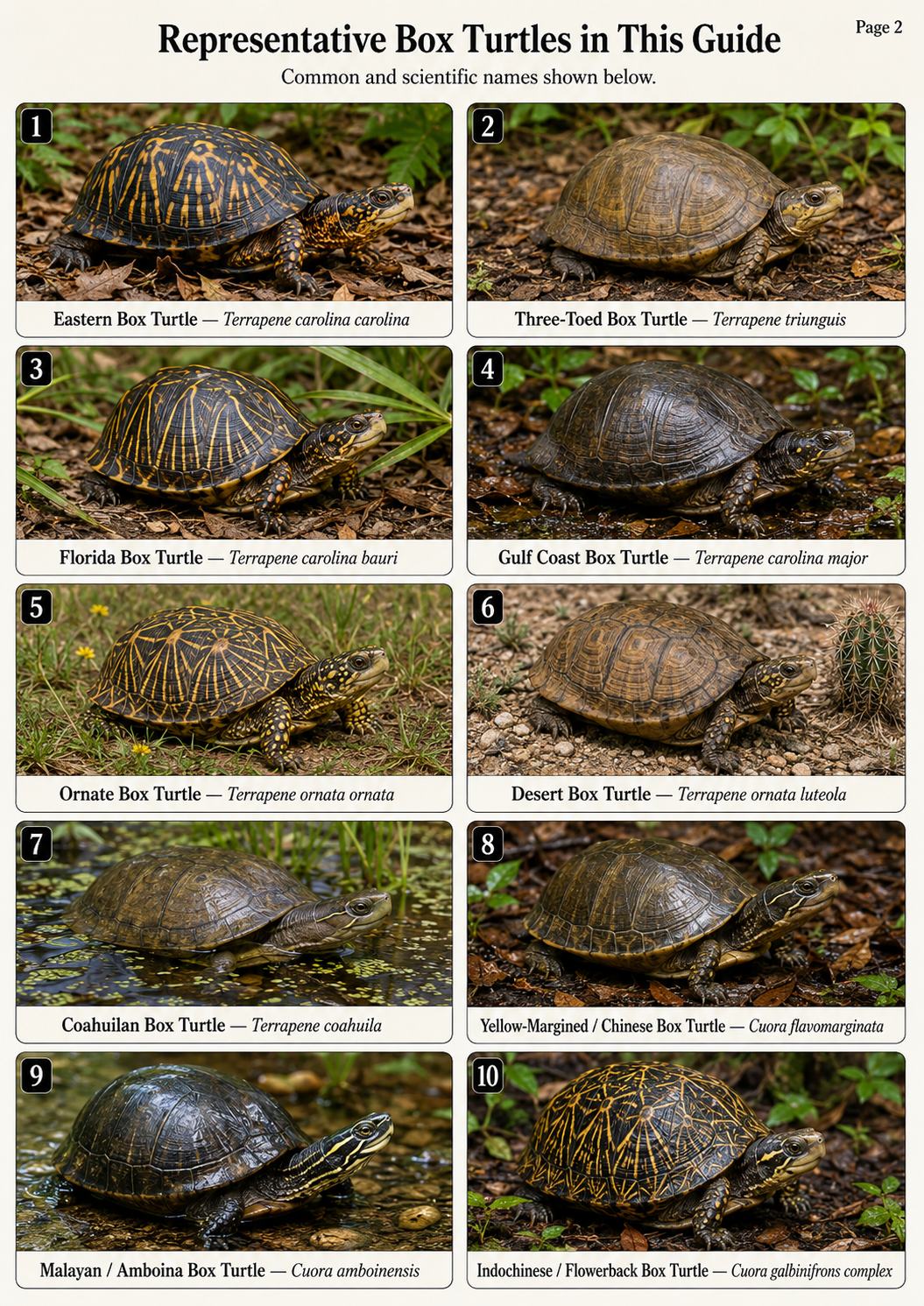
- Moist temperate woodland Terrapene: eastern and three-toed box turtles use forest floor, field edges, leaf litter, moist soil, ephemeral pools, shaded retreats, and seasonal temperature changes.
- Humid subtropical Terrapene: Florida and Gulf Coast box turtles experience longer warm seasons, high humidity, heavy rainfall, wet hammocks, marsh margins, and frequent access to shallow water.
- Prairie and semidesert Terrapene: ornate and desert box turtles inhabit open grasslands, prairie, thornscrub, and semiarid habitats. They avoid extremes by burrowing and may become highly active after rainfall.
- Aquatic Terrapene: the Coahuilan box turtle is the only living Terrapene that is fundamentally aquatic, occupying shallow wetlands in the Cuatro Ciénegas basin of Mexico.
- Humid forest-floor Asian Cuora: yellow-margined and the Indochinese/flowerback complex use dense cover, humid soil and leaf litter, shallow water, and comparatively sheltered forest microclimates.
- Warm semiaquatic Asian Cuora: Malayan/Amboina box turtles are strongly aquatic lowland tropical turtles of marshes, ponds, rice paddies, and still warm water.
Shell Anatomy, the Hinged Plastron, and Shell Health
The shell is living skeletal tissue. The upper shell is the carapace; the lower shell is the plastron. Bone lies beneath keratinized scutes in most box turtles. The shell is supplied by blood vessels and nerves and can be painful when injured.
In box turtles, a transverse plastral hinge allows the front and rear portions of the plastron to close against the carapace. The ability to close varies with species, age, body condition, injury, and individual anatomy. Hatchlings may have a less functional hinge than mature adults.
- Do not paint, polish, oil, wax, drill, or glue decorative material to a healthy shell.
- Do not use the shell as a handle for tethering or attaching trackers unless a trained wildlife professional is using an approved research technique.
- Shell cracks, punctures, soft areas, foul odor, discharge, deep pitting, or unstable scutes require veterinary assessment.
- Normal growth rings and mild retained superficial keratin should not be aggressively peeled away.
- Shell shape reflects long-term nutrition, UVB, exercise, substrate, hydration, and growth rate. Deformity in a mature animal cannot simply be “fixed” by increasing calcium.
Before Your Box Turtle Arrives
Build the enclosure before acquisition and operate the heat, UVB, misting, filtration, and seasonal controls long enough to verify that the intended environment is actually being produced.
- Confirm the exact species or subspecies, geographic origin if known, captive-bred versus wild-caught history, age, sex, and prior brumation history.
- Ask for the previous enclosure temperatures, humidity, lighting, water access, substrate, diet, and recent weight trend.
- Ask about nasal discharge, swollen eyes, oral plaques, ear swellings, shell lesions, diarrhea, parasites, prior antibiotic treatment, unexplained deaths, or infectious-disease testing in the source collection.
- Have a quarantine enclosure, digital gram scale, digital thermometers, hygrometer, infrared thermometer, UVB system, water dish or filtered aquatic area, and secure transport container ready.
- Locate a veterinarian experienced with reptiles and chelonians before an emergency occurs.
Captive Origin, Conservation, and Legal Possession
Many box turtle populations are declining because of habitat loss, roads, collection, illegal trade, and fragmentation. Asian Cuora include some of the world’s most threatened turtles. The fact that a turtle is offered for sale does not establish legal or ethical provenance.
- Prefer documented captive-bred animals. This is particularly important for Asian box turtles and uncommon Mexican species.
- Do not collect healthy wild box turtles as pets. Adult Terrapene often occupy long-term home ranges; removing breeding adults can affect local populations for decades.
- Verify law before possession or transport. Native box-turtle collection, possession, sale, breeding, and transport rules differ by state and country, and some species have CITES or endangered-species protection.
- Never release a long-term captive turtle into the wild. Captive animals can introduce ranavirus, herpesvirus, Mycoplasma, adenovirus, parasites, or other pathogens and may be outside their native genetic population or range.
- Road encounters: when legal and safe, a healthy wild box turtle in immediate road danger should generally be moved only across the road in the direction it was already traveling, not relocated to a distant “better habitat.”
Indoor Versus Outdoor Housing
Box turtles are active terrestrial or semiaquatic animals with complex thermal and moisture requirements. Housing should be designed as a small habitat rather than a display tank.
Outdoor housing
For temperate North American Terrapene maintained within a suitable climate, a secure outdoor enclosure can provide excellent natural daylight, UVB, rainfall, soil depth, plant cover, temperature variation, and behavioral opportunity. Outdoor housing is not automatically safe: local heat, freezing conditions, predators, flooding, toxic plants, pesticides, and escape risk must be managed.
Indoor housing
Indoor housing allows tighter environmental control and may be necessary for inappropriate climates, quarantine, illness, juveniles, Asian forest species, or conservation-sensitive animals. The major limitation is usually insufficient floor area. Glass aquaria marketed for small reptiles are commonly too small for a mature box turtle to establish meaningful gradients.
Floor area is more important than height
Most box turtles benefit more from a larger footprint than from a tall enclosure. Walls must nevertheless be high enough to prevent climbing out, because box turtles are persistent climbers and can use corners or furnishings as ladders.
Outdoor Pen Design and Safety
- Walls: use opaque or visually solid walls whenever possible. Turtles may pace persistently against transparent or open wire boundaries.
- Height: approximately 18–24 in (46–61 cm) of smooth above-ground wall is practical for many adults, with an inward cap/overhang at corners if climbing is possible.
- Buried barrier: extend the barrier about 8–12 in (20–30 cm) below ground where the species and soil allow digging.
- Predator protection: protect against dogs, raccoons, foxes, coyotes, rats, corvids, and other local predators. Juveniles require especially secure overhead protection.
- Shade: at least part of the enclosure must remain deeply shaded through the hottest part of the day. A turtle must be able to leave direct sun completely.
- Drainage: prevent flooding of burrows and overwintering sites. At the same time, woodland species need moist soil zones and humid cover.
- Vegetation and litter: provide pesticide-free grasses, shrubs, safe ground cover, leaf litter, logs, bark, and multiple hide sites.
- Water: provide an easy-entry soaking pan or pond appropriate to the species. Ramps should allow a weakened turtle to exit without climbing a steep slippery wall.
- No lawn free roaming: lawn mowers, string trimmers, dogs, pools, gates, vehicles, garden chemicals, and escape make unsupervised yard access hazardous.
- No toxic chemicals: avoid slug bait, rodenticides, herbicides, insecticides, treated lumber residues, and systemic pesticides on plants.
Outdoor high-temperature safety: For Eastern, three-toed, and similar North American box turtles, brief daytime ambient temperatures into the low 90s°F (about 32–34°C) can be tolerated only when abundant deep shade, moist soil and leaf litter, burrows or hides, and clean soaking water allow the turtle to maintain a substantially cooler body temperature. Approximately 95°F (35°C) should be regarded as a practical upper ambient limit for routine outdoor housing. When air temperatures approach or exceed 95°F, verify that the coolest turtle-accessible retreat remains below approximately 82–85°F (28–29°C). If this cannot be maintained, move the turtle to controlled indoor conditions. Ambient temperatures of 100°F (38°C) or higher should be considered high risk for ordinary captive outdoor housing.
Indoor Enclosure Materials and Security
- Large PVC, sealed wood, or purpose-built pens: often provide better usable floor area than glass tanks and can retain appropriate humidity while still permitting ventilation.
- Glass: can work when sufficiently large, but visual barriers along lower walls can reduce pacing. Never place a glass enclosure in direct sunlight.
- Open-top turtle tables: useful for drier temperate species when room humidity is adequate, but they can lose humidity rapidly and make thermal control difficult.
- Ventilation: even humid species need air exchange. Humidity should be created with moist substrate, water, plants, and controlled misting—not by sealing an enclosure until it becomes stagnant.
- Heat safety: lamps should be mounted so the turtle cannot contact the bulb or fixture. Hot rocks should not be used.
- Escape prevention: corners, filter hoses, logs, pots, and shelter roofs can become climbing aids. A box turtle that can get its front feet onto an edge can often lever itself higher than expected.
Substrate, Leaf Litter, Burrowing, Drainage, and Nesting
Deep substrate is a functional part of box-turtle biology. It permits digging, moisture regulation, hiding, nesting, cooling, and in some temperate species seasonal retreat.
- Woodland Terrapene: use a deep moisture-retentive soil-based mix topped with pesticide-free leaf litter. Provide both moist and relatively drier zones.
- Ornate/desert forms: use deep, firm, diggable soil with sand/clay character rather than loose dry sand alone. A humid buried retreat remains necessary.
- Asian forest Cuora: use moist soil, leaf litter, moss/cork where appropriate, and excellent drainage so the upper surface is not continuously waterlogged.
- Semiaquatic species: provide an accessible land/nesting zone in addition to water. Females must have suitable land substrate even when the species spends much of its time in water.
- Depth: for a normal adult terrestrial box turtle, 4–8 in (10–20 cm) of substrate is a useful indoor starting range, with deeper areas for large animals, nesting females, and species that burrow strongly.
Avoid sharp gravel, cedar, strongly aromatic wood products, calcium sand, dusty substrates, and permanently saturated soil. Paper is useful for quarantine or medical monitoring but is not ideal as a permanent habitat for a healthy digging species.
Water, Soaking, and Semiaquatic Systems
Terrestrial North American box turtles
Provide a shallow, stable water pan large enough for the turtle to enter completely and soak, but shallow enough that a normal adult can keep its head well above water without swimming. A textured ramp or low rim makes entry and exit easier. Change the water whenever contaminated.
Humid forest box turtles
Yellow-margined and many other forest Cuora benefit from a larger shallow-water area in addition to humid land. Water depth should allow easy standing and surface access unless the exact species is known to be a strong swimmer.
Strongly semiaquatic and aquatic species
Malayan/Amboina and Coahuilan box turtles should not be housed as ordinary terrestrial box turtles with only a small soaking dish. They require substantial permanent water, stable land areas, gentle entry/exit, and water-quality management comparable to other freshwater turtles.
Water Quality and Filtration
When a species has a substantial aquatic zone, water becomes part of the enclosure’s life-support system.
- Use filtration sized for a turtle’s heavy organic waste load, often larger than an aquarium filter rated only for fish.
- Remove feces and uneaten food promptly and perform regular partial water changes.
- Use dechlorinated or otherwise safe source water appropriate for the local supply.
- Measure water temperature independently from air temperature.
- Design intake guards and plumbing so feet, head, and shell cannot become trapped.
- Provide a dry or at least well-drained land area where the shell can dry normally unless a specialist protocol specifically calls for otherwise.
- For chronically ill aquatic/semi-aquatic turtles, veterinary diagnostics may include water-quality review because environmental stress can contribute to skin, shell, respiratory, and systemic disease.
Temperature and Basking Heat
Box turtles are ectotherms and must be able to choose among warmer and cooler microclimates. Merck’s current reptile husbandry table lists a broad air-temperature zone of approximately 72–82°F (22–28°C) for temperate/subtropical box turtles, with a basking area generally warmer than the main air zone. Species-specific requirements are more useful than this broad generalization.
Use an overhead basking source to warm a patch of substrate or natural surface while leaving at least one large shaded cool zone. Avoid heating the entire enclosure to the basking temperature.
For Eastern, three-toed, and similar North American box turtles in outdoor enclosures, approximately 95°F (35°C) should be treated as the practical upper ambient limit for routine housing, and any period approaching that level should be safe only if the enclosure still provides access to much cooler shaded refuges. Ambient temperatures of 100°F (38°C) or higher are high risk for ordinary captive outdoor housing.
Measuring Temperature Correctly
| Tool | Best use | Limitation |
|---|---|---|
| Digital probe thermometer | Continuous reading of cool-zone air, warm hide, burrow, or water temperature. | One probe represents one microclimate only. |
| Infrared thermometer | Rapid mapping of shell-height basking surfaces, soil, logs, stones, and water-edge surfaces. | Measures surface temperature, not air or deep substrate. |
| Digital thermometer/hygrometer | Continuous air temperature and relative humidity. | Placement affects the reading; use more than one sensor in a large enclosure. |
| Aquarium thermometer | Continuous water-temperature monitoring in semiaquatic systems. | Does not measure basking or land temperature. |
| Thermostat | Controls electrical heat sources and reduces overheating risk. | A thermostat setting is not proof that the actual basking surface or cool zone is correct. |
UVB, UVA, and Visible Light
Box turtles are diurnal reptiles that benefit from a complete daylight environment. Heat, bright visible light, UVA, and UVB should overlap in the principal basking zone while dense cover permits retreat into shade.
For commonly kept North American Terrapene, current practical husbandry guidance generally targets approximately UVI 3–4 at the basking site. Forest-dwelling Asian Cuora often use filtered light and generally warrant lower-to-moderate exposure with extensive shade; exact evidence-based UVI targets are not available for every species.
- Position UVB according to measured output at shell height, not merely the distance recommended on a lamp package.
- Mesh screens reduce UVB to varying degrees depending on wire thickness and open area.
- Ordinary window glass and most clear plastics block biologically useful UVB.
- Replace or reposition lamps based on meter readings and manufacturer performance data rather than calendar age alone when possible.
- Provide bright white daytime lighting; do not use red, blue, or purple night bulbs.
UV Cards and UV Index Meters
UV-sensitive test cards can show that a lamp is producing some ultraviolet output and are useful for quick qualitative checks. They do not provide a dependable numerical UV Index and should not be used to decide whether a basking site is at UVI 1, 2, 3, or 4.
A reptile-appropriate UV Index meter, such as a Solarmeter 6.5/6.5R or equivalent, is the preferred quantitative tool. Measure where the top of the turtle’s shell actually reaches the light. Keep a shaded area at substantially lower UVI so the turtle can regulate exposure.
Humidity and Moisture Gradients
Box turtles regulate hydration through drinking, soaking, food, soil moisture, burrows, leaf litter, and behavior. A single relative-humidity reading does not describe the entire habitat.
- Eastern/three-toed: generally about 60–80% ambient humidity with deeper humid soil and leaf litter.
- Florida/Gulf Coast: generally higher humidity, often approximately 70–85%, with abundant water access and damp refuges.
- Adult ornate/desert: often approximately 30–60% ambient depending on season/locality, but always with a substantially more humid burrow or hide.
- Hatchlings: require greater moisture security than many adults and dehydrate rapidly.
- Asian forest box turtles: generally need high humidity and moist substrate together with air movement and areas that are not continuously waterlogged.
Misting can be useful to mimic rainfall and stimulate activity, but spraying is not a substitute for deep moist substrate, leaf litter, drinking water, or appropriate water features.
Furnishings, Cover, and Environmental Enrichment
For a box turtle, enrichment means the opportunity to behave like a box turtle. Useful features include:
- deep leaf litter to push through and hide beneath;
- multiple logs, cork flats, low caves, and vegetation clumps;
- soil mounds and gentle terrain changes;
- separate sunny/basking and shaded areas;
- multiple moist and dry microhabitats;
- a shallow pool or soaking dish with safe entry and exit;
- edible or nontoxic live plants grown without systemic pesticides;
- scattered feeding locations and naturalistic foraging opportunities;
- visual barriers that allow an animal to leave another turtle’s view.
Avoid excessively steep rock piles or decor that can trap a turtle upside down. Heavy items should rest on a stable base so digging cannot undermine them.
Outdoor Sunlight
Unfiltered natural sunlight provides excellent visible light and UV exposure and can be highly beneficial when outdoor temperature and species requirements are appropriate. Natural sunlight should be provided through a secure pen, not by placing an indoor glass enclosure outdoors.
Outdoor turtles need a mosaic of full sun, dappled shade, deep shade, moist retreat, water, and buried substrate. The objective is not “maximum sun”; it is behavioral choice.
Handling and Restraint
Most healthy box turtles tolerate brief necessary handling but do not benefit from frequent carrying or household roaming.
- Approach calmly and place one hand on each side of the shell.
- Support the entire body and keep the turtle horizontal.
- Hold low over a secure surface in case the turtle pushes or twists unexpectedly.
- Keep fingers away from the mouth of large or defensive Asian box turtles.
- Never pick up a turtle by a limb or tail.
- Do not force the shell open when a box turtle closes tightly. Veterinary examination uses controlled techniques that avoid damaging the hinge or limbs.
- Wash hands after handling the turtle or anything from its enclosure.
Terrain, Falls, and Righting Safety
Box turtles can climb surprisingly well but are not designed for tall vertical falls. Keep platforms low and stable, and avoid narrow ledges above hard surfaces.
A healthy turtle should normally be able to right itself on natural substrate. However, smooth flooring, steep-sided bowls, deep water, obesity, neurologic disease, weakness, or a highly domed shell can interfere. Design the enclosure so an overturned turtle is unlikely to become trapped beneath a heat source or underwater.
Normal Behavior and Communication
- Morning activity: many Terrapene become active after warming, especially on humid mornings or after rain.
- Midday retreat: woodland and grassland box turtles often shelter during the hottest or driest part of the day.
- Rain response: activity commonly increases during and after rainfall.
- Burrowing: hiding beneath litter or soil is normal for thermoregulation, moisture conservation, nesting, and seasonality.
- Soaking: periodic soaking is normal in terrestrial species; prolonged continuous soaking can also signal dehydration, overheating, skin disease, parasites, or inappropriate humidity.
- Shell closure: withdrawing and closing the plastron is a normal defense response, particularly in a newly acquired or frightened animal.
- Seasonal appetite: temperate turtles may eat less as days shorten and temperatures decline. Illness should not automatically be labeled “brumation.”
Sex Identification
Sexual characteristics vary among species and become more reliable after maturity.
| Feature | Typical male tendency | Typical female tendency / caution |
|---|---|---|
| Plastron | Often concave in many Terrapene. | Often flatter; degree varies by species. |
| Tail | Usually longer and thicker, with cloacal opening farther from shell margin. | Usually shorter, narrower tail with cloaca closer to body. |
| Eye color | Eastern males often have red/orange irises. | Females more often brown/yellow; this is not reliable in every animal or subspecies. |
| Hind claws/toes | Species-specific differences; ornate males may show an enlarged/curved inner hind toe. | Usually less modified. |
| Shell/body proportions | May differ slightly by species. | Females may become broader posteriorly when reproductive. |
Do not determine sex from one color characteristic alone. Juveniles can be impossible to sex confidently without maturity or specialist examination.
Reproductive Considerations
Female box turtles can form follicles and eggs without a male. Some species can store sperm for extended periods after mating, so a newly acquired female may lay fertile eggs unexpectedly.
- Provide deep, diggable, appropriately moist nesting substrate before a mature female begins searching for a nest site.
- Persistent pacing, repeated digging without laying, hind-limb straining, anorexia, weakness, abnormal posture, or prolonged retention of eggs warrants veterinary evaluation.
- Dystocia may be associated with inadequate nesting substrate, dehydration, low temperature, hypocalcemia, abnormal eggs, pelvic obstruction, stress, or concurrent disease.
- Radiographs and ultrasound are commonly used to distinguish normal gravidity from egg retention or follicular disease.
- Preovulatory follicular stasis, postovulatory egg stasis, ectopic eggs, yolk coelomitis, and salpingitis may require medical and/or surgical treatment.
- Do not breed conservation-sensitive species without verified legal origin, genetic/record management, suitable facilities, and a plan for offspring.
Species-Specific Husbandry Comparison
The following values are practical starting points for healthy adults. They are not rigid prescriptions. Outdoor climate, enclosure scale, individual behavior, age, season, health, and locality can justify adjustment. Where high-quality captive data are limited, the table identifies the range as provisional rather than presenting it as an established standard.
| Species/group | Approximate adult size | Adult enclosure starting point | Temperature | Humidity / water | UV / key point |
|---|---|---|---|---|---|
| Eastern T. c. carolina | Typically 4.5–6 in; large adults may approach 8 in (11–20 cm) | ~6.5×3.5×2 ft (2.0×1.1×0.6 m) or larger indoors; secure outdoor pen preferred when climate permits | Bask 84–88°F (29–31°C); cool 70–75°F (21–24°C) | ~60–80%; deep moist soil, leaf litter, large shallow soak | UVI ~3–4; temperate woodland, seasonal |
| Three-toed T. triunguis / T. c. triunguis | ~5–7 in (13–18 cm) | ~5×3×2 ft (1.5×0.9×0.6 m) or larger; outdoor pen when appropriate | Bask ~85°F (29°C); cool 70–75°F (21–24°C) | ~60–80%; moist retreat and soaking water | UVI ~3–4; warm-temperate woodland |
| Florida T. c. bauri | Usually ~5–7 in (13–18 cm) | ~6×3×2 ft (1.8×0.9×0.6 m) or larger | Bask ~88–92°F (31–33°C); cool 75–80°F (24–27°C) | ~70–85%; wet end, deep humid cover, frequent soaking access | UVI ~3–4; subtropical; little reason to force deep brumation in typical pet care |
| Gulf Coast T. c. major | ~6–8+ in (15–20+ cm) | ~8×4×2 ft (2.4×1.2×0.6 m) or large outdoor pen | Bask ~88–92°F (31–33°C); cool 75–80°F (24–27°C) | ~70–85%; large soak/wetland feature useful | UVI ~3–4; largest common-box-turtle form |
| Ornate T. o. ornata | Most 4–6 in; females may reach ~6.7 in (10–17 cm) | ~5×2.5×2 ft (1.5×0.75×0.6 m) or larger | Bask 90–95°F (32–35°C); cool 70–77°F (21–25°C) | Adult ambient ~30–60%; humid burrow always; hatchlings wetter | UVI ~3–4; prairie/grassland burrower |
| Desert T. o. luteola | ~5–5.75 in (13–15 cm) | Similar to ornate; deep diggable floor and secure humid retreat | Provisional bask 90–95°F (32–35°C); cool 70–78°F (21–26°C) | Provisional ~30–50/60% ambient plus humid burrow; rainfall pulses important | UVI ~3–4; semidesert grassland, not a bare sand desert species |
| Coahuilan T. coahuila | Up to ~9.1 in (23 cm) | Large custom semiaquatic system; roughly ≥8×4 ft (≥2.4×1.2 m) footprint for an adult is a welfare-oriented starting scale | Specialist-managed; provisional water ~72–80°F (22–27°C), bask 85–90°F (29–32°C) | Shallow wetland-dominant habitat with permanent clean water plus stable land | Conservation specialist; do not use ordinary terrestrial Terrapene husbandry |
| Yellow-margined Cuora flavomarginata | ~5–8 in (13–20 cm) | ≥4×2×1.5 ft (1.2×0.6×0.45 m), larger preferred | Ambient/water 75–82°F (24–28°C); bask 86–90°F (30–32°C); night 68–75°F (20–24°C) | ~60–80%; humid forest substrate plus shallow water | Low-to-moderate measured UV with shade; semi-terrestrial forest species |
| Malayan / Amboina Cuora amboinensis | Up to ~8 in (20 cm) | ≥4×2×1.5 ft (1.2×0.6×0.45 m), preferably larger and water-dominant | Reasonable captive start: water 75–82°F (24–28°C); bask 86–90°F (30–32°C); night 70–76°F (21–24°C) | ~70–90%; large warm shallow-water area and dry land | Strongly aquatic tropical box turtle; no brumation |
| Indochinese / flowerback complex C. galbinifrons, C. bourreti, C. picturata | Roughly 6–8.5 in (15–22 cm), species/sex dependent | Large humid forest enclosure ≥4×2 ft (≥1.2×0.6 m), larger preferred | Approximate active-season range 68–77°F (20–25°C), localized 80–84°F (27–29°C); cooler nights | ~70–90% with ventilation, deep leaf litter, substantial shallow-water area | Conservation-managed; deep winter cooling is an advanced breeding protocol, not generic pet advice |
Eastern Box Turtle — Terrapene carolina carolina
Approximate adult size: commonly about 4.5–6 in (11–15 cm) straight carapace length, with large individuals approaching roughly 8 in (20 cm).
Eastern box turtles are terrestrial woodland turtles of the eastern United States. They commonly use hardwood forest, forest edges, field margins, wetland margins, leaf litter, soft soil, logs, and shallow pools. Activity often increases in humid weather and after rain.
Housing
For an adult kept indoors, approximately 6.5×3.5×2 ft (2.0×1.1×0.6 m) or larger is a modern practical starting point. A secure outdoor pen with equivalent or greater usable area is preferred in appropriate climate. Provide deep soil, leaf litter, multiple hides, a humid lower layer, shade, and a shallow soaking pool.
Temperature
Use a basking surface around 84–88°F (29–31°C) and a cool zone around 70–75°F (21–24°C). Natural nighttime cooling is appropriate. Northern populations experience much colder seasonal conditions in the wild, but this does not mean a pet should be deliberately chilled without a controlled brumation plan.
Humidity and light
Maintain roughly 60–80% relative humidity with deeper moist substrate and dense leaf litter. Provide a basking UVI around 3–4 with abundant shaded cover.
Three-Toed Box Turtle — Terrapene triunguis (traditionally T. carolina triunguis)
Approximate adult size: about 5–7 in (13–18 cm).
Three-toed box turtles are warm-temperate woodland and edge-habitat turtles of the central and south-central United States. They are closely related to the common-box-turtle complex but merit their own husbandry adjustments.
Provide at least about 5×3×2 ft (1.5×0.9×0.6 m) indoors, with a larger outdoor pen preferred where climate allows. Use a basking area near 85°F (29°C), cool region 70–75°F (21–24°C), humidity about 60–80%, deep moist soil and litter, and UVI around 3–4.
Seasonal reduction in activity is normal in much of the range. Intentional brumation should be reserved for healthy animals with known species/locality and appropriate veterinary and husbandry planning.
Florida Box Turtle — Terrapene carolina bauri
Approximate adult size: commonly about 5–7 in (13–18 cm).
Florida box turtles occur in subtropical habitats ranging from comparatively dry scrub/pine systems to damp palm hammocks, wetland edges, and seasonally flooded environments. They require more persistent moisture and a longer warm season than northern eastern box turtles.
A practical adult indoor enclosure is approximately 6×3×2 ft (1.8×0.9×0.6 m) or larger, with dense shaded cover, deep moist substrate, leaf litter, and generous soaking water. Use a basking area around 88–92°F (31–33°C), cooler zone 75–80°F (24–27°C), humidity roughly 70–85%, and UVI around 3–4.
Most companion Florida box turtles do not require an artificially imposed deep northern-style hibernation. Seasonal changes can be expressed through modest photoperiod, rainfall, and temperature variation without forcing temperatures inappropriate for the animal’s origin.
Gulf Coast Box Turtle — Terrapene carolina major
Approximate adult size: commonly 6–8 in (15–20 cm) and occasionally larger; this is generally the largest common-box-turtle form.
Gulf Coast box turtles are large, humidity-associated turtles from the southeastern coastal plain. They use swamp margins, marshy areas, wet forest, and other habitats with abundant cover and water.
Give a large adult approximately 8×4×2 ft (2.4×1.2×0.6 m) or more usable indoor floor area, or preferably a spacious secure outdoor pen in suitable climate. Provide deep damp soil, leaf litter, heavy cover, and a larger soaking/wetland feature than would be typical for an ornate box turtle.
A reasonable starting gradient is basking around 88–92°F (31–33°C), cooler area 75–80°F (24–27°C), humidity around 70–85%, and UVI around 3–4. Ensure ample shade so the large turtle can leave heat completely.
Ornate Box Turtle — Terrapene ornata ornata
Approximate adult size: most adults are around 4–6 in (10–15 cm); females may reach about 6.7 in (17 cm).
Ornate box turtles are terrestrial prairie and grassland specialists. The 2024 IUCN/SSC account emphasizes open semiarid to xeric habitat and the importance of soft substrate for burrowing and nesting. They are not appropriately housed in a barren dry sand box.
Provide at least about 5×2.5×2 ft (1.5×0.75×0.6 m) for an adult, with deep firm diggable soil, grasses/cover, multiple burrows or hides, and a humid retreat. Use a basking surface around 90–95°F (32–35°C), cool zone around 70–77°F (21–25°C), adult ambient humidity about 30–60%, and UVI around 3–4.
Hatchlings and juveniles need substantially greater moisture security than many adults. Chronic desiccation is not “desert husbandry.”
Desert Box Turtle — Terrapene ornata luteola
Approximate adult size: often about 5–5.75 in (13–15 cm).
The desert box turtle is a western form of the ornate-box-turtle complex associated with semidesert grassland, desert scrub, open woodland, and rainfall-driven activity. Its ecology is more complex than the name “desert” suggests.
Modern species-specific controlled husbandry data are less extensive than for the eastern and ornate forms. A reasonable starting plan is therefore based on current ornate-box-turtle care and desert-box-turtle field ecology: a basking surface around 90–95°F (32–35°C), cool zone 70–78°F (21–26°C), ambient humidity approximately 30–50/60% with a much more humid underground retreat, deep diggable soil, and UVI around 3–4.
Rainfall pulses and temporary access to shallow water are biologically important. Do not keep the entire enclosure hot and dry without a humid burrow.
Coahuilan Box Turtle — Terrapene coahuila
Approximate adult size: up to about 9.1 in (23 cm) carapace length.
Captive management should use a large shallow-water-dominant system with aquatic vegetation or structure, secure dry/semidry land, basking areas, easy water exits, strong filtration, and a nesting area for females. A footprint of at least roughly 8×4 ft (2.4×1.2 m) for an adult is a welfare-oriented starting scale rather than an experimentally established minimum.
Published conservation biology provides excellent natural-history data but fewer standardized household-husbandry temperatures. A provisional managed-care starting point is water roughly 72–80°F (22–27°C) with a land basking site around 85–90°F (29–32°C), adjusted according to institutional experience, behavior, season, and actual source locality. Specialist zoological/veterinary guidance should supersede generic values.
Yellow-Margined / Chinese Box Turtle — Cuora flavomarginata
Approximate adult size: roughly 5–8 in (13–20 cm), with sex and population variation.
This is an Asian geoemydid box turtle, not an Asian version of Terrapene carolina. It uses humid forest-floor habitat, dense cover, shallow water, and seasonal temperature variation.
Use at least approximately 4×2×1.5 ft (1.2×0.6×0.45 m) for one adult, with larger preferred. Provide deep moist soil and leaf litter, hiding structure, a large shallow soaking area, and good ventilation.
A reasonable current starting range is ambient/water around 75–82°F (24–28°C), basking 86–90°F (30–32°C), cool zone 72–75°F (22–24°C), night 68–75°F (20–24°C), and humidity around 60–80%. Provide low-to-moderate measured UV exposure with abundant shade rather than intense open-desert lighting.
Malayan / Amboina Box Turtle — Cuora amboinensis
Approximate adult size: up to about 8 in (20 cm).
University of Michigan’s Animal Diversity Web describes this species as a lowland tropical Southeast Asian turtle of marshes, shallow ponds, rice paddies, and other warm still-water environments and notes that it is among the most aquatic box turtles.
Use a large semiaquatic enclosure rather than a dry terrestrial pen. An adult should have at least roughly 4×2×1.5 ft (1.2×0.6×0.45 m), preferably more, with much of the floor devoted to warm shallow water, a completely accessible dry land/basking area, hiding cover, and powerful filtration.
A practical starting range is water 75–82°F (24–28°C), basking 86–90°F (30–32°C), nighttime 70–76°F (21–24°C), and humidity around 70–90%. These turtles are tropical and do not undergo temperate brumation.
Indochinese / Flowerback Box Turtles — Cuora galbinifrons, C. bourreti, and C. picturata
Approximate adult size: roughly 6–8.5 in (15–22 cm), varying with species and sex.
The animals once broadly grouped as the Cuora galbinifrons complex are now generally treated as multiple species. They are highly threatened Asian forest turtles and are best understood through conservation-program husbandry rather than generic pet-store box-turtle care.
Provide a large cool-humid forest-floor enclosure, at least about 4×2 ft (1.2×0.6 m) for an adult and preferably larger, with deep leaf litter, plants, cork/log hides, moist soil, substantial shallow water, and high ventilation despite the high humidity.
Published zoo programs use varied seasonal protocols. A cautious active-season starting band is approximately 68–77°F (20–25°C) with a small localized warm area around 80–84°F (27–29°C), cooler nights, and humidity around 70–90%. Smithsonian breeding success in Bourret’s box turtles has involved controlled winter cooling to much lower temperatures, even about 40°F (4°C), followed by gradual spring warming. That is an advanced conservation-breeding protocol, not a generic instruction for companion turtles.
Additional Mexican and North American Terrapene
The box-turtle fauna also includes Mexican common-box-turtle forms and the spotted box turtle Terrapene nelsoni. These are uncommon in responsible companion care, and some are poorly known biologically. The IUCN/SSC Tortoise and Freshwater Turtle Specialist Group provides species accounts for the common-box-turtle complex, Coahuilan box turtle, and spotted box turtle.
Do not extrapolate a detailed eastern-box-turtle enclosure to an uncommon Mexican animal simply because both are Terrapene. Geographic elevation, rainfall, seasonal temperature, vegetation, and conservation status should be established before husbandry is designed. For poorly documented species, zoological or conservation-program data should take precedence over commercial care sheets.
Other Asian Cuora
Asian box turtles include yellow-margined, three-striped, McCord’s, keeled, Pan’s, Zhou’s, Yunnan, Bourret’s, Vietnamese, Amboina, and other highly threatened species. Many have been heavily affected by wildlife trade.
There is no safe universal “Asian box turtle” temperature or water-depth formula. Some are terrestrial forest-floor turtles; others are semiaquatic; some experience cool montane winters, while others come from warm lowland tropics. Exact species identification, legal provenance, and specialist-managed husbandry are prerequisites.
The Turtle Survival Alliance and accredited-zoo conservation programs are especially valuable sources for these animals because their recommendations are linked to long-term managed populations rather than short-term pet keeping.
Shell, Scute, Skin, Beak, Nail, and Eye Care
Shell and scutes
Normal shell growth produces firm keratinized scutes over living bone. Persistent softening, deep pits, ulceration, discharge, foul odor, red/purple discoloration of the plastron, or unstable shell tissue is abnormal.
Beak
A mild keratin beak edge is normal, but progressive overgrowth can reflect inappropriate diet texture, lack of natural wear, trauma, metabolic disease, or chronic illness. Severe beak trimming should be performed by a veterinarian or experienced chelonian professional; clipping too deeply can expose sensitive tissue.
Nails
Appropriate soil, bark, stones, and walking area usually provide wear. Very long or deformed nails can reflect chronic soft indoor housing or abnormal limb use and may require careful trimming.
Eyes and ears
Swollen eyelids, ocular discharge, or a rounded swelling over the tympanic membrane are not normal “hibernation changes.” Aural abscesses are common chelonian infections and often require surgical debridement. Nutritional vitamin-A imbalance and ascending oral infection can contribute, but vitamin A should not be injected or supplemented aggressively without a diagnosis because overdose is also harmful.
Seasonality and Brumation
Temperate Terrapene experience strong annual cycles. Natural brumation is part of the biology of many northern eastern, three-toed, and ornate populations. Southern Florida, Gulf Coast, tropical Asian, and many subtropical species experience different seasonal patterns.
Intentional brumation should be considered only when species/locality is known, the turtle is mature and healthy, body condition is appropriate, hydration is normal, infectious-disease risk has been assessed, and a safe frost-protected, flood-protected, predator-proof hibernaculum can be maintained. Temperature should be monitored throughout.
For ordinary companion care, especially when origin is uncertain, it is often safer to provide seasonal photoperiod and modest temperature variation without forcing deep winter cooling. Conservation breeding protocols—such as the very low controlled winter temperatures used for some Cuora bourreti programs—should not be copied casually.
Cleaning and Sanitation
- Remove feces, urates, spoiled food, and visibly contaminated substrate promptly.
- Wash soaking dishes daily and whenever fecal contamination occurs.
- For semiaquatic systems, maintain filtration and partial water changes; do not rely on clear appearance alone.
- Use reptile-safe disinfectants at correct dilution and contact time, followed by rinsing where required.
- Do not use the same buckets, nets, brushes, soaking pans, or feeding equipment for quarantined and established turtles.
- Bioactive substrate still requires observation, spot cleaning, periodic substrate management, and pathogen awareness.
- Porous wood and soil may be impossible to disinfect reliably after certain serious infectious diseases and may need disposal.
Salmonella and Household Hygiene
Healthy-looking turtles can carry Salmonella and shed it intermittently. CDC’s August 2026 investigation again documented a multistate outbreak associated with pet turtles; all confirmed patients in that outbreak were children younger than 10 years.
- Wash hands with soap and running water after touching the turtle, water, feces, substrate, food dishes, filters, or enclosure equipment.
- Do not kiss or snuggle turtles or hold them close to the face.
- Keep turtle equipment out of kitchens and food-preparation sinks.
- Do not allow turtles to roam on kitchen floors, tables, children’s play areas, or other surfaces where contamination is difficult to control.
- Pour dirty enclosure water into a toilet or utility drain appropriate for animal waste, not a kitchen or food-preparation sink.
- Children younger than 5 years, adults 65 years and older, and immunocompromised people have increased risk of serious salmonellosis.
- U.S. federal law prohibits sale and distribution of turtles with a carapace length under 4 in (10.2 cm) as pets. Turtles larger than 4 in can still carry Salmonella.
Quarantine and Biosecurity
Box turtles deserve stricter biosecurity than is often practiced. Ranavirus, Terrapene herpesviruses, emydid Mycoplasma, adenovirus, parasites, and other pathogens can move through collections and potentially between wild and captive chelonians.
A practical minimum quarantine period is 90 days, with longer quarantine appropriate for wild-caught animals, imports, animals from mixed collections, or turtles with abnormal clinical signs.
- House new turtles in a separate enclosure and preferably a separate room/airspace.
- Use dedicated water pans, brushes, buckets, nets, scales/containers, and feeding tools.
- Care for established healthy turtles before quarantined animals.
- Record body weight, appetite, stool, respiratory signs, eye appearance, oral cavity, shell condition, and activity.
- Discuss fecal examination and species/risk-appropriate infectious-disease testing with a reptile veterinarian.
- For conservation collections, wild-caught turtles, unexplained respiratory disease, oral plaques, or mortality clusters, PCR testing may include ranavirus/FV3, emydid Mycoplasma, Terrapene herpesvirus 1/2, and box-turtle adenovirus according to case risk.
- Do not assume one negative test eliminates every pathogen or every stage of infection; sampling timing and specimen type matter.
- Do not share water, equipment, or enclosure drainage with amphibians or unrelated aquatic turtles when ranavirus is a concern.
Routine Health Monitoring
| Monitor | Suggested approach | Why it matters |
|---|---|---|
| Body weight | Use a gram scale; weekly during quarantine, illness, juvenile growth, or reproduction, then monthly for stable adults. | Small gradual losses can precede obvious illness. |
| Body condition | Assess limb musculature, fat pockets, shell fit, and whether the turtle can close normally without excessive fat bulging. | Captive adults can become obese even while the shell makes weight gain difficult to appreciate visually. |
| Eyes/nose/mouth/ears | Check for discharge, bubbles, plaques, swelling, asymmetry, or reluctance to open the eyes. | Important for respiratory disease, herpesvirus/ranavirus concern, stomatitis, hypovitaminosis, and aural abscess. |
| Shell | Photograph periodically and palpate gently for new soft areas, cracks, wounds, or discharge. | Detects trauma, infection, burns, and chronic metabolic problems. |
| Feces/urates | Record frequency and obvious changes. | Useful for hydration, GI disease, parasites, diet, and seasonal activity. |
| Environment | Log basking/cool temperatures, nighttime minimum, humidity, water temperature where relevant, and UVI. | Seasonal room changes and lamp aging alter conditions over time. |
Common Diseases and Health Problems
| Problem | Common signs / contributing factors | Prevention and response |
|---|---|---|
| Nutritional secondary hyperparathyroidism / metabolic bone disease | Inadequate calcium/UVB, unbalanced diet, rapid growth, chronic poor husbandry. Soft or deformed shell, weakness, fractures, abnormal beak. | Correct diet, UVB and temperature; veterinary imaging/lab assessment when clinical disease is present. Use the Box Turtle Diet Guide for nutrition. |
| Hypovitaminosis A / nutritional epithelial disease | Swollen eyelids, ocular/nasal discharge, oral/respiratory disease, renal effects. Historically common with monotonous diets. | Correct diet through veterinary guidance; avoid indiscriminate high-dose vitamin A because toxicity is possible. |
| Aural abscess | Rounded swelling over one or both tympanic membranes; may follow oral/respiratory infection or nutritional disease. | Usually requires surgical debridement rather than simple antibiotic treatment alone; investigate underlying husbandry/nutrition. |
| Upper respiratory disease | Nasal discharge, bubbles, wheezing, open-mouth breathing, lethargy; infectious agents can include Mycoplasma, herpesvirus, ranavirus, and secondary bacteria. | Isolate promptly, correct environment, obtain reptile-veterinary diagnostics and targeted treatment. |
| Ranavirus | Can cause oral plaques, swollen eyelids, respiratory signs, lethargy, systemic illness, and sudden death; transmission can occur by direct contact, water, and fomites. | Strict quarantine, separate water/equipment, PCR testing when indicated, immediate isolation of suspect animals. |
| Terrapene herpesvirus / adenovirus / Mycoplasma | Respiratory/oral disease or subclinical infection depending on pathogen and host. | Risk-based PCR testing, quarantine, and collection-level veterinary planning. |
| Shell trauma | Vehicle, mower, dog bite, fall, predator, crushing, or equipment injury. | Shell fractures can communicate with body cavity and internal organs; cover open wounds cleanly and obtain urgent veterinary care. |
| Shell infection / dermatitis | Pitting, ulceration, discoloration, odor, discharge; risk with trauma, continuously wet dirty substrate, poor water quality. | Correct environment and obtain cytology/culture/biopsy or imaging as indicated rather than relying on home antiseptics. |
| Dystocia / follicular disease | Persistent digging, straining, anorexia, hind-limb weakness, abdominal enlargement, abnormal eggs or follicles. | Deep nest substrate, UVB/calcium/hydration, imaging and timely veterinary treatment. |
| Dehydration / renal stress | Sunken eyes, thick urates, prolonged soaking, poor appetite, weakness; risk with dry substrate, excessive heat, inadequate water. | Correct moisture/water and temperature; veterinary fluids/labs for significant cases. |
| Obesity | Excess soft tissue bulging around limbs, inability to close shell normally, reduced mobility. | Adjust diet, seasonal intake, enclosure size, exercise, and body-condition monitoring. |
| Parasites | Especially wild-caught/imported animals; may cause weight loss, diarrhea, anemia or no obvious signs. | Fecal evaluation based on risk; treat identified clinically relevant parasites rather than deworming blindly. |
| Beak/nail overgrowth | Soft captive surfaces, diet imbalance, abnormal growth, trauma or systemic disease. | Improve natural wear and underlying husbandry; professional trimming when needed. |
| Burns / overheating | Hot rocks, unguarded lamps, direct sun on containers, failed thermostat. | Use measured gradients and guarded controlled heat; visible burns or heat collapse require veterinary care. |
| Myiasis / fly strike | Outdoor debilitated or wounded turtles can attract flies and maggots. | Inspect outdoor turtles daily; wounds require prompt cleaning and veterinary treatment. |
Warning Signs Requiring Veterinary Attention
- progressive weight loss or failure to regain normal seasonal weight;
- persistent anorexia while maintained at appropriate temperatures;
- swollen or closed eyes, nasal bubbles, respiratory noise, or open-mouth breathing;
- white/yellow oral plaques, severe drooling, or difficulty swallowing;
- rounded swelling over the ear/tympanic membrane;
- soft shell, new deformity, fracture, bleeding, deep pitting, odor, or discharge;
- persistent straining or nesting behavior without laying;
- prolapse from the cloaca;
- marked weakness, tremors, inability to right, dragging limbs, or abnormal neurologic behavior;
- severe dehydration, collapse, or heat exposure;
- acute illness or death in more than one turtle in a collection.
Safe Transport
Transport a terrestrial box turtle in a secure ventilated plastic container or carrier lined with absorbent paper or a towel. The container should be only large enough for the turtle to turn around comfortably; a large enclosure allows dangerous sliding during vehicle motion.
- Do not transport in a deep bowl of water.
- For semiaquatic species, transport moist rather than submerged unless a specialist protocol requires otherwise.
- Keep the carrier out of direct sun and away from air-conditioning vents.
- Use insulated transport for temperature-sensitive Asian species.
- Never place a chemical hand warmer directly against the turtle or carrier wall.
- Bring weight records, husbandry values, photographs of the enclosure, diet/supplement labels, and any recent fecal sample requested by the veterinarian.
Recommended Equipment Checklist
- large species-appropriate floor-oriented enclosure or secure outdoor pen;
- opaque escape-proof walls and predator protection for outdoor housing;
- deep species-appropriate substrate and leaf litter;
- multiple hides and visual barriers;
- stable shallow soaking pan or species-appropriate aquatic section;
- oversized filtration system for semiaquatic species;
- overhead basking heat source;
- thermostat/dimmer appropriate to the heat source;
- digital probe thermometers and digital hygrometer;
- infrared temperature gun;
- aquarium thermometer for permanent water sections;
- species-appropriate UVB fixture;
- UV Index meter when possible;
- bright white visible-light/daylight or plant lighting;
- timers for seasonal day/night cycles;
- hand mister or irrigation/misting system where appropriate;
- digital gram scale and written/photographic health log;
- dedicated quarantine and cleaning equipment;
- secure ventilated transport carrier.
Feeding and Nutrition — Companion Article
Detailed nutrition is intentionally reserved for the Box Turtle Diet Guide. That guide covers age-related animal-food versus plant-food balance, safe cultured prey, gut loading, plant selection, mushrooms and fruit, commercial diets, calcium and vitamins, feeding frequency, hydration, seasonal feeding, body-condition management, and species-specific feeding differences for terrestrial, semiaquatic, and Asian box turtles.
Environmental husbandry and nutrition must be considered together. A turtle maintained too cold, too dry, chronically overheated, without effective UVB, or without appropriate water access may develop poor appetite or metabolic disease even when the offered foods are nutritionally sound.
Selected References and Source Material
This guide prioritizes current veterinary manuals, university and peer-reviewed sources, the IUCN/SSC Tortoise and Freshwater Turtle Specialist Group, accredited zoo and conservation programs, and detailed contemporary husbandry references already curated on the site’s Reptile Resources page. Historical care sheets are useful background but do not control current medical, lighting, or supplementation recommendations where stronger evidence exists.
- Box Turtle Diet Guide. Dr. Bob’s Pet Health Information. Companion species-specific nutrition article.
- Reptile and Amphibian Species Resources — Box Turtles. Dr. Bob’s Pet Health Information. Curated species-specific source directory.
- Divers SJ, Comolli JR. Management and Husbandry of Reptiles. Merck Veterinary Manual. Reviewed July 2025.
- Important Husbandry Requirements for Selected Reptiles. Merck Veterinary Manual.
- Reproductive Diseases of Reptiles. Merck Veterinary Manual. Reviewed July 2025.
- Bacterial Diseases of Reptiles. Merck Veterinary Manual. Includes chelonian aural abscess and mycoplasmosis.
- Nutrition in Reptiles. Merck Veterinary Manual. Reviewed 2025.
- Baines FM. UVB Lighting for Reptiles. LafeberVet. 2024.
- Baines FM, Chattell J, Dale J, et al. How much UV-B does my reptile need? The UV-Tool. Journal of Zoo and Aquarium Research. 2016;4(1):42–63.
- Eastern Box Turtle Care Sheet. ReptiFiles. Current detailed husbandry reference.
- Three-Toed Box Turtle Care Sheet. ReptiFiles.
- Ornate Box Turtle Care Sheet. ReptiFiles.
- Eastern Box Turtle. Smithsonian’s National Zoo and Conservation Biology Institute.
- Eastern Box Turtle (Terrapene carolina). University of Georgia Savannah River Ecology Laboratory.
- Kiester AR, Willey LL. Terrapene carolina — Eastern/Common Box Turtle. IUCN/SSC Tortoise and Freshwater Turtle Specialist Group. 2015.
- Hughes DF, Allender MC, Bernstein NP, et al. Terrapene ornata — Ornate/Western/Desert Box Turtle. IUCN/SSC Tortoise and Freshwater Turtle Specialist Group. 2024.
- Howeth JG, Brown WS. Terrapene coahuila — Coahuilan Box Turtle. IUCN/SSC Tortoise and Freshwater Turtle Specialist Group.
- Buskirk JR, Ponce-Campos P. Terrapene nelsoni — Spotted Box Turtle. IUCN/SSC Tortoise and Freshwater Turtle Specialist Group.
- Cuora amboinensis — Amboina/Southeast Asian Box Turtle. Animal Diversity Web, University of Michigan Museum of Zoology.
- Latney L, Penn. Chinese Box Turtle Client Handout. Veterinary species-specific reference for Cuora flavomarginata.
- How to Care for Bourret’s Box Turtles and Other Asian Box Turtles. Smithsonian’s National Zoo. 2022.
- Augustine L, Haislip N. Husbandry and reproduction of the Indochinese box turtle Cuora galbinifrons, Bourret’s box turtle C. bourreti, and Southern Vietnam box turtle C. picturata in North America. International Zoo Yearbook. 2019;53:238–249.
- Turtle Survival Center / Asian Box Turtle Conservation Collections. Turtle Survival Alliance.
- Wildlife Epidemiology — Turtle and Tortoise PCR Diagnostics. University of Illinois Veterinary Diagnostic Laboratory.
- Box Turtle Health Surveillance and Upper Respiratory PCR Panels. University of Illinois Veterinary Diagnostic Laboratory.
- Reptiles and Amphibians — Healthy Pets, Healthy People. U.S. Centers for Disease Control and Prevention. Updated 2026.
- Salmonella Outbreak Linked to Turtles. U.S. Centers for Disease Control and Prevention. August 5, 2026.
- Divers SJ, Stahl SJ, eds. Mader’s Reptile and Amphibian Medicine and Surgery. 3rd ed. Elsevier; 2019.
Social Housing
Box turtles may occur in overlapping home ranges in nature, but this does not mean they require a companion in a confined enclosure. Solitary housing is the safest routine recommendation.